
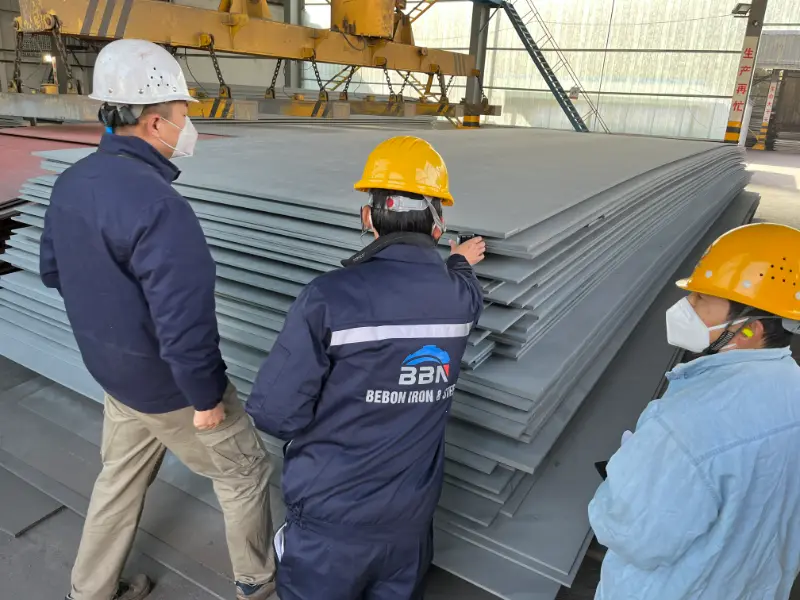
CCS Grade AQ63 Shipbuilding Steel Plate
CCS Grade AQ63 Shipbuilding Steel Plate - High-Strength Quenched and Tempered Steel for Offshore & Marine Structures
In-depth analysis of CCS Grade AQ63 shipbuilding steel: chemical composition, mechanical and thermal properties, international equivalents, and application guidelines for marine and offshore engineering.
Hot rolling followed by quenching and tempering; suitable for cold forming (limited), welding (with preheating if required), and machining.
- Phone : +8618037372205
- Email : [email protected]
- WhatsApp: Contact via Whtsapp
- WeChat: +8618037372205
CCS Grade AQ63 Shipbuilding Steel Plate Introduction
CCS Grade AQ63 is a high-strength quenched and tempered steel plate, certified by the China Classification Society (CCS) for use in shipbuilding and offshore structures. It belongs to the CCS 'AQ' series, where 'A' denotes the impact test temperature of 0 °C, and '63' indicates a minimum yield strength of 63 kgf/mm² (≈618 MPa). This steel offers an optimal combination of high strength, good weldability, and excellent toughness, making it suitable for critical structural components in harsh marine environments. Typical applications include hull structural members, deck plating, stiffeners, and heavy lifting equipment. The material is produced to strict chemical composition and carbon equivalent controls, and it is normally delivered in the quenched and tempered condition. It meets the requirements of the CCS Rules for Materials and Welding. Common international equivalents exist under DNV, ABS, LR, BV, and other major classification societies.
CCS Grade AQ63 Shipbuilding Steel Plate Chemical Composition
The chemical requirements for CCS Grade AQ63 are specified in the CCS Rules for Materials and Welding. The steel is fully killed and fine-grained. Limits are given for all major elements, and the carbon equivalent (Ceq) is controlled to ensure good weldability. Typical ladle analysis values are shown below; product analysis may have slight deviations according to the standard.
| Chemical Element | Specification Value (%) | Remarks |
|---|---|---|
| Carbon (C) | ≤ 0.20 | - |
| Silicon (Si) | ≤ 0.55 | - |
| Manganese (Mn) | ≤ 1.70 | - |
| Phosphorus (P) | ≤ 0.020 | - |
| Sulfur (S) | ≤ 0.010 | - |
| Chromium (Cr) | ≤ 0.80 | - |
| Nickel (Ni) | ≤ 1.00 | - |
| Molybdenum (Mo) | ≤ 0.50 | - |
| Copper (Cu) | ≤ 0.50 | - |
| Vanadium (V) | ≤ 0.10 | - |
| Titanium (Ti) | ≤ 0.05 | - |
| Aluminium (Al, acid soluble) | ≥ 0.015 | Fine grain practice |
| Nitrogen (N) | ≤ 0.020 | - |
| Carbon Equivalent (Ceq) | ≤ 0.55 | Ceq = C+Mn/6+(Cr+Mo+V)/5+(Ni+Cu)/15 |
CCS Grade AQ63 Shipbuilding Steel Plate Thermal and Electrical Physical Properties
Physical properties listed below are typical for quenched and tempered high-strength low-alloy steels of this class and may vary slightly with exact composition and heat treatment. These values are derived from published data for similar grades (e.g., S620Q-type steels) and are provided for design guidance.
| Property | Specification Value | Unit | Test Condition |
|---|---|---|---|
| Density (ρ) | 7.85 | g/cm³ | Room temperature |
| Elastic Modulus (E) | 205 – 210 | GPa | Room temperature |
| Shear Modulus (G) | 80 | GPa | Room temperature (calculated) |
| Poisson's Ratio (ν) | 0.28 – 0.30 | - | Room temperature |
| Thermal Expansion Coefficient (α) | 11.5 – 12.0 | 10⁻⁶/K | 20–100 °C |
| Thermal Conductivity (λ) | 35 – 40 | W/(m·K) | at 20 °C |
| Specific Heat Capacity (c) | 460 | J/(kg·K) | at 20 °C |
| Electrical Resistivity (ρₑ) | 0.25 – 0.30 | μΩ·m | at 20 °C |
CCS Grade AQ63 Shipbuilding Steel Plate Mechanical Properties
The following mechanical properties are required by the CCS standard for Grade AQ63 plates in the transverse (or longitudinal) direction, as applicable. Test pieces are taken from the quenched and tempered product. Values apply to thickness ranges indicated. The Charpy V-notch impact test is performed at 0 °C for the 'A' grade.
| Property | Specification Value | Unit | Test Condition |
|---|---|---|---|
| Yield Strength (ReH, min) | 618 | MPa | Thickness ≤ 50 mm, transverse |
| Yield Strength (ReH, min) | 588 | MPa | Thickness > 50 mm ≤ 100 mm, transverse |
| Tensile Strength (Rm) | 720 – 890 | MPa | Thickness ≤ 100 mm, transverse |
| Elongation (A, min) | 15 | % | Gauge length 5.65√S₀ (longitudinal/transverse as agreed), thickness ≤ 50 mm |
| Elongation (A, min) | 15 | % | Gauge length 5.65√S₀, thickness > 50 mm ≤ 100 mm |
| Charpy V-notch impact energy (KV₂, min average / single) | 34 / 24 | J | Temperature 0 °C, longitudinal |
| Charpy V-notch impact energy (KV₂, min average / single) | 34 / 24 | J | Temperature 0 °C, transverse (when agreed) |
| Bend test (180°, d = mandrel diameter, a = specimen thickness) | d = 3a (t ≤ 50 mm); d = 4a (t > 50 mm) | - | No cracks or defects |
CCS Grade AQ63 Shipbuilding Steel Plate Fully Equivalent Material Standards & Substitutable Grade Recommendations
| Country/Region | Standard | Grade | Remarks |
|---|---|---|---|
| International (Norway) | DNV GL | AQ63 | |
| International (USA) | ABS | AQ63 | |
| International (UK) | Lloyd's Register (LR) | AQ63 | |
| International (France) | Bureau Veritas (BV) | AQ63 | |
| International (Japan) | Nippon Kaiji Kyokai (NK) | AQ63 | |
| International (South Korea) | Korean Register (KR) | AQ63 | |
| International (Italy) | RINA | AQ63 |
CCS Grade AQ63 Shipbuilding Steel Plate Application Introduction
CCS AQ63 steel is specifically designed for structural applications where high strength, good weldability, and reliable toughness at low temperatures are required. Its typical use is in the shipbuilding and offshore industry, but it also serves in heavy machinery and structural engineering projects that demand a certified high-strength material. Below are the key application areas and examples of products and components.
Product Applications: Hull structural plates (side shell, deck, bottom), Deck stiffeners and girders, Bulkheads and hatch coamings, Jack-up rig legs and spudcans, Transition pieces for wind turbine towers, Heavy-lift crane booms
Processed into products: Plates cut, formed, and welded into large panels and sub-assemblies, Flanges and webs for I-beams and T-beams, Reinforcing pads and doubler plates, Base plates for heavy machinery, Stiffeners for ship frames and longitudinals
Application industries: Shipbuilding, Offshore oil & gas platforms, Renewable energy (offshore wind turbine foundations), Heavy-duty machinery and cranes, Pressure vessel manufacturing (with additional certification)
CCS Grade AQ63 Shipbuilding Steel Plate Similar / Near-Equivalent High-Strength Steel Grades
| Country/Region | Standard | Grade | Remarks |
|---|---|---|---|
| EU | EN 10025-6 | S620Q (1.8914) | Similar strength level, quenched and tempered, not specific to shipbuilding; may need additional impact and welding approval. |
| USA | ASTM A514/A514M | Grade S (S620Q analog) | High-yield, quenched and tempered; limited availability in marine-certified plates. |
| China | GB/T 16270 | Q620D/Q620E | Chinese high-strength QT steel, comparable strength; requires additional certification for marine use. |
| International | ISO 4950-3 | S620QL | ISO structural steel, similar mechanical properties, not automatically certified for marine classification. |
Notes:
All data are based on CCS Rules for Materials and Welding (latest edition) and typical product information. Buyers should verify specific requirements with the mill test certificates. Preheating before welding may be necessary depending on thickness and joint configuration; post-weld heat treatment is generally not required. The material is often supplied with ultrasonic testing according to classification society rules. Dimensional tolerances are as per standard EN 10029 or CCS requirements. For Z-quality (through-thickness properties), a supplementary requirement can be specified.
- Share



