
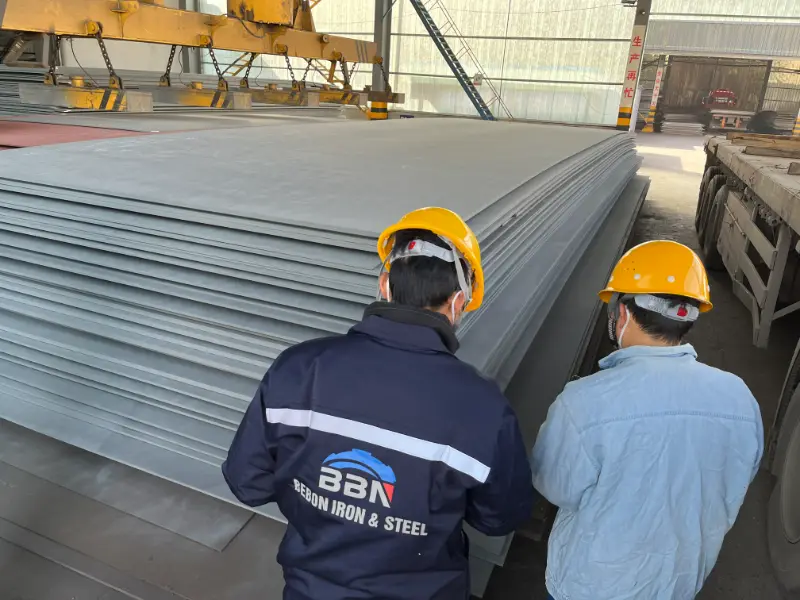
CCS Grade DQ63 Shipbuilding Steel Plate
CCS Grade DQ63 Shipbuilding Steel Plate - High Strength Quenched & Tempered Steel
Detailed material properties of CCS Grade DQ63 high strength quenched and tempered shipbuilding steel plate, including chemical composition, mechanical and physical properties, equivalent grades, and application guide.
Hot rolling, quenching and tempering, welding, bending, forming
- Phone : +8618037372205
- Email : [email protected]
- WhatsApp: Contact via Whtsapp
- WeChat: +8618037372205
CCS Grade DQ63 Shipbuilding Steel Plate Introduction
CCS Grade DQ63 is a high strength quenched and tempered shipbuilding steel plate certified by the China Classification Society (CCS). It belongs to the high strength structural steel category for ships, specifically designed for severe marine and offshore environments requiring excellent toughness and weldability at sub-zero temperatures. The 'D' denotes a minimum impact test temperature of -20°C, and 'Q' indicates the quenched and tempered delivery condition. With a minimum yield strength of 620 MPa, it is commonly utilized in heavy loaded hull structures, deck components, and offshore platforms. This grade offers a balanced combination of high strength, good ductility, and reliable low-temperature impact toughness.
CCS Grade DQ63 Shipbuilding Steel Plate Chemical Composition
Typical ladle analysis according to CCS Rules. For thickness ≤ 100 mm. The steel is fully killed and fine grain treated. Carbon equivalent (Ceq) is limited to ensure weldability. Microalloying elements such as Nb, V, Ti may be used alone or in combination.
| Element | Standard Value | Remarks |
|---|---|---|
| C | ≤ 0.20 | Ladle analysis |
| Si | ≤ 0.55 | Ladle analysis |
| Mn | 0.90 ~ 1.70 | Ladle analysis |
| P | ≤ 0.025 | Ladle analysis |
| S | ≤ 0.025 | Ladle analysis |
| Cr | ≤ 0.25 | Residual / microalloy |
| Ni | ≤ 0.40 | Residual / microalloy |
| Mo | ≤ 0.08 | Residual / microalloy |
| Cu | ≤ 0.30 | Residual / microalloy |
| Nb | ≤ 0.05 | Grain refinement |
| V | ≤ 0.10 | Grain refinement |
| Ti | ≤ 0.02 | Grain refinement |
| Als (acid soluble Al) | ≥ 0.015 | Minimum for fine grain practice |
| Ceq (max.) | See note | Calculated from actual ladle analysis per CCS formula |
CCS Grade DQ63 Shipbuilding Steel Plate Physical Properties
Physical properties are representative for quenched and tempered high strength low-alloy steel. Values may vary slightly with exact composition and heat treatment. These properties are useful for thermal and structural analysis.
| Property | Typical Value | Unit | Test Condition / Remarks |
|---|---|---|---|
| Density (ρ) | 7.85 | g/cm³ | At room temperature |
| Modulus of elasticity (E) | 206 | GPa | At room temperature |
| Shear modulus (G) | 79 | GPa | Calculated |
| Poisson's ratio (ν) | 0.3 | - | In elastic range |
| Coefficient of thermal expansion (α) | 11.7 | 10⁻⁶/K | 20–100 °C |
| Coefficient of thermal expansion (α) | 12.5 | 10⁻⁶/K | 20–200 °C |
| Coefficient of thermal expansion (α) | 13.2 | 10⁻⁶/K | 20–300 °C |
| Thermal conductivity (λ) | 45 | W/(m·K) | At 20 °C |
| Thermal conductivity (λ) | 42 | W/(m·K) | At 200 °C |
| Specific heat capacity (cp) | 460 | J/(kg·K) | At 20–100 °C |
| Electrical resistivity (ρe) | 0.22 | 10⁻⁶ Ω·m | At 20 °C |
CCS Grade DQ63 Shipbuilding Steel Plate Mechanical Properties
Tensile and impact test requirements at delivery condition (quenched and tempered). Tests are performed in accordance with CCS Rules. Transverse impact values are given for information; usually longitudinal specimens are tested unless otherwise agreed. Bend test (mandrel diameter) is required for plate thickness up to 100 mm.
| Property | Required Value | Unit | Test Condition / Thickness |
|---|---|---|---|
| Yield strength (ReH) | ≥ 620 | MPa | t ≤ 100 mm, transverse |
| Tensile strength (Rm) | 720 - 890 | MPa | t ≤ 100 mm, transverse |
| Elongation after fracture (A5) | ≥ 15 | % | L₀=5.65√S₀, transverse |
| Bend test (bend angle 180°) | D = 3a | mm | t ≤ 12 mm (mandrel diameter = 3 × thickness) |
| Bend test (bend angle 180°) | D = 4a | mm | 12 < t ≤ 25 mm |
| Bend test (bend angle 180°) | D = 5a | mm | 25 < t ≤ 50 mm |
| Bend test (bend angle 180°) | D = 6a | mm | 50 < t ≤ 100 mm |
| Impact energy (KV₂) at -20°C, longitudinal | ≥ 41 | J | Average of 3 tests, min. single 28 J |
| Impact energy (KV₂) at -20°C, transverse | ≥ 27 | J | Average of 3 tests, min. single 19 J |
CCS Grade DQ63 Shipbuilding Steel Plate Fully Equivalent Material Standards and Replaceable Grades
| Country / Region | Standard | Grade | Remarks |
|---|---|---|---|
| International | IACS | DQ63 | Common IACS grade; most class societies adopt identical designation |
| UK | Lloyd's Register (LR) | DH63 | Same chemistry and mechanical requirements |
| Norway/Germany | DNV | D63 | Equivalent to CCS DQ63 |
| France | Bureau Veritas (BV) | D63 | Equivalent to CCS DQ63 |
| USA | American Bureau of Shipping (ABS) | DH63 | Equivalent to CCS DQ63 |
| Japan | ClassNK (NK) | KD63 | Equivalent to CCS DQ63 |
| Italy | RINA | D63 | Equivalent to CCS DQ63 |
| Russia | Russian Maritime Register (RMRS) | D63 | Equivalent strength level |
CCS Grade DQ63 Shipbuilding Steel Plate Application Introduction
CCS DQ63 is designed for critical structural components in ships and offshore installations that are subject to high static and dynamic loads. Its excellent low-temperature toughness makes it suitable for Arctic and cold climate service. The steel can be welded using all common methods, provided proper low-hydrogen procedures and preheating are observed due to the high strength level.
Product Applications: Hull main structural members (keel, stringers, deck longitudinal), Deck plates and shell plating for ice-class vessels, Jack-up rig legs and cantilever structures, Crane pedestals and heavy lift equipment on vessels, Pressure hulls for submarines and deep-sea submersibles
Processed into products: Transverse frames and stiffeners, Web plates of girders, Bulkhead plates, Connection brackets and node joints, Wind turbine tower foundations (offshore)
Application industries: Shipbuilding, Offshore oil & gas platforms, Marine engineering, Heavy machinery, Bridge construction (subject to additional qualification)
CCS Grade DQ63 Shipbuilding Steel Plate Similar / Substitute Materials Recommendation
| Country / Region | Standard | Grade | Remarks |
|---|---|---|---|
| Europe | EN 10025-6 | S620Q | Quenched & tempered structural steel; comparable strength (620 MPa min. yield), but not specifically certified for ship classification; additional testing may be required |
| Europe | EN 10025-6 | S690Q | Higher strength level (690 MPa); can be used as an alternative where higher load capacity is needed, but lower ductility and stricter welding requirements |
| China | GB/T 16270 | Q620D | High strength structural steel for quenched and tempered condition; similar strength and toughness level; supplementary ship classification testing required |
| USA | ASTM A514 / A517 | Grade B / Grade H | Quenched and tempered alloy steel plates; high yield strength (≥690 MPa); used for structural applications; additional marine certification recommended |
Notes:
- All mechanical property values are based on CCS Rules for thickness up to 100 mm; for thicknesses above 100 mm the mechanical properties may be subject to special agreement.
- Ultrasonic testing according to CCS requirements is normally performed on plate thickness ≥ 6 mm.
- The steel is supplied with CCS survey and certification; test pieces are taken in transverse direction for tensile tests and longitudinal for impact tests (unless ordered otherwise).
- Additional through-thickness tensile testing (Z-quality) may be agreed for improved lamellar tearing resistance.
- Share



