
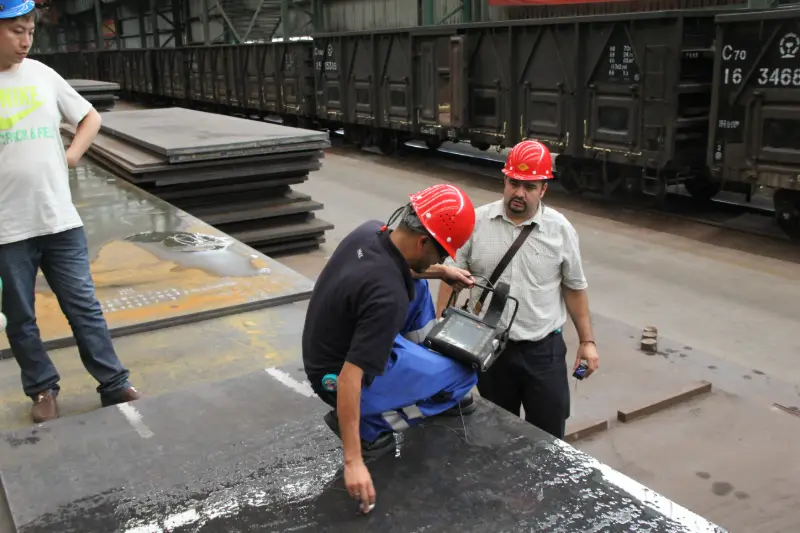
ABS Grade EQ56 Shipbuilding Steel Plate
ABS Grade EQ56 Shipbuilding Steel Plate - High-Strength Quenched & Tempered Marine Steel
Detailed material data for ABS Grade EQ56 shipbuilding steel plate, including chemical composition, mechanical and physical properties, international equivalents, and application guidance for marine and offshore engineering.
Quenching and Tempering (Q&T), hot rolling, controlled rolling, normalized rolling (for some thicknesses), welding, flame cutting, cold forming (with care), machining
- Phone : +8618037372205
- Email : [email protected]
- WhatsApp: Contact via Whtsapp
- WeChat: +8618037372205
ABS Grade EQ56 Shipbuilding Steel Plate Introduction
ABS Grade EQ56 is a high-strength, quenched and tempered steel plate primarily designed for shipbuilding and offshore structures under the rules of the American Bureau of Shipping. It offers a minimum yield strength of 460 MPa with excellent toughness at low temperatures, meeting the stringent requirements of marine classification societies.
- Excellent weldability and through-thickness properties for critical structural applications.
- Superior resistance to brittle fracture in cold environments, with guaranteed Charpy impact energy at -40°C.
- Controlled chemical composition with low carbon equivalent values to ensure good fabrication characteristics.
- Supplied in quenched and tempered condition to meet the required mechanical properties.
ABS Grade EQ56 Shipbuilding Steel Plate Chemical Composition
Chemical composition requirements per ABS Rules for Materials and Welding (Part 2, Chapter 1). The steel is fully killed and fine-grain treated. Maximum carbon equivalent (CEV) is controlled to ensure good weldability: CEV ≤ 0.43% (for thickness ≤ 50 mm) and ≤ 0.45% (for thickness > 50 mm). CEV = C + Mn/6 + (Cr+Mo+V)/5 + (Ni+Cu)/15.
| Element | Standard Requirement (wt.%) | Remarks |
|---|---|---|
| Carbon (C) | ≤ 0.18 | On heat analysis |
| Manganese (Mn) | 0.90 – 1.60 | May be adjusted for thickness |
| Silicon (Si) | ≤ 0.50 | Deoxidation element |
| Phosphorus (P) | ≤ 0.025 | Controlled for low-temperature toughness |
| Sulfur (S) | ≤ 0.025 | Typical max; lower for improved Z-properties |
| Aluminum (Al total) | ≥ 0.015 | Fine grain practice |
| Niobium (Nb) | 0.02 – 0.05 | Microalloying for grain refinement |
| Vanadium (V) | 0.05 – 0.10 | Precipitation strengthening |
| Titanium (Ti) | ≤ 0.02 | Optional, may be used for grain control |
| Copper (Cu) | ≤ 0.35 | Residual element |
| Chromium (Cr) | ≤ 0.20 | Residual element |
| Nickel (Ni) | ≤ 0.40 | May improve toughness |
| Molybdenum (Mo) | ≤ 0.08 | Residual element |
| Boron (B) | ≤ 0.0005 | Optional; if added must be reported |
| CEV | ≤ 0.43 (t≤50mm) ≤ 0.45 (t>50mm) | Carbon Equivalent Value |
ABS Grade EQ56 Shipbuilding Steel Plate Physical, Thermal and Electrical Properties
Typical values for low-alloy quenched and tempered steel with similar composition. These are not mandatory ABS requirements but are representative for engineering calculations. Properties may vary slightly with actual composition and heat treatment.
| Property | Typical Value | Unit | Test Condition / Remarks |
|---|---|---|---|
| Density (ρ) | 7.85 | g/cm³ | At 20°C |
| Elastic Modulus (E) | 205 | GPa | At 20°C |
| Shear Modulus (G) | 80 | GPa | At 20°C |
| Poisson's Ratio (ν) | 0.30 | – | At 20°C |
| Thermal Expansion Coefficient (α) | 11.7 | 10⁻⁶/K | 20 – 100°C; linear thermal expansion |
| Thermal Conductivity (λ) | 52 | W/(m·K) | At 20°C |
| Specific Heat Capacity (cp) | 460 | J/(kg·K) | At 20°C |
| Electrical Resistivity (ρe) | 0.23 | 10⁻⁶ Ω·m | At 20°C |
ABS Grade EQ56 Shipbuilding Steel Plate Mechanical Properties
Mechanical properties are per ABS Rules. Testing is performed in the quenched and tempered condition. Through-thickness properties (Z35, Z25) can be supplied upon agreement. Bend test: no cracks or defects when bent 180° over a former diameter of 3a (a = specimen thickness) for both transverse and longitudinal specimens.
| Property | Standard Requirement | Unit | Test Condition |
|---|---|---|---|
| Yield Strength (ReH) | ≥ 460 | MPa | Tensile test, transverse or longitudinal, ambient temperature |
| Tensile Strength (Rm) | 570 – 720 | MPa | Tensile test, transverse or longitudinal, ambient temperature |
| Elongation (A) | ≥ 17 | % | Gauge length 200 mm (or 5.65√So proportional); transverse specimen |
| Elongation (A) | ≥ 17 | % | Longitudinal specimen (based on 200 mm gauge length) |
| Charpy Impact Energy (KV2) | ≥ 41 (longitudinal) ≥ 28 (single longitudinal) | J | At -40°C; V-notch; average of three tests, one individual minimum |
| Charpy Impact Energy (KV2) | ≥ 34 (transverse) ≥ 24 (single transverse) | J | At -40°C; V-notch; optional transverse requirement agreed with purchaser |
| Bend Test | No cracks or defects | – | Bend angle 180°; former diameter 3a (a = specimen thickness); ambient temperature |
ABS Grade EQ56 Shipbuilding Steel Plate Fully Equivalent International Standards & Grades
| Country / Region | Standard | Grade | Remarks |
|---|---|---|---|
| International (DNV) | DNV Rules for Classification of Ships | E56 | Identical chemical and mechanical requirements |
| UK (Lloyd's Register) | LR Rules for Materials | EH56 | Equivalent quenched and tempered ship plate |
| France (Bureau Veritas) | BV Rules for Materials | E56 | Matched strength and impact class |
| China (CCS) | CCS Rules for Materials and Welding | E56 | Same yield and tensile requirements |
| Japan (NK) | NK Rules for Materials | KE56 | Quenched and tempered E-grade 460 MPa min yield |
| Korea (KR) | KR Rules for Materials | RE56 | Equivalent product class |
| Italy (RINA) | RINA Rules for Materials | E56 | Equivalent shipbuilding grade |
| Russia (RMRS) | Rules for the Classification and Construction of Sea-Going Ships | E56 | Equivalent high-strength shipbuilding steel |
ABS Grade EQ56 Shipbuilding Steel Plate Application Introduction
ABS EQ56 steel is employed in the construction of high-stress marine and offshore structures where both high strength and excellent low-temperature toughness are essential. The quenched and tempered microstructure provides an optimum balance of strength, ductility and weldability for critical welded details.
- Typical fabrication processes include plasma/flame cutting, cold forming with adequate bending radii, and multi-pass welding with low-hydrogen consumables.
- Preheating and post-weld heat treatment are generally not required for moderate thicknesses, but should follow classification society guidelines based on carbon equivalent and joint restraint.
Product Applications: Hull plates and stiffeners for high-stress regions (e.g., sheer strake, bilge strake, deck stringer), Deck plates and bottom shell plates in large vessels, Legs, spudcans, and brace members of jack-up drilling units, A-frames, crane pedestals, and heavy-lift gear mounts, Fatigue-critical nodes in offshore structures
Processed into products: Welded beams and columns for ship hulls, Transition pieces and large-diameter tubular joints, Skid rails and load-bearing plates on offshore decks, Mooring components and padeyes (where classification allows), Bottom plates of large dredgers and heavy ice-class ship structures
Application industries: Shipbuilding (container ships, bulk carriers, tankers, LNG carriers), Offshore oil & gas (jack-up rigs, semi-submersibles, fixed platforms), Marine renewable energy (offshore wind turbine foundations), Port and harbor machinery (ship unloaders, container cranes), Heavy lifting and construction equipment for harsh environments
ABS Grade EQ56 Shipbuilding Steel Plate Similar or Compatible Substitutue Materials
| Country / Region | Standard | Grade | Remarks |
|---|---|---|---|
| USA (ABS) | ABS Rules | EH47 | Minimum yield 460 MPa, E-class impact, controlled rolled or normalized; can be used in some structural applications but EQ56 is quenched and tempered with better ductility and through-thickness properties. |
| Europe (EN) | EN 10025-6 | S460Q / S460QL / S460QL1 | Quenched and tempered structural steel with min. 460 MPa yield; suitable for welded structures but not ship-class certified unless approved by classification society. |
| USA (ASTM) | ASTM A514 / A517 | Grade S | High-strength quenched and tempered steel with min. 690 MPa yield; higher strength but similar weldability challenges. Not a direct substitute but used in mobile equipment and offshore components where higher strength is permitted. |
| Europe (EN) | EN 10025-4 | S460M / S460ML | Thermomechanical rolled structural steel with min. 460 MPa yield; lower carbon equivalent, limited weldability advantage, but not quenched and tempered, may require approval for shipbuilding. |
Notes:
Certification: All deliveries are accompanied by ABS inspection certificate 3.1 or 3.2 as required.
Through-thickness properties: If improved Z-direction performance is needed, steel must be ordered with Z-quality designation (e.g., Z25, Z35) per ABS requirements.
Ultrasonic testing: Class C or D according to ASTM A578 or EN 10160 can be specified to ensure internal soundness.
Welding consumables: E8018-C3 or equivalent low-hydrogen electrodes and FCAW wires with matching strength grades are recommended for manual and semi-automatic welding.
- Share



