
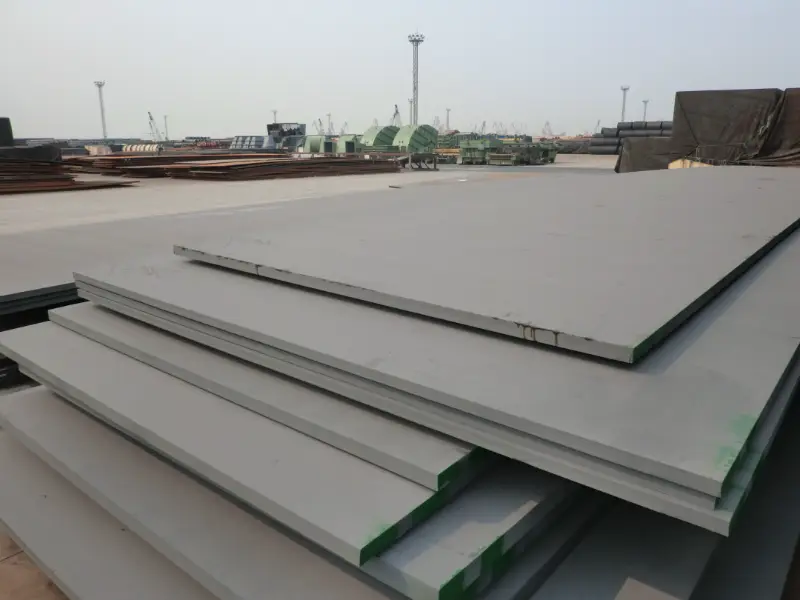
ABS Grade FQ56 Shipbuilding Steel Plate
ABS Grade FQ56 Shipbuilding Steel Plate: Quenched & Tempered High-Strength Steel
Complete material data and properties for ABS Grade FQ56 – a quenched and tempered high-strength steel for shipbuilding and offshore structures, including chemical composition, mechanical properties, thermal/physical reference values, and international equivalents.
Welding, gas cutting, cold forming (with care), machining
- Phone : +8618037372205
- Email : [email protected]
- WhatsApp: Contact via Whtsapp
- WeChat: +8618037372205
ABS Grade FQ56 Shipbuilding Steel Plate Introduction
ABS Grade FQ56 is a high-strength, quenched and tempered structural steel for shipbuilding and offshore applications, classified by the American Bureau of Shipping. The designation FQ56 indicates:
- F: impact test temperature of -60°C for excellent low-temperature toughness
- Q: quenched and tempered condition
- 56: minimum yield strength of 56 kgf/mm² (approx. 550 MPa)
It offers an outstanding combination of high strength, weldability, and notch toughness, making it suitable for critical hull structures, ice-class vessels, and offshore platforms operating in Arctic environments. The steel is supplied in plate form, typically up to 100 mm thick, and meets the stringent requirements of ABS Rules for Materials and Welding. Its fine-grained microstructure and controlled alloying ensure reliable performance under dynamic loading and low temperatures.
ABS Grade FQ56 Shipbuilding Steel Plate Chemical composition
The chemical composition of ABS Grade FQ56 is controlled within the limits below to achieve the required strength, toughness, and weldability. Actual values are reported by the steel manufacturer and must comply with the maximum or range limits per ABS Rules.
- Carbon equivalent (CE) is often calculated to ensure weldability; typical limits are agreed upon at the time of ordering.
- Microalloying with Nb, V, Ti, and Al is used for grain refinement and precipitation strengthening.
- Low sulfur and phosphorus contents improve through-thickness ductility and toughness.
| Chemical element | Standard value | Remarks |
|---|---|---|
| C | ≤ 0.18 | Ladle analysis, max. |
| Mn | 0.90 – 1.60 | Range typical; may vary by manufacturer within limits |
| Si | 0.15 – 0.55 | Killed steel, fine grain practice |
| P | ≤ 0.020 | Stringent control for toughness |
| S | ≤ 0.010 | Stringent control for toughness |
| Cu | ≤ 0.35 | Residual |
| Ni | ≤ 2.00 | Improves low-temperature toughness |
| Cr | ≤ 1.50 | Hardenability element |
| Mo | ≤ 0.50 | Hardenability and creep resistance |
| V | ≤ 0.08 | Microalloy, grain refiner |
| Ti | ≤ 0.05 | Microalloy, grain refiner |
| Nb | ≤ 0.05 | Microalloy, grain refiner |
| Al (total) | ≥ 0.020 | Grain refining, deoxidation |
| N | ≤ 0.012 | Controlled to avoid strain aging |
ABS Grade FQ56 Shipbuilding Steel Plate Thermal and electrical physical properties
Typical physical properties for quenched and tempered low-alloy steel at room temperature unless otherwise specified. These values are not mandated by ABS rules but are representative for this type of steel and may vary slightly with actual composition and heat treatment condition.
| Property item | Standard requirement value | Unit | Test condition |
|---|---|---|---|
| Density (ρ) | 7850 | kg/m³ | 20 °C |
| Young´s modulus (E) | 205 | GPa | 20 °C |
| Shear modulus (G) | 80 | GPa | 20 °C, calculated from E and Poisson ratio |
| Poisson ratio (ν) | 0.3 | - | 20 °C |
| Thermal expansion coefficient (α) | 11.7 × 10⁻⁶ | K⁻¹ | 20 – 100 °C |
| Thermal expansion coefficient (α) | 12.5 × 10⁻⁶ | K⁻¹ | 20 – 200 °C |
| Thermal conductivity (λ) | 45 | W/(m·K) | 20 °C |
| Specific heat capacity | 460 | J/(kg·K) | 20 °C |
| Electrical resistivity (ρ_e) | 0.23 × 10⁻⁶ | Ω·m | 20 °C |
ABS Grade FQ56 Shipbuilding Steel Plate Mechanical properties
The following mechanical properties are required for ABS FQ56 plates in the quenched and tempered condition. Values vary with plate thickness. Testing is performed at room temperature unless otherwise noted.
- Tensile tests are transverse to the rolling direction.
- Charpy V-notch impact tests are longitudinal, with the test temperature at -60 °C; minimum average energy must be met for each set of three specimens.
- Bend tests are performed to ensure formability without cracking.
| Property item | Standard requirement value | Unit | Test condition |
|---|---|---|---|
| Yield strength (ReH) | ≥ 550 | MPa | Thickness ≤ 50 mm, transverse |
| Yield strength (ReH) | ≥ 530 | MPa | Thickness > 50 mm ≤ 70 mm, transverse |
| Yield strength (ReH) | ≥ 510 | MPa | Thickness > 70 mm ≤ 100 mm, transverse |
| Tensile strength (Rm) | 620 – 770 | MPa | Thickness ≤ 50 mm, transverse |
| Tensile strength (Rm) | 590 – 750 | MPa | Thickness > 50 mm ≤ 70 mm, transverse |
| Tensile strength (Rm) | 570 – 730 | MPa | Thickness > 70 mm ≤ 100 mm, transverse |
| Elongation (A5) | ≥ 16 | % | Gauge length 5.65√So, transverse |
| Charpy V‑notch impact (KV2) | ≥ 41 (average) | J | -60 °C, longitudinal, thickness ≤ 50 mm |
| Charpy V‑notch impact (KV2) | ≥ 27 (average) | J | -60 °C, longitudinal, thickness > 50 mm |
| Bend test (180°) | No cracks | - | Bend diameter = 3 × thickness, any orientation |
ABS Grade FQ56 Shipbuilding Steel Plate Completely equivalent material standards and recommended alternative grades
| Country/Region | Standard | Grade | Remarks |
|---|---|---|---|
| International | Bureau Veritas | FQ56 | Identical classification society grade |
| International | DNV | FQ56 | Identical classification society grade |
| International | Lloyd´s Register | FQ56 | Identical classification society grade |
| International | Nippon Kaiji Kyokai | FQ56 | Identical classification society grade |
| International | RINA | FQ56 | Identical classification society grade |
| International | Korean Register | FQ56 | Identical classification society grade |
| International | CCS | FQ56 | Identical classification society grade |
| International | ABS | FQ56 | Original grade |
| European Union | EN 10025-6 | S550QL1 | Yield 550 MPa, impact -60 °C; not ship‑rule specific but technically equivalent |
ABS Grade FQ56 Shipbuilding Steel Plate Application Introduction
ABS FQ56 is designed for the most demanding marine and offshore structural applications where high strength and exceptional low‑temperature toughness are required. It can be used in welded structures that must withstand high static and dynamic loads, fatigue, and brittle fracture risks.
Key application sectors:
Product Applications: Ice‑breaker hull plates and stiffeners, LNG carrier membrane tank supporting structures, Offshore platform legs, braces, and nodes, Wind turbine installation vessel hulls, Deck plating for dynamically positioned vessels, Structural parts of polar research vessels
Processed into products: Shell plates and bottom plates (high stress areas), Longitudinal stiffeners and frames, Web frames and deck girders, Connection brackets and knuckles, Bollard mounting pads and towing brackets, Crane pedestals and heavy‑load transfer structures
Application industries: Shipbuilding – especially ice‑class vessels, LNG carriers, naval ships, Offshore oil & gas – fixed platforms, jack‑up rigs, FPSOs, Marine renewable energy – offshore wind turbine foundations, substations, Arctic engineering – icebreakers, Arctic offshore structures, Heavy lifting and transport – crane pedestals, heavy‑lift vessel hulls
ABS Grade FQ56 Shipbuilding Steel Plate Similar / alternative material recommendations
| Country/Region | Standard | Grade | Remarks |
|---|---|---|---|
| International | ABS | EQ56 | Same strength, impact temperature -40 °C; less demanding than FQ56 |
| International | ABS | DQ56 | Same strength, impact temperature -20 °C |
| International | ABS | AQ56 | Same strength, impact temperature 0 °C |
| International | ABS | FQ70 | Higher strength, yield ≥ 690 MPa, same impact temperature |
| European Union | EN 10025-6 | S500QL1 | Slightly lower yield (500 MPa), impact -60 °C |
| European Union | EN 10025-6 | S550QL | Same yield, impact -40 °C, but higher test temperature |
Notes:
- When ordering, supplementary requirements may be specified, such as through‑thickness tensile testing (Z‑properties), ultrasonic testing, or stricter carbon equivalent limits.
- Welding must be carried out using low‑hydrogen consumables and procedures qualified in accordance with ABS Rules to maintain toughness in the heat‑affected zone.
- Due to the quenched and tempered condition, hot forming above tempering temperature is not permitted unless followed by re‑heat treatment.
- The data provided herein are based on publicly available ABS Rules and typical values; for a specific project, the manufacturer's material certificate shall prevail.
- Share



