
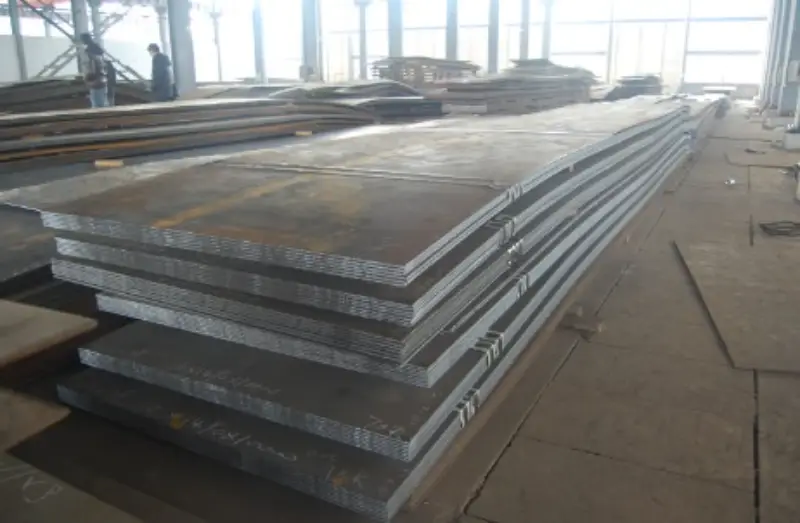
ABS Grade AQ63 Shipbuilding Plate
ABS Grade AQ63 Shipbuilding Plate - High Strength Quenched and Tempered Steel for Marine & Offshore Structures
Comprehensive technical data for ABS Grade AQ63 shipbuilding steel plate: chemical composition, mechanical properties, thermal and electrical physical properties, international equivalent grades, forming processes, and application guidance for offshore and marine engineering.
Cutting, cold forming, hot forming (with subsequent heat treatment), welding (low-hydrogen processes), machining, drilling
- Phone : +8618037372205
- Email : [email protected]
- WhatsApp: Contact via Whtsapp
- WeChat: +8618037372205
ABS Grade AQ63 Shipbuilding Plate Introduction
ABS Grade AQ63 is an extra-high strength, quenched and tempered shipbuilding steel plate certified by the American Bureau of Shipping (ABS). It is specifically designed for critical structural components in ships, offshore platforms, and marine equipment that demand a minimum yield strength of 620 MPa. The AQ63 grade belongs to the high-strength quenched and tempered series, combining excellent weldability with superior toughness at low temperatures. Its fine-grained microstructure, achieved through controlled rolling and heat treatment, ensures homogeneous mechanical properties across heavy plate thicknesses, typically ranging from 6 mm to 150 mm. The steel meets the stringent requirements of the ABS Rules for Materials and Welding, Part 2, and is commonly supplied in normalized or quenched-and-tempered condition under mill certification.
ABS Grade AQ63 Shipbuilding Plate Chemical Composition
The chemical composition of ABS Grade AQ63 is strictly controlled to ensure deep hardenability and low-temperature toughness. The typical limits conform to ABS Part 2, Table 2 for extra-high strength quenched and tempered steels. Micro-alloying elements (Nb, V, Ti, Al) are added to refine the grain structure, while low sulfur and phosphorus levels minimize lamellar tearing risk. Carbon equivalent (CEV) limits are applied for weldability control. Detailed values:
| Element | Ladle Analysis Max (%) | Remarks |
|---|---|---|
| Carbon (C) | 0.18 | Max. Higher carbon may be allowed for thicker plates provided CEV and hardenability are met |
| Silicon (Si) | 0.10 – 0.50 | Typical range; may be adjusted for deoxidation |
| Manganese (Mn) | 0.90 – 1.60 | Range ensures strength and toughness balance |
| Phosphorus (P) | 0.020 | Max. Limits for improved weldability and toughness |
| Sulfur (S) | 0.015 | Max. Low sulfur for resistance to lamellar tearing |
| Chromium (Cr) | 0.25 | Max. Residual element |
| Nickel (Ni) | 1.50 | Max. Permissible for low-temperature toughness |
| Molybdenum (Mo) | 0.50 | Max. Enhances hardenability |
| Copper (Cu) | 0.35 | Max. Residual |
| Aluminium (Al) | 0.015 min (acid soluble) | Total Al minimum may be required for grain refinement |
| Niobium (Nb) | 0.02 – 0.05 | Micro-alloy for grain refinement |
| Vanadium (V) | 0.05 – 0.10 | Max. as per agreement; may be added for strength |
| Titanium (Ti) | 0.02 | Max. or as agreed for grain control |
| Nitrogen (N) | 0.009 | Max. unless sufficient Al is present to fix N |
| Carbon Equivalent (CEV) | 0.52 (typically) | CEV = C + Mn/6 + (Cr+Mo+V)/5 + (Ni+Cu)/15, max as per base material specification |
ABS Grade AQ63 Shipbuilding Plate Physical Properties
The following physical properties are typical for quenched and tempered low-alloy steel of the 620 MPa yield class, based on published data for similar compositions. These values are not part of the ABS specification but are useful for engineering design. Variations may occur with actual heat chemistry and heat treatment. Density, elastic moduli, and thermal conductivity are essential for structural analysis and weld preheat calculation.
| Property | Typical Value | Unit | Condition / Remarks |
|---|---|---|---|
| Density (ρ) | 7850 | kg/m³ | At 20°C; standard steel density |
| Modulus of Elasticity (E) | 205 – 210 | GPa | Tensile modulus; slightly temperature dependent; at room temperature |
| Shear Modulus (G) | 79 – 81 | GPa | Calculated from E and Poisson's ratio |
| Poisson's Ratio (ν) | 0.30 | dimensionless | Typical for structural steel in elastic range |
| Thermal Expansion Coefficient (α) | 11.5 – 12.5 ×10⁻⁶ | /K | Mean value between 20°C and 100°C. Higher at elevated temperature. |
| Thermal Conductivity (λ) | 42 – 46 | W/(m·K) | At 20°C; decreases with temperature |
| Specific Heat Capacity (cp) | 460 – 480 | J/(kg·K) | At 20°C; increases with temperature |
| Electrical Resistivity (ρe) | 0.22 – 0.28 | μΩ·m | At 20°C; depends on alloy content |
ABS Grade AQ63 Shipbuilding Plate Mechanical Properties
Mechanical properties are verified by transverse test specimens taken from the plate at a specified location (usually 1/4 width). Tensile testing is performed at room temperature, and Charpy V-notch impact testing at a prescribed low temperature (commonly -40°C for AQ63). Values below are minimum requirements unless otherwise stated. Test report shall include yield strength, tensile strength, elongation, and impact energy. Bend tests may be required, depending on additional class notations.
| Property | Requirement | Unit | Test Condition / Remarks |
|---|---|---|---|
| Yield Strength (ReH) | 620 | MPa | Minimum; upper yield point may be used. Specified for plate thickness ≤ 50 mm. Reduction of 10 MPa for thickness > 50 mm up to 100 mm according to ABS Part 2, Table 1. |
| Yield Strength (ReH), thickness 50-100 mm | 610 | MPa | Reduced min. yield for thicker sections |
| Tensile Strength (Rm) | 720 – 890 | MPa | Applicable to all thicknesses |
| Elongation (A5) | 15 | % | Minimum; gauge length 5.65√So. For thickness ≤ 50 mm; reduced by 1% for 50-100 mm. |
| Elongation (A5), thickness 50-100 mm | 14 | % | Reduced elongation for thicker plates |
| Charpy V-Notch Impact Energy (KV) | 46 (longitudinal) / 31 (transverse) | J | At -40°C. Minimum average of three specimens; individual value not less than 70% of specified average. ABS Part 2, Chapter 2. |
| Bend Test (through 180°) | No cracks or defects | - | Bend test may be part of the approval. Mandrel diameter usually 3t (t = specimen thickness) for transverse bend. Not routinely required for Q+T grades unless specified. |
ABS Grade AQ63 Shipbuilding Plate Fully Equivalent Material Grades from Other Classification Societies
| Country / Region | Standard / Class Society | Grade Designation | Remarks |
|---|---|---|---|
| International | DNV (Det Norske Veritas) | NV E620 | Same minimum yield and impact requirements; full cross-recognition with ABS |
| International | Lloyd's Register (LR) | LR EH620 | Equivalent extra-high strength quenched and tempered steel |
| International | Bureau Veritas (BV) | BV E620 | Matches ABS AQ63 chemical and mechanical limits |
| International | China Classification Society (CCS) | CCS E620 | Full equivalent under IACS unified requirements |
| International | ClassNK (NK) | NK KE620 | Identical property requirements |
| International | RINA (Registro Italiano Navale) | RINA E620 | Cross-reference with ABS approval |
| International | Korean Register (KR) | KR RE620 | Full substitution possible under common IACS URs |
ABS Grade AQ63 Shipbuilding Plate Application Introduction
ABS Grade AQ63 is optimally used where weight savings, high strength, and low-temperature toughness are critical. It is processed by quenching and tempering, allowing usage in extreme environments. Typical fabrication involves cutting (plasma/laser), cold forming within specified strain limits, and welding with low-hydrogen consumables to avoid hydrogen-induced cracking. The steel is suitable for heavy offshore structures, ship hulls in ice zones, and high-load bearing members.
Product Applications: Hull plates for ultra-large container ships, Legs and spudcans of jack-up drilling rigs, Crane pedestals and boom structures, FPSO mooring and structural components, Pressure hulls for submersibles, Ice-strengthened ship shells, Modular offshore accommodation units
Processed into products: Bottom and side shell plating, Deck stringers and sheerstrakes, Bulkhead plates and stiffeners, Bracket assemblies and heavy inserts, Transition joints between different steel grades, Jacket main chords and braces, Welded built-up box girders for crane booms
Application industries: Shipbuilding (naval and commercial vessels), Offshore oil & gas exploration and production, Marine heavy lifting and transport, Renewable energy (offshore wind turbine foundations, substations), Arctic engineering and icebreaker construction
ABS Grade AQ63 Shipbuilding Plate Similar Alternative Materials
| Country / Region | Standard | Grade | Characteristics and Suitability |
|---|---|---|---|
| Europe | EN 10025-6 | S690QL / S690QL1 | High yield structural steel; impact tested at -40°C (-60°C for QL1). Similar strength, but CEV and delivery condition may differ; requires additional verification for marine service. |
| Europe | EN 10225 | S620Q/S620QL | Weldable structural steels for fixed offshore structures; designed for marine environment; closest in philosophy to ABS AQ63. |
| USA | ASTM A514 / A517 | Grade S (or F) | Quenched and tempered high yield plate; 690 MPa yield class; impact properties at -40°C achievable, but not a direct shipbuilding spec. |
| Japan | JIS G 3128 | SHY 685 / SHY 685N | High yield strength steel for welded structures; similar strength, but toughness requirements for shipbuilding need validation. |
| International | ISO 19902 / ISO 3183 | X80 / X80Q (pipeline grade) | High strength, but primarily for pipe; plate form may be used as substitute with caution and engineering approval. |
Notes:
Welding Guidelines: Preheating may be required based on thickness and CEV (typically 100-150°C). Low-hydrogen practices mandatory. Post-weld heat treatment (PWHT) not typical but can be applied with agreed procedures. Z-Direction Properties: Can be supplied to Z35 requirements per ABS for enhanced through-thickness ductility when specified. Certification: Each plate is stamped with ABS mark and notation AQ63, heat number, and additional markings as per class rules. Third-party inspection to EN 10204 Type 3.1 or 3.2 is standard.
- Share



