
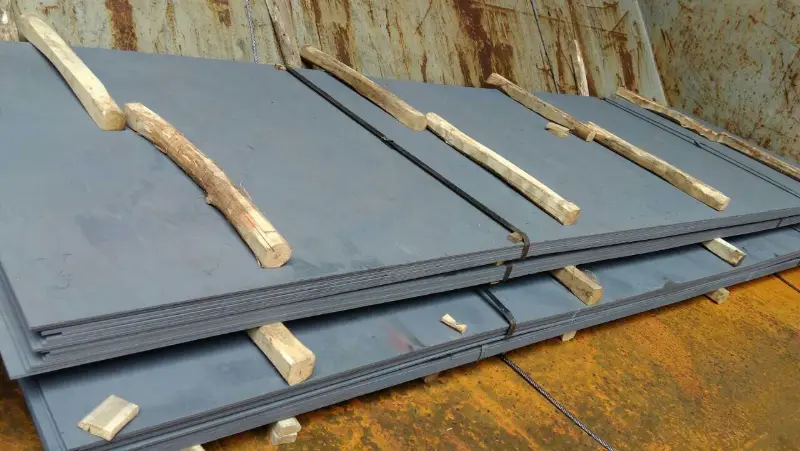
ABS Grade DQ63 High-Strength Quenched and Tempered Shipbuilding Steel Plate
ABS Grade DQ63 Shipbuilding Steel Plate – High Strength Quenched & Tempered Marine Steel
Comprehensive material data for ABS Grade DQ63, a high strength quenched and tempered steel plate for ship and offshore structures in accordance with ABS Rules for Building and Classing Steel Vessels.
Hot rolling followed by quenching and tempering; suitable for cold forming (limited), welding, and machining
- Phone : +8618037372205
- Email : [email protected]
- WhatsApp: Contact via Whtsapp
- WeChat: +8618037372205
ABS Grade DQ63 High-Strength Quenched and Tempered Shipbuilding Steel Plate Introduction
ABS Grade DQ63 is a high-strength, quenched and tempered (Q&T) structural steel plate primarily used in shipbuilding and offshore constructions. As classified under the American Bureau of Shipping (ABS) rules, the designation "DQ" indicates delivery in the quenched and tempered condition, while "63" refers to a minimum specified yield strength of 620 MPa (90 ksi). This grade offers excellent strength-to-weight ratio, good weldability with low carbon equivalent, and reliable impact toughness at -20 °C. Typical thicknesses range from 6 mm up to 100 mm. The steel is intended for critical hull structures, offshore platforms, lifting equipment, and other heavy fabrications where high load-bearing capacity and good low-temperature performance are required.
ABS Grade DQ63 High-Strength Quenched and Tempered Shipbuilding Steel Plate Chemical Composition
The chemical composition limits are per ABS Rules, Part 2. Values represent ladle analysis. Alloying elements may be added at the manufacturer's discretion to meet mechanical properties. A sufficient amount of grain-refining elements (e.g., Al, Nb, V) shall be present.
Note: Carbon equivalent (CEV) is usually limited to 0.43% for thicknesses ≤50 mm and 0.45% for 50–100 mm when specified.
| Element | Content (%) | Remarks |
|---|---|---|
| Carbon (C) | ≤ 0.20 | Product analysis tolerance +0.02 |
| Manganese (Mn) | 0.90 – 1.60 | When used as a deliberate alloying element |
| Silicon (Si) | ≤ 0.55 | |
| Phosphorus (P) | ≤ 0.025 | |
| Sulfur (S) | ≤ 0.025 | |
| Aluminum (Al, acid-soluble) | ≥ 0.015 | Required when aluminum is used as a grain refiner |
| Nickel (Ni) * | ≤ 0.40 | Residual unless otherwise agreed |
| Chromium (Cr) * | ≤ 0.25 | Residual unless otherwise agreed |
| Copper (Cu) * | ≤ 0.35 | Residual unless otherwise agreed |
| Molybdenum (Mo) * | ≤ 0.08 | Residual unless otherwise agreed |
| Niobium (Nb) ** | ≤ 0.09 | Typical micro-alloying addition |
| Vanadium (V) ** | ≤ 0.12 | Typical micro-alloying addition |
| Titanium (Ti) ** | ≤ 0.20 | Typical micro-alloying addition |
ABS Grade DQ63 High-Strength Quenched and Tempered Shipbuilding Steel Plate Thermal and Electrical Physical Properties
The following physical properties are typical for low-alloy quenched and tempered steels and are provided for general engineering calculations. Actual values may vary slightly with composition and heat treatment. These are not mandatory specification requirements.
| Property | Typical Value | Unit | Test Condition / Remarks |
|---|---|---|---|
| Density (ρ) | 7850 | kg/m³ | Room temperature |
| Modulus of Elasticity (E) | 205 | GPa | Room temperature |
| Shear Modulus (G) | 80 | GPa | Room temperature |
| Poisson's Ratio (ν) | 0.3 | – | Room temperature |
| Thermal Expansion Coefficient (α) | 11.5 – 13.0 × 10⁻⁶ | K⁻¹ | 20–200°C (approximate range) |
| Thermal Conductivity (λ) | 42 – 48 | W/(m·K) | at 20°C |
| Specific Heat Capacity (cp) | 460 – 480 | J/(kg·K) | Room temperature |
| Electrical Resistivity (ρₑ) | 0.20 – 0.25 × 10⁻⁶ | Ω·m | Room temperature |
ABS Grade DQ63 High-Strength Quenched and Tempered Shipbuilding Steel Plate Mechanical Properties
Mechanical properties apply to the quenched and tempered condition. All test specimens are taken transverse to the rolling direction unless otherwise agreed. Impact properties are evaluated at -20°C for the DQ grade. Values for thicknesses above 100 mm are subject to separate agreement.
| Property | Required Value | Unit | Test Condition / Thickness |
|---|---|---|---|
| Yield Strength (ReH, min.) | 620 | MPa | t ≤ 50 mm |
| Yield Strength (ReH, min.) | 550 | MPa | 50 mm < t ≤ 70 mm |
| Yield Strength (ReH, min.) | 520 | MPa | 70 mm < t ≤ 100 mm |
| Tensile Strength (Rm) | 720 – 890 | MPa | t ≤ 50 mm |
| Tensile Strength (Rm) | 700 – 870 | MPa | 50 mm < t ≤ 70 mm |
| Tensile Strength (Rm) | 680 – 850 | MPa | 70 mm < t ≤ 100 mm |
| Elongation after Fracture (A, min.) | 15 | % | GL = 50 mm, t ≤ 50 mm |
| Elongation after Fracture (A, min.) | 15 | % | GL = 50 mm, t > 50 mm (proportional to S₀) |
| Bend Test (180°) | 3t | mm (former diameter) | t ≤ 40 mm, crack-free |
| Bend Test (180°) | 4t | mm (former diameter) | 40 mm < t ≤ 100 mm, crack-free |
| Charpy Impact Energy (KV₂, min.) | 41 | J (longitudinal) | -20°C, average of 3 tests |
| Charpy Impact Energy (KV₂, min.) | 27 | J (transverse) | -20°C, average of 3 tests |
ABS Grade DQ63 High-Strength Quenched and Tempered Shipbuilding Steel Plate Fully Equivalent Material Standards & Substitute Grades
| Country/Region | Standard | Grade | Remarks |
|---|---|---|---|
| Europe (EN) | EN 10025-6 | S620Q (1.8914) | Quenched & tempered; yield 620 MPa. Impact energy at -20°C must be separately specified (J2 or K2 option) to match DQ63 toughness. |
| International (ISO) | ISO 4950-2 | E620 DD | High yield strength flat products; DD delivers -20°C impact. |
| Japan (JIS) | JIS G 3128 | SHY 685 N (or SHY 685 NS) | Tensile strength 780–930 MPa; yield ≥ 685 MPa (slightly higher). Impact test at -20°C available by agreement; not fully identical to DQ63. |
| China (GB) | GB/T 712 | E620 (Q620) | E-grade (-40°C) toughness exceeds DQ63; D-grade (-20°C) match possible when ordered with DQ63 property requirements. |
| USA (ASTM) | ASTM A514/A514M | Grade B, H, F, Q (depending on plate thickness) | Yield strength ≥ 690 MPa (100 ksi), but manufacturers can supply 620 MPa min with modified chemistry; supplementary -20°C impact required. |
ABS Grade DQ63 High-Strength Quenched and Tempered Shipbuilding Steel Plate Application Introduction
ABS DQ63 steel is designed for heavy structural components that demand high strength, good weldability, and reliable notch toughness at sub-zero temperatures. Its balanced chemistry and fine-grained microstructure allow it to be used in the following areas:
Product Applications: Container ship hatch coamings and main deck plating, Jack-up rig leg chords and spud cans, Boom and luffing cylinder attachments for heavy-duty cranes, Arctic-class ice-strengthened hulls, Offshore mooring components (fairleads, bollards), Splash-zone structural members on offshore platforms
Processed into products: Longitudinal stiffeners and web frames in hull girders, Sheer strakes and stringer plates, Deck inserts and lifting pad eyes, Crane pedestals and slewing rings, Node cans and tubular joints (K-joints, Y-joints) in offshore jackets, Fatigue-critical brackets and connections in dynamic structures
Application industries: Commercial and naval shipbuilding, Offshore oil & gas platforms (jack-ups, semi-submersibles, FPSOs), Ship-to-shore cranes and heavy-lift equipment, Bridge construction (main girders, orthotropic decks), Pressure vessel and storage tank fabrication (with separate code compliance), Wind turbine foundations (transition pieces, monopiles)
ABS Grade DQ63 High-Strength Quenched and Tempered Shipbuilding Steel Plate Similar or Closely Related Substitute Materials
| Country/Region | Standard | Grade | Remarks |
|---|---|---|---|
| ABS | ABS Rules | ABS Grade EQ63 | Same strength level but toughness requirement at -40°C; fully meets DQ63 properties at -20°C. A superior (more stringent) substitute. |
| Lloyd's Register | LR Rules | LR DH63 | Equivalent shipbuilding grade under Lloyds class; DH63 requires -20°C impact, same strength. Subject to LR approval. |
| EN | EN 10025-6 | S690Q (1.8931) | Minimum yield 690 MPa, tensile 770–940 MPa. Provides higher strength; can be used as an upgrade when weldability and CEV are controlled. |
| ASTM | ASTM A514/A517 | Grade Q (as-rolled or Q&T) | Minimum yield 690 MPa; often used in offshore pedestal cranes. Excess strength may require design concessions. |
| NORSOK | M-120 | Y62 (420 mm max thickness) | Norwegian offshore standard, similar strength with -20°C toughness; used in North Sea platforms. |
Notes:
- Welding: Low-hydrogen welding procedures are mandatory. Preheating (typically 100–175°C) and interpass temperature control are required depending on plate thickness and carbon equivalent. Post-weld heat treatment (PWHT) is generally not recommended for thicknesses under 50 mm.
- Forming: Cold forming is allowed with due consideration to minimum bending radii (≥ 3t). Hot forming must not exceed the original tempering temperature, and re-tempering may be required.
- Tolerances: Thickness tolerances are per ABS rules, usually in accordance with ASTM A6/A6M or EN 10029 for flat products.
- Inspection: Material is supplied with ABS surveyor inspection and certification (3.1 or 3.2 as required).
- Share



