
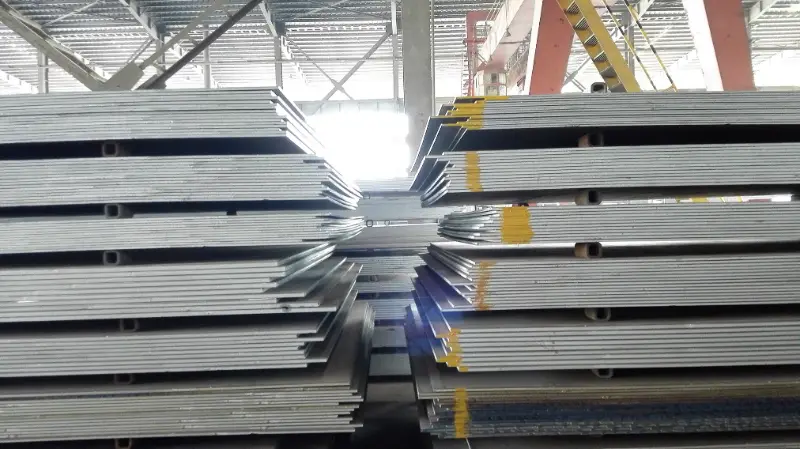
LR Grade EH36 Shipbuilding Steel Plate
LR Grade EH36 Shipbuilding Steel Plate: High-Strength Hull Structural Material with Superior Low-Temperature Toughness
Explore the chemical composition, mechanical properties, and thermal characteristics of LR Grade EH36 shipbuilding steel plate. Find equivalent grades, similar materials, and application guidance for marine and offshore structures.
Hot rolling, normalizing, thermomechanical controlled processing (TMCP), quenching and tempering (optional for thicker sections), welding, cutting, forming
- Phone : +8618037372205
- Email : [email protected]
- WhatsApp: Contact via Whtsapp
- WeChat: +8618037372205
LR Grade EH36 Shipbuilding Steel Plate Introduction
LR Grade EH36 is a high-strength hull structural steel specified under Lloyd's Register rules, primarily designed for marine and offshore applications. Classified as an extra-high-strength shipbuilding steel with a minimum yield strength of 355 MPa, EH36 provides excellent weldability, good toughness at low temperatures (down to -40°C), and reliable performance in heavy-section plates. It is typically supplied in normalized or thermomechanically controlled processed (TMCP) condition, ensuring fine-grained microstructure and consistent mechanical properties. This grade meets the requirements of IACS UR W11 and is widely recognized across international classification societies, making it a standard choice for critical structural components in ship hulls, decks, and offshore platforms.
LR Grade EH36 Shipbuilding Steel Plate Chemical Composition
Chemical composition limits according to IACS UR W11 and Lloyd's Register Rules for Grade EH36. Elements are controlled to ensure adequate strength, toughness, and weldability. Optional microalloying elements may be added for grain refinement and precipitation strengthening. The carbon equivalent (Ceq) is typically limited to ≤0.38% for thickness ≤50 mm to maintain good weldability.
| Element | Standard Value (max, unless range) | Remarks |
|---|---|---|
| Carbon (C) | ≤ 0.18% | - |
| Manganese (Mn) | 0.90 – 1.60% | For thickness >25 mm, minimum Mn may be increased to 1.10% |
| Silicon (Si) | ≤ 0.50% | Usually 0.10–0.50% |
| Phosphorus (P) | ≤ 0.035% | Lower values enhance toughness and reduce temper embrittlement |
| Sulfur (S) | ≤ 0.035% | Low sulfur improves ductility and weldability |
| Aluminum (Al, acid soluble) | ≥ 0.015% | Required for fully killed steel; acts as grain refiner |
| Niobium (Nb) | ≤ 0.05% | Optional, microalloy for grain refinement |
| Vanadium (V) | ≤ 0.10% | Optional, precipitation hardening |
| Titanium (Ti) | ≤ 0.02% | Optional, aids grain refinement, particularly in normalized steel |
| Chromium (Cr) | ≤ 0.20% | Residual |
| Nickel (Ni) | ≤ 0.40% | Residual; may be specified higher for special toughness |
| Molybdenum (Mo) | ≤ 0.08% | Residual |
| Copper (Cu) | ≤ 0.35% | Residual; higher levels may be used for improved corrosion resistance |
| Nitrogen (N) | ≤ 0.009% | Controlled when microalloyed with AI, V, Nb, or Ti |
| Carbon Equivalent (Ceq) | ≤ 0.38% (thk ≤50 mm, TMCP/N) | Ceq = C + Mn/6 + (Cr+Mo+V)/5 + (Ni+Cu)/15; for thicker plates or higher strength may be adjusted |
LR Grade EH36 Shipbuilding Steel Plate Thermal and Electrical Physical Properties
Typical physical properties for EH36 steel at room temperature and atmospheric pressure. These values are representative of carbon-manganese structural steels and can vary slightly depending on exact composition and heat treatment. They are provided for general engineering calculations.
| Property | Typical Value | Unit | Test Conditions / Remarks |
|---|---|---|---|
| Density (ρ) | 7850 | kg/m³ | At 20°C |
| Modulus of Elasticity (E) | 210 | GPa | At ambient temperature |
| Shear Modulus (G) | ≈ 80 | GPa | Calculated from E and ν |
| Poisson's Ratio (ν) | 0.3 | – | Within elastic range |
| Thermal Expansion Coefficient (α) | 12.0 × 10⁻⁶ | /K | Mean coefficient between 20°C and 100°C |
| Thermal Expansion Coefficient (α) | 13.0 × 10⁻⁶ | /K | Between 20°C and 200°C |
| Thermal Expansion Coefficient (α) | 13.8 × 10⁻⁶ | /K | Between 20°C and 300°C |
| Thermal Conductivity (λ) | 52 | W/(m·K) | At 20°C; decreases with increasing temperature (e.g., ~46 W/(m·K) at 200°C) |
| Specific Heat Capacity (cp) | 460 | J/(kg·K) | At 20°C; increases moderately with temperature |
| Electrical Resistivity (ρe) | 0.2 × 10⁻⁶ | Ω·m | At 20°C, typical for low-alloy steel |
LR Grade EH36 Shipbuilding Steel Plate Mechanical Properties
Mechanical property requirements for LR Grade EH36 plates according to IACS UR W11 and Lloyd's Register Rules. Minimum values are specified at room temperature unless otherwise noted. Impact tests are conducted on Charpy V-notch specimens at -40°C. The bend test mandrel diameter depends on the actual tensile strength achieved during testing.
| Property | Standard Requirement | Unit | Test Conditions / Remarks |
|---|---|---|---|
| Yield Strength (ReH) | ≥ 355 | MPa | For all product thicknesses up to 100 mm |
| Tensile Strength (Rm) | 490 – 620 | MPa | For thickness ≤ 100 mm; may vary for greater thicknesses |
| Elongation (A5) | ≥ 21 | % | For thickness ≤ 50 mm, gauge length 5.65√So |
| Elongation (A5) | ≥ 19 | % | For thickness >50–70 mm |
| Elongation (A5) | ≥ 18 | % | For thickness >70–100 mm |
| Charpy Impact Energy (KV) – longitudinal | ≥ 34 | J | At -40°C, V-notch, test piece 10×10 mm, thickness ≤ 50 mm |
| Charpy Impact Energy (KV) – transverse | ≥ 24 | J | At -40°C, V-notch, thickness ≤ 50 mm |
| Charpy Impact Energy (KV) – longitudinal | ≥ 24 | J | At -40°C, thickness >50–70 mm |
| Charpy Impact Energy (KV) – transverse | ≥ 17 | J | At -40°C, thickness >50–70 mm |
| Bend Test (180°) | No cracks | – | Mandrel diameter 4t (for Rm 490–580 MPa) or 5t (for Rm 580–620 MPa); t = thickness of specimen |
LR Grade EH36 Shipbuilding Steel Plate Fully Equivalent Material Standards and Substitutable Grade Designations
| Country / Region | Standard | Grade | Remarks |
|---|---|---|---|
| International/IACS | IACS UR W11 | EH36 | Base specification for high strength hull steels; adopted by all member classification societies |
| USA | ASTM A131 / A131M | EH36 | Marine steel plates – high strength structural; identical to IACS EH36 |
| Norway/Germany | DNV GL Rules | EH36 | Former DNV and Germanischer Lloyd; unified to DNV GL, now DNV |
| France | BV Rules | EH36 | Bureau Veritas |
| China | CCS Rules | EH36 | China Classification Society |
| India | IRS Rules | EH36 | Indian Register of Shipping |
| Japan | NK Rules | EH36 | Nippon Kaiji Kyokai |
| Italy | RINA Rules | EH36 | Registro Italiano Navale |
| Russia | RMRS Rules | EH36 | Russian Maritime Register of Shipping |
| South Korea | KR Rules | EH36 | Korean Register |
| Poland | PRS Rules | EH36 | Polski Rejestr Statków |
| Croatia | CRS Rules | EH36 | Croatian Register of Shipping |
LR Grade EH36 Shipbuilding Steel Plate Application Introduction
LR Grade EH36 is a versatile heavy plate grade specifically tailored for demanding marine and offshore environments. Its combination of high strength and sub-zero toughness makes it ideal for critical welded structures exposed to dynamic loads and cold temperatures. Typical applications include:
Product Applications: Hull structural components (plates, stiffeners, frames, girders, stringers), Decks, bottom shells, side shells, and bulkheads of vessels, Offshore platform legs, bracings, and module support frames, Large-diameter welded pipes for deep water applications, Lifting beams and heavy-duty structural members
Processed into products: Ship hull plates (keel plates, bilge strakes, sheer strakes), Internal stiffening elements (T-bars, angles, bulb flats), Deck and bottom longitudinals, Transverse frames and web frames, Watertight doors and hatch coamings, Pile sleeves and transition pieces for monopiles (offshore wind), Node cans и K-joints for offshore jackets, Structural nodes in bridges built by cantilever method
Application industries: Commercial and naval shipbuilding (tankers, bulk carriers, container ships, frigates), Offshore oil & gas (fixed platforms, jack-up rigs, FPSOs, subsea templates), Port and harbor infrastructure (crane girders, berths, lock gates), Renewable energy (offshore wind turbine foundations, transition pieces), Heavy civil engineering (bridge girders, pressure tunnels, penstocks)
LR Grade EH36 Shipbuilding Steel Plate Similar / Closely Related Alternative Material Suggestions
| Country / Region | Standard | Grade | Remarks |
|---|---|---|---|
| EU | EN 10025-4 | S355ML | Thermomechanical rolled fine-grain steel; YS ≥355 MPa, impact at -50°C, tensile 470–630 MPa. Chemical composition slightly different; suitable for structural use but may not meet all IACS shipbuilding requirements. |
| EU | EN 10025-4 | S355M | TMCP rolled structural steel, YS ≥355 MPa, impact at -20°C (if marked J2). Lower toughness temperature than EH36; may require impact test verification for marine use. |
| USA | ASTM A572 | Grade 50 | High-strength low-alloy structural steel; YS 345 MPa, tensile 450 MPa min. Lower minimum yield and no low-temperature impact guarantee; not directly substitutable without additional testing. |
| Japan | JIS G3106 | SM490YB | Welded structural steel, YS 365 MPa min for t≤16 mm; impact at 0°C or -5°C typical. Lacks low-temperature toughness; appropriate for less demanding structural applications. |
| International | IACS UR W11 | DH36 | Same strength level but with impact test temperature at -20°C. Suitable if service temperature is less severe. |
| International | IACS UR W11 | FH36 | Higher toughness variant, impact at -60°C; can replace EH36 in all environments with enhanced safety margin. |
Notes:
Production and Certification: EH36 plates are typically produced via continuous casting followed by normalizing or TMCP to achieve fine grain size and homogeneous properties. Lloyd's Register surveyors witness the testing and stamp approved plates.
Welding: Use low-hydrogen electrodes and preheating when thickness >30 mm to avoid cold cracking. Post-weld heat treatment may be required depending on service conditions.
Corrosion Protection: For marine exposure, protective coatings (paint, epoxy) or cathodic protection are recommended; the steel itself relies on low alloy content and uniform microstructure for corrosion resistance but is not considered corrosion-resistant.
Further Processing: Good formability allows cold bending and flanging; hot forming may be applied with attention to re-normalizing if required by the classification society.
- Share



