
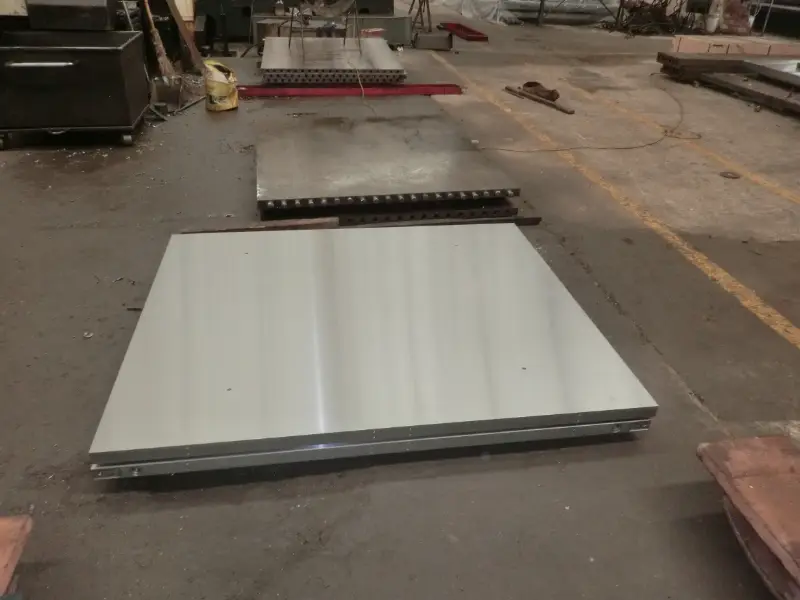
LR Grade FH36 Shipbuilding Steel Plate
LR Grade FH36 Shipbuilding Steel Plate - High Strength, Low Temperature Marine Steel
Complete material data for LR Grade FH36 shipbuilding steel plate: chemical composition, mechanical and physical properties, international equivalents, and application guide for marine and offshore structures.
Thermo-mechanical controlled processing (TMCP), Normalizing, Normalizing rolling, Quenching and tempering (upon agreement)
- Phone : +8618037372205
- Email : [email protected]
- WhatsApp: Contact via Whtsapp
- WeChat: +8618037372205
LR Grade FH36 Shipbuilding Steel Plate Introduction
LR Grade FH36 is a high-strength shipbuilding steel plate certified by Lloyd's Register (LR), designed for critical low-temperature applications in marine and offshore structures. It belongs to the EH/FH series of normalized or thermo-mechanically controlled processed (TMCP) steels with a minimum yield strength of 355 MPa. The 'F' designation indicates guaranteed notch toughness at -60°C. This grade combines excellent weldability, good formability, and reliable through-thickness properties, making it ideal for hulls, decks, and structural components in ice-strengthened vessels and Arctic-class offshore platforms.
LR Grade FH36 Shipbuilding Steel Plate Chemical Composition
Chemical requirements according to Lloyd's Register rules for grade FH36. Values are ladle analysis for thickness ≤ 100 mm. Microalloying elements (Nb, V, Ti) may be used singly or in combination to achieve strength and toughness. The carbon equivalent (CEV) is typically ≤ 0.38% for good weldability.
| Element | Standard Value (max unless range) | Remarks |
|---|---|---|
| Carbon (C) | ≤ 0.16 | Ladle analysis |
| Manganese (Mn) | 0.90 - 1.60 | Range allowed; higher Mn for thicker plates |
| Silicon (Si) | 0.10 - 0.50 | Range; may be adjusted for deoxidation |
| Phosphorus (P) | ≤ 0.025 | Strict control for notch toughness |
| Sulfur (S) | ≤ 0.025 | Low S for improved transverse properties |
| Aluminum (Al, total) | ≥ 0.015 | Fine grain practice confirmed by Al/N ratio |
| Niobium (Nb) | ≤ 0.05 | Grain refinement |
| Vanadium (V) | ≤ 0.10 | Precipitation hardening |
| Titanium (Ti) | ≤ 0.02 | Grain refinement, inclusion shape control |
| Copper (Cu) | ≤ 0.35 | Residual element |
| Nickel (Ni) | ≤ 0.40 | Permitted for low-temperature toughness |
| Chromium (Cr) | ≤ 0.20 | Residual |
| Molybdenum (Mo) | ≤ 0.08 | Residual |
| Nitrogen (N) | ≤ 0.012 | Typically measured for fine grain confirmation |
| Carbon Equivalent (CEV) | Typically ≤ 0.38 | CEV = C + Mn/6 + (Cr+Mo+V)/5 + (Ni+Cu)/15 |
LR Grade FH36 Shipbuilding Steel Plate Physical Properties
Physical properties are typical for low-carbon microalloyed steel and are provided for engineering reference only. They are not mandatory certification requirements but are representative of FH36 grade in the as-delivered condition at room temperature unless otherwise noted.
| Property | Typical Value | Unit | Test Condition |
|---|---|---|---|
| Density (ρ) | 7.85 | g/cm³ | 20°C |
| Modulus of Elasticity (E) | 210 | GPa | 20°C |
| Shear Modulus (G) | ≈ 80 | GPa | 20°C, calculated |
| Poisson's Ratio (ν) | 0.3 | - | Elastic range |
| Thermal Expansion Coefficient (α) | 12.0 × 10⁻⁶ | K⁻¹ | 20 - 100°C |
| Thermal Conductivity (λ) | 50 | W/(m·K) | 20°C |
| Specific Heat Capacity | 460 | J/(kg·K) | 20°C |
| Electrical Resistivity (ρe) | 0.20 - 0.25 | μΩ·m | 20°C |
LR Grade FH36 Shipbuilding Steel Plate Mechanical Properties
Mechanical properties specified by Lloyd's Register for transverse test pieces (tensile) and longitudinal Charpy V-notch impact tests. Values apply to product thicknesses up to 100 mm. For plates supplied in the TMCP condition, properties may be verified on specimens with reduced gauge length per the standard.
| Property | Standard Requirement | Unit | Test Condition |
|---|---|---|---|
| Yield Strength (ReH) | ≥ 355 | MPa | Transverse, ambient temperature |
| Tensile Strength (Rm) | 490 - 620 | MPa | Transverse, ambient temperature |
| Elongation (A) | ≥ 21 | % | Transverse, gauge length 5.65√So |
| Bend Test (Bend diameter) | 3a (t ≤ 25 mm); 4a (t > 25 mm) | - | 180° bending, a = specimen thickness |
| Charpy Impact (KV2) | ≥ 34 (avg.) | J | Longitudinal, -60°C, 10x10 mm specimen |
| Charpy Impact (KV2) | ≥ 24 (single minimum) | J | Longitudinal, -60°C, 10x10 mm specimen |
| Through-thickness reduction of area (Z) | Z15, Z25, Z35 by agreement | % | According to EN 10164 or LR rules |
LR Grade FH36 Shipbuilding Steel Plate Fully Equivalent International Grade Standards and Replacements
| Country/Region | Standard | Grade | Remarks |
|---|---|---|---|
| International | IACS UR W11 | FH36 | Unified requirement for all IACS members |
| USA | ABS | FH36 | American Bureau of Shipping |
| France | BV | FH36 | Bureau Veritas |
| China | CCS | FH36 | China Classification Society |
| Norway/Germany | DNV | FH36 | DNV GL (now DNV) |
| Korea | KR | FH36 | Korean Register |
| Japan | NK (ClassNK) | FH36 | Nippon Kaiji Kyokai |
| Italy | RINA | FH36 | Registro Italiano Navale |
| Russia | RMRS | FH36 | Russian Maritime Register of Shipping |
| Europe | EN 10025-4 | S355ML | Only if impact tested at -60°C (not standard, requires special agreement); CEV adjusted accordingly |
| USA | ASTM A131/A131M | FH36 | Standard specification for structural steel for ships |
LR Grade FH36 Shipbuilding Steel Plate Application Introduction
LR FH36 is engineered for heavy-duty structural applications requiring high strength and exceptional notch toughness at sub-zero temperatures. It is widely used in the shipbuilding and offshore industries where safety and reliability are paramount. Its weldability and formability allow efficient fabrication into complex shapes. Typical applications include:
Product Applications: Hull plates and stiffeners, Ice-strengthened shell plating, Deck and bottom plating, Bulkheads and watertight flats, Jack-up rig legs and spud cans, Offshore mooring structures, Subsea templates and manifolds
Processed into products: Hull shell plates (ice belt), Longitudinal and transverse frames, Rudders and rudder horns, Stern frames and shaft brackets, Bitts and fairleads, Offshore platform nodes and braces, Tubular joints (with Z-quality requirements)
Application industries: Shipbuilding (commercial and naval vessels), Offshore oil & gas platforms, Arctic and ice-class ships, Port and harbor equipment, Pressure vessels (by supplementary requirements), Bridge and civil engineering (where low-temperature toughness is needed), Wind turbine foundations (offshore monopiles, transition pieces)
LR Grade FH36 Shipbuilding Steel Plate Similar or Alternative Grade Recommendations
| Country/Region | Standard | Grade | Remarks |
|---|---|---|---|
| UK | LR | EH36 | Higher impact test temperature (-40°C); same strength; easier availability for less severe low-temperature service |
| UK | LR | DH36 | Impact test at -20°C; suitable for general ocean service |
| UK | LR | FH40 | Higher yield strength (≥ 390 MPa) with -60°C toughness; increased load capacity |
| Europe | EN 10225 | S355G10+N/M | Offshore structural steel with low temperature toughness down to -40°C or -50°C, can be ordered with -60°C qualification |
| Europe | EN 10025-6 | S460QL | Quenched and tempered steel with min. 460 MPa yield and -60°C impact; higher strength alternative but requires careful welding |
Notes:
Notes: All data is based on Lloyd's Register Rules and standard industrial references. For actual project certification, the specific LR inspection and testing regime must be applied. Supplementary requirements such as through-thickness testing (Z-quality), CTOD testing, and simulated post-weld heat treatment may be specified. The typical chemical composition is not mandatory; the final analysis is verified by the steel manufacturer's certificate. Physical properties are for design purposes and may vary slightly with processing route and thickness.
- Share



