
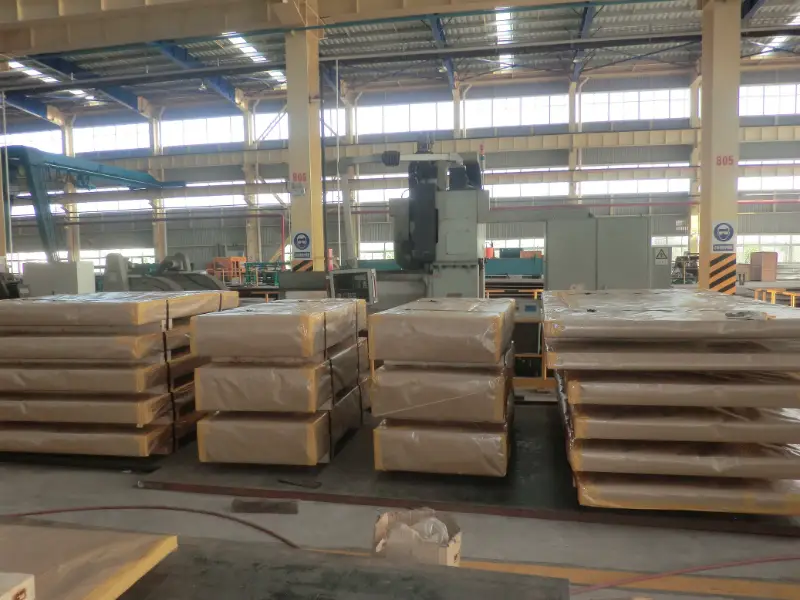
LR Grade AH40 Shipbuilding Steel Plate
LR Grade AH40 Shipbuilding Steel Plate: Chemical, Mechanical & Physical Properties, International Equivalents
Comprehensive data for LR Grade AH40 shipbuilding steel plate including chemical composition, mechanical properties (yield, tensile, impact, bend test), physical properties (density, modulus, thermal), international equivalents (ASTM A131 AH40, ABS, DNV, BV, NK, KR, CCS), and application guide.
Hot rolling, controlled rolling, normalizing, thermo-mechanical controlled processing (TMCP), quenching and tempering (Q&T)
- Phone : +8618037372205
- Email : [email protected]
- WhatsApp: Contact via Whtsapp
- WeChat: +8618037372205
LR Grade AH40 Shipbuilding Steel Plate Introduction
LR Grade AH40 is a high-strength shipbuilding structural steel certified by Lloyd's Register (LR). It is designed for the construction of ship hulls and offshore structures where high strength, excellent weldability, and good toughness are essential. The designation "AH40" indicates an "A" grade (impact tested at 0°C) with a minimum yield strength of 390 MPa. Key features:
- High strength (ReH ≥ 390 MPa) permits reduced plate thickness and weight.
- Good notch toughness at 0°C ensures reliability in marine environments.
- Excellent weldability with conventional shipyard procedures.
- Supplied in normalized, controlled-rolled, or thermo-mechanically controlled processed (TMCP) conditions.
- Conforms to LR Rules, Chapter 3, and is interchangeable with ASTM A131 AH40 and equivalent grades from other IACS classification societies.
This steel is widely utilized for decks, shell plating, bulkheads, and primary structural components in large vessels, enabling weight reduction while maintaining structural integrity. Microalloying with niobium, vanadium, and titanium provides grain refinement and consistent tensile properties across a wide thickness range.
LR Grade AH40 Shipbuilding Steel Plate Chemical Composition
The chemical composition complies with LR Rules, Chapter 3. The steel is microalloyed with niobium, vanadium, and titanium for grain refinement and precipitation strengthening. Acid-soluble aluminum is required for fine grain practice. Carbon equivalent (CEV) is controlled to ensure good weldability.
| Chemical Element | Standard Value (wt%) | Remarks |
|---|---|---|
| Carbon (C) | ≤0.18 | Key element for strength and hardenability |
| Silicon (Si) | ≤0.50 | Deoxidizer, contributes to strength |
| Manganese (Mn) | 0.90 – 1.60 | Enhances strength and toughness |
| Phosphorus (P) | ≤0.035 | Impurity, limited for toughness |
| Sulfur (S) | ≤0.035 | Impurity, controlled for weldability |
| Copper (Cu) | ≤0.35 | Residual element, can improve corrosion resistance |
| Chromium (Cr) | ≤0.20 | Residual, increases hardenability |
| Nickel (Ni) | ≤0.40 | Residual, improves toughness |
| Molybdenum (Mo) | ≤0.08 | Residual microalloying element |
| Aluminum, acid soluble (Als) | ≥ 0.015 | Grain refinement, deoxidation |
| Niobium (Nb) | ≤ 0.05 | Microalloy, grain refinement, precipitation strengthening |
| Vanadium (V) | ≤ 0.10 | Microalloy, precipitation strengthening |
| Titanium (Ti) | ≤ 0.02 | Microalloy, grain refinement, improves toughness |
| Niobium + Vanadium + Titanium (Nb+V+Ti) | ≤ 0.12 | Sum of microalloying elements |
LR Grade AH40 Shipbuilding Steel Plate Thermal & Electrical Physical Properties
These physical properties are typical for carbon-manganese shipbuilding steels and serve as reference data for engineering calculations. They are not part of the mandatory specification but are derived from published literature on similar structural steels. Values vary slightly with temperature and processing condition.
| Property | Typical Value | Unit | Test Condition / Temperature |
|---|---|---|---|
| Density (ρ) | 7.85 | g/cm³ | 20°C |
| Elastic modulus (E) | 205 | GPa | 20°C |
| Shear modulus (G) | 79.3 | GPa | 20°C |
| Poisson's ratio (ν) | 0.30 | – | 20°C |
| Thermal expansion coefficient (α) | 11.5 | ×10⁻⁶ /K | 20°C – 100°C |
| Thermal expansion coefficient (α) | 12.2 | ×10⁻⁶ /K | 20°C – 200°C |
| Thermal expansion coefficient (α) | 12.9 | ×10⁻⁶ /K | 20°C – 300°C |
| Thermal conductivity (λ) | 52 | W/(m·K) | 20°C |
| Thermal conductivity (λ) | 51 | W/(m·K) | 100°C |
| Thermal conductivity (λ) | 48 | W/(m·K) | 200°C |
| Thermal conductivity (λ) | 45 | W/(m·K) | 300°C |
| Specific heat capacity (cₑ) | 460 | J/(kg·K) | 20°C |
| Specific heat capacity (cₑ) | 480 | J/(kg·K) | 100°C |
| Specific heat capacity (cₑ) | 500 | J/(kg·K) | 200°C |
| Specific heat capacity (cₑ) | 530 | J/(kg·K) | 300°C |
| Electrical resistivity (ρₑ) | 0.23 | ×10⁻⁶ Ω·m | 20°C |
LR Grade AH40 Shipbuilding Steel Plate Mechanical Properties
Mechanical properties are dependent on plate thickness and testing direction. The values listed below are the minimum specified requirements according to LR Rules. Tensile testing is transverse unless otherwise agreed. Impact testing is performed on longitudinal specimens for thickness ≤ 50 mm; transverse tests may be agreed for thicker plates. All tests are carried out at ambient temperature after the specified delivery condition.
| Property | Required Value | Unit | Test Condition |
|---|---|---|---|
| Upper yield strength (ReH) | ≥ 390 | MPa | Plate thickness t ≤ 100 mm |
| Upper yield strength (ReH) | ≥ 380 | MPa | Plate thickness 100 mm < t ≤ 150 mm |
| Upper yield strength (ReH) | ≥ 370 | MPa | Plate thickness 150 mm < t ≤ 200 mm |
| Tensile strength (Rm) | 510 – 650 | MPa | All thicknesses up to 200 mm |
| Elongation (A) | ≥ 20 | % | t ≤ 100 mm, gauge length 5.65√S₀ |
| Elongation (A) | ≥ 19 | % | 100 mm < t ≤ 150 mm, gauge length 5.65√S₀ |
| Elongation (A) | ≥ 18 | % | 150 mm < t ≤ 200 mm, gauge length 5.65√S₀ |
| Charpy V-notch impact energy (KV₂) | ≥ 31 (average), min single ≥ 21 | J | 0°C, longitudinal specimens, standard 10×10 mm |
| Bend test (180°) | D = 3a, no cracks | – | t ≤ 25 mm |
| Bend test (180°) | D = 4a, no cracks | – | t > 25 mm |
LR Grade AH40 Shipbuilding Steel Plate Fully Equivalent Material Standards & Substitute Grades
| Country / Region | Standard | Grade | Remarks |
|---|---|---|---|
| International (USA) | ASTM A131 / A131M | AH40 | Identical chemical and mechanical property requirements |
| International (ABS) | ABS Rules | AH40 | American Bureau of Shipping, fully interchangeable |
| International (DNV) | DNV Rules | AH40 | Det Norske Veritas, identical grade |
| International (BV) | BV Rules | AH40 | Bureau Veritas, equivalent in all aspects |
| International (GL) | GL Rules | AH40 | Germanischer Lloyd, now part of DNV GL |
| International (NK) | NK Rules | AH40 | Nippon Kaiji Kyokai, identical specification |
| International (KR) | KR Rules | AH40 | Korean Register, fully equivalent |
| International (RINA) | RINA Rules | AH40 | Registro Italiano Navale, interchangeable grade |
| China (CCS) | CCS Rules | AH40 | China Classification Society, same technical requirements |
LR Grade AH40 Shipbuilding Steel Plate Application Introduction
LR Grade AH40 steel plate is extensively used in shipbuilding and marine construction where high structural strength combined with good weldability and moderate-temperature toughness is necessary. Its high yield strength allows structural weight savings without compromising safety. Typical application areas:
- Main decks and strength decks of large merchant ships, container vessels and bulk carriers.
- Shell plating, bottom and side shell plates, and bilge strakes.
- Longitudinal and transverse bulkheads, watertight compartments.
- Frames, stiffeners, webs, and girders forming the primary hull structure.
- Deckhouses, hatch coamings, and superstructure components.
- Offshore platform topsides, jacket legs, flare booms, and helidecks.
Thanks to its fine-grain structure and controlled rolling, AH40 maintains consistent properties across plate thickness, making it a reliable choice for critical structural components.
Product Applications: Hull shell plates and bottom plates, Deck plates and stringer plates, Bulkhead and division panels, Longitudinal stiffeners and frames, Transverse web frames and girders, Offshore platform decks and module support structures, Pontoons, barges, and floating docks
Processed into products: Welded hull shell structures, Watertight and non-watertight bulkheads, Deck longitudinals and beams, Floor plates and bracket assemblies, Engine room structural casings, Rudder horns and steering gear foundations, Hatch covers and coamings, Anchor handling pockets and fairlead supports
Application industries: Shipbuilding (commercial and naval vessels), Offshore oil & gas platforms and FPSOs, Marine engineering and port construction, Bridge building and heavy civil infrastructure, Heavy machinery and crane manufacturing
LR Grade AH40 Shipbuilding Steel Plate Similar / Proximate Alternative Materials
| Country / Region | Standard | Grade | Remarks |
|---|---|---|---|
| International (Various) | LR / ABS / DNV etc. | DH40 | Same strength and chemistry as AH40, but impact tested at -20°C. Suitable for lower-temperature environments. |
| International (Various) | LR / ABS / DNV etc. | EH40 | Impact tested at -40°C, otherwise identical chemistry and mechanical properties. Suitable for arctic service. |
| International (Various) | ASTM A131 / Classification Societies | AH36 | Lower yield strength (355 MPa) but similar weldability and toughness; can be considered where strength over 390 MPa is not required. |
| China | GB/T 712 | AH40 | Chinese national standard for shipbuilding steel, similar to LR AH40 but with minor variations in sulfur/phosphorus limits. |
Notes:
Additional considerations:
- For low-temperature environments, grades DH40 (impact at -20°C), EH40 (impact at -40°C), or FH40 (impact at -60°C) should be selected.
- Ultrasonic testing and other non-destructive examinations can be specified in the purchase order.
- Through-thickness properties (Z-grade) may be requested for highly restrained welded joints.
- Welding must be performed with low-hydrogen practices and appropriate preheat to avoid cold cracking, although the carbon equivalent is low for this grade.
- Material certificates and markings according to LR Rules are mandatory and must be retained for traceability.
- Actual mechanical property values are typically significantly higher than the minimum specification, depending on the mill process and thickness.
- Share



