
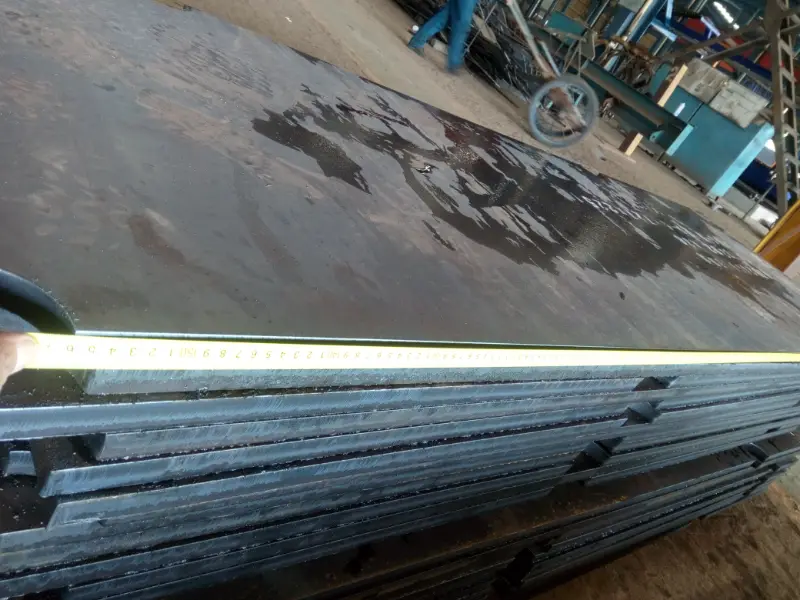
ASTM A131 Grade EH36 Shipbuilding Steel Plate
ASTM A131 Grade EH36 Shipbuilding Steel Plate: High Strength, Low Temperature Toughness
Detailed technical data for ASTM A131 Grade EH36 shipbuilding steel, including chemical composition, mechanical & physical properties, international equivalents, and typical applications in ship hulls and offshore structures.
Hot rolling, normalizing, controlled rolling, thermo-mechanical controlled processing (TMCP), quenching and tempering (optional by agreement)
- Phone : +8618037372205
- Email : [email protected]
- WhatsApp: Contact via Whtsapp
- WeChat: +8618037372205
ASTM A131 Grade EH36 Shipbuilding Steel Plate Introduction
ASTM A131 Grade EH36 is a high strength hull structural steel widely used in shipbuilding and offshore engineering. It belongs to the higher-strength series of the ASTM A131/A131M standard, with a specified minimum yield strength of 355 MPa (51 ksi) and excellent low-temperature impact toughness (longitudinal Charpy V-notch energy ≥ 34 J at -40°C). EH36 is typically supplied in normalized or thermo-mechanical controlled rolled (TMCP) condition, providing a fine-grained microstructure that ensures good weldability, formability, and resistance to brittle fracture in cold marine environments. Its balanced chemical composition includes microalloying elements such as niobium, vanadium, and titanium for grain refinement and precipitation strengthening. This steel grade is approved by all major classification societies (ABS, LR, DNV, BV, CCS, etc.) and is used extensively for hull plates, decks, bulkheads, and structural components of ships, offshore platforms, and polar vessels. Stringent quality control and through-thickness properties make EH36 a reliable choice for critical load-bearing structures subjected to dynamic loading and low service temperatures.
ASTM A131 Grade EH36 Shipbuilding Steel Plate Chemical Composition as per ASTM A131/A131M
The chemical composition of EH36 steel is carefully controlled to achieve high strength and superior low-temperature toughness. Carbon is kept low for weldability, while manganese and silicon provide solid solution strengthening. Microalloying elements like niobium, vanadium, and titanium impart grain refinement and precipitation hardening. Sufficient aluminum is added for deoxidation and grain size control. Impurity limits for phosphorus and sulfur ensure cleanness and ductility. The values below represent the ladle (heat) analysis; product analysis tolerances are stated in the standard.
| Element | Composition (max, or range) | Remarks |
|---|---|---|
| Carbon (C) | ≤ 0.18% | Lower carbon improves weldability and toughness |
| Manganese (Mn) | 0.90 – 1.60% | Main strengthening element; upper limit depends on CEV |
| Phosphorus (P) | ≤ 0.035% | Impurity control for ductility |
| Sulfur (S) | ≤ 0.035% | Impurity control for reduced hot shortness |
| Silicon (Si) | 0.10 – 0.50% | Deoxidation and strength contribution |
| Nickel (Ni) | ≤ 0.40% | Optional, may be added for low-temperature toughness |
| Chromium (Cr) | ≤ 0.20% | Residual element; higher levels may be permissible by agreement |
| Molybdenum (Mo) | ≤ 0.08% | Residual element |
| Copper (Cu) | ≤ 0.35% | Residual; higher amounts can be specified for atmospheric corrosion resistance |
| Vanadium (V) | 0.05 – 0.10% | Microalloying for precipitation strengthening |
| Niobium (Nb) | 0.02 – 0.05% | Microalloying for grain refinement |
| Titanium (Ti) | 0.007 – 0.05% | Microalloying, also aids in weld heat-affected zone toughness |
| Aluminum (Al, acid soluble) | ≥ 0.015% | Grain refining element; total Al is typically 0.020 – 0.050% |
ASTM A131 Grade EH36 Shipbuilding Steel Plate Thermal & Electrical Physical Properties
The physical properties of ASTM A131 EH36 are typical for low‑alloy structural steel and are not specified in the standard. These values are provided as guidance only and may vary slightly depending on exact composition, heat treatment, and temperature. Density and elastic constants are standard for carbon‑manganese steels. Thermal and electrical data are average values at room temperature unless otherwise noted.
| Property | Typical Value | Unit | Test Condition / Remarks |
|---|---|---|---|
| Density (ρ) | 7850 | kg/m³ | At 20°C |
| Elastic Modulus (E) | 200 – 210 | GPa | At 20°C; decreases with temperature |
| Shear Modulus (G) | 77 – 83 | GPa | At 20°C |
| Poisson's Ratio (ν) | 0.27 – 0.30 | — | Room temperature |
| Thermal Expansion Coefficient (α) | 11.5 – 12.5 | ×10⁻⁶/°C | 20–100°C average |
| Thermal Conductivity (λ) | 45 – 52 | W/(m·K) | At 20°C |
| Specific Heat Capacity | 450 – 500 | J/(kg·K) | At 20°C |
| Electrical Resistivity (ρₑ) | 0.22 – 0.28 | μΩ·m | At 20°C |
ASTM A131 Grade EH36 Shipbuilding Steel Plate Mechanical Properties as per ASTM A131/A131M
The following mechanical properties are mandatory for EH36 plates. Tensile testing is conducted on transverse specimens unless otherwise agreed. Elongation requirements depend on gauge length and plate thickness. Charpy V-notch impact tests are performed at -40°C (-40°F) with minimum average and individual values as listed. Bend tests (cold) demonstrate formability. All values meet the minimum requirements of the standard; actual properties may be higher depending on mill practice and rolling process.
| Property | Required Value | Unit | Test Condition |
|---|---|---|---|
| Yield Strength (ReH) | ≥ 355 | MPa | Transverse, thickness ≤ 100 mm (51 ksi) |
| Tensile Strength (Rm) | 490 – 620 | MPa | Transverse (71 – 90 ksi) |
| Elongation (A5, 200 mm gauge) | ≥ 21 | % | Plate thickness ≤ 50 mm |
| Elongation (A5, 200 mm gauge) | ≥ 21 | % | Plate thickness > 50 mm to ≤ 70 mm |
| Elongation (A50, 50 mm gauge) | ≥ 24 | % | Plate thickness ≤ 50 mm |
| Elongation (A50, 50 mm gauge) | ≥ 24 | % | Plate thickness > 50 mm to ≤ 70 mm |
| Charpy V‑notch Impact Energy (KV₂) | Average ≥ 34 J, Individual ≥ 24 J | J | Longitudinal, test temperature -40°C |
| Charpy V‑notch Impact Energy (KV₂) | Average ≥ 25 ft·lbf, Individual ≥ 18 ft·lbf | ft·lbf | Longitudinal, test temperature -40°F |
| Cold Bend (180°) | d = 3a (crack‑free) | — | Bend diameter for EH36; a = specimen thickness |
ASTM A131 Grade EH36 Shipbuilding Steel Plate Completely Equivalent Material Standards & Alternative Designations
EH36 under ASTM A131 is fully recognized by all IACS classification societies. The following table lists the direct equivalents from major marine standards. Plates certified by any of these societies are normally accepted as interchangeable for ship construction projects worldwide.
| Country / Region | Standard / Society | Designation | Remarks |
|---|---|---|---|
| USA | ABS (American Bureau of Shipping) | ABS EH36 | Identical strength and toughness class |
| UK | LR (Lloyd's Register) | LR EH36 | Same requirements as ASTM EH36 |
| Norway/Germany | DNV (Det Norske Veritas) | DNV E36 | Direct correspondence |
| France | BV (Bureau Veritas) | BV EH36 | Equivalent grade |
| China | CCS (China Classification Society) | CCS EH36 | Adopts same chemical/mechanical requirements |
| Japan | NK (ClassNK) | NK KE36 | KE36 is the NK notation for EH36 |
| South Korea | KR (Korean Register) | KR EH36 | Equivalent to ASTM A131 EH36 |
| Italy | RINA (Registro Italiano Navale) | RINA EH36 | Same toughness class |
ASTM A131 Grade EH36 Shipbuilding Steel Plate Application Introduction
ASTM A131 EH36 steel is engineered for demanding marine environments where high strength, excellent weldability, and guaranteed low‑temperature impact resistance are required. It is the material of choice for critical structural components in shipbuilding, offshore platforms, and arctic engineering. Its good formability and consistent properties make it suitable for a variety of fabrication processes, including cutting, bending, and welding. Typical end‑uses and components are listed below.
Product Applications: Hull plates (shell plates, bottom plates, bilge strakes), Strength and weather decks, Transverse and longitudinal bulkheads, Structural members of semi‑submersibles and jack‑up rigs, Lower and upper hulls of FPSO units, Container ship hatch coamings and crane pedestals
Processed into products: Stiffeners, frames, and web frames, Rudder horns and stern frames, Bilge keels and skegs, Jack‑up leg chords and bracings, Wind turbine towers and transition pieces, Bridge box girders, diaphragms, and sole plates, Tie rods and anchor systems in marine structures
Application industries: Shipbuilding (commercial & naval), Offshore oil & gas, Marine engineering (ports, terminals), Renewable energy (offshore wind turbine foundations), Heavy bridge construction (cable anchors, girders), Polar research vessels and icebreakers
ASTM A131 Grade EH36 Shipbuilding Steel Plate Near‑equivalent / Similar Performance Steel Grades
Although not identical in every aspect, the following structural steel grades offer comparable strength and, in some cases, similar low‑temperature toughness. Substitution must consider specification requirements for impact testing temperature, CEV, and delivery condition. Always consult the relevant standard before substitution.
| Country / Region | Standard | Designation | Remarks |
|---|---|---|---|
| Europe | EN 10025-4 | S355ML | TMCP delivery, yield 355 MPa, impact at –50°C; close to EH36 but may require through‑thickness properties for marines |
| Europe | EN 10225 | S355G10+N | Structural steel for offshore fixed structures; similar strength, impact at –40°C or lower |
| USA | ASTM A572/A572M | Grade 50 [345] | Yield 345 MPa (50 ksi), impact typical, but EH36 has better low‑temperature toughness guarantee |
| Worldwide | ISO 630-3 | E355 | Welded structural steel; minimum yield 355 MPa, impact temperature class depends on suffix |
| USA | API 2H / 2W | Grade 50 | Offshore structural steel plates; similar chemistry, but supplementary requirements needed for EH36 equivalence |
Notes:
Welding: EH36 can be welded by all common methods (SMAW, SAW, GMAW, FCAW). Pre‑heat may be required depending on thickness and carbon equivalent (typically CEV ≤ 0.38% by agreement). Low‑hydrogen consumables are recommended. Through‑thickness (Z‑direction) properties: When specified, EH36 can be ordered with Z35 or Z25 requirements per EN 10164 or ASTM A770 to resist lamellar tearing. Ultrasonic testing: Plates are often supplied with UT to ASTM A578 Level II or per purchaser's specification. Alternative delivery conditions: By agreement, EH36 can be delivered in quenched and tempered condition for improved strength/toughness balance or for thicker gauges.
Disclaimer: The data provided are based on the ASTM A131/A131M standard and typical reference values. Actual properties may vary with production route. Always refer to the latest edition of the standard and specific material test certificates for design purposes.
- Share



