
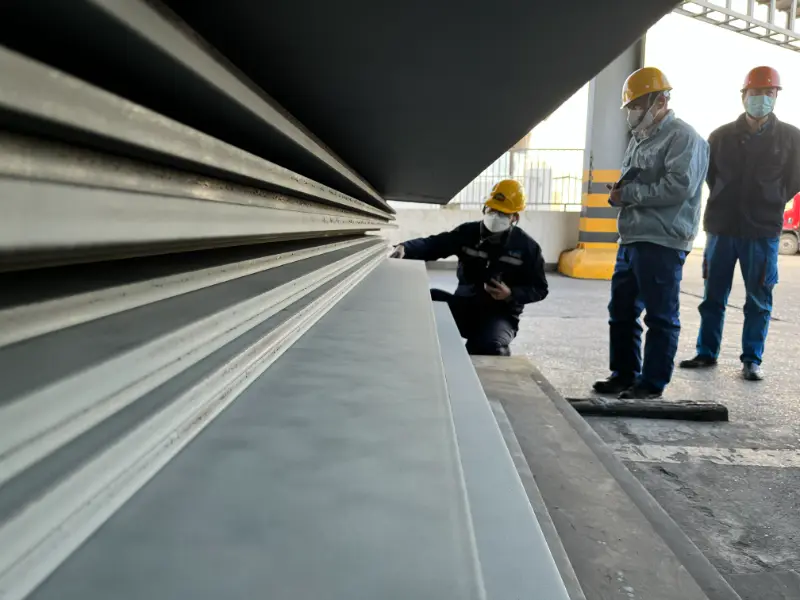
ASTM A131 Grade FH36 Shipbuilding Steel Plate
ASTM A131 Grade FH36 Shipbuilding Steel Plate: Properties, International Equivalents & Applications
Complete technical data for ASTM A131 Grade FH36 shipbuilding steel plate: chemical composition, mechanical and physical properties, international equivalents, similar materials, and application guidelines for marine and offshore structures.
Hot rolling, Normalizing, Thermo-Mechanical Controlled Processing (TMCP), Quenching & Tempering (when specified)
- Phone : +8618037372205
- Email : [email protected]
- WhatsApp: Contact via Whtsapp
- WeChat: +8618037372205
ASTM A131 Grade FH36 Shipbuilding Steel Plate Introduction
ASTM A131 Grade FH36 is a high-strength, fine-grain structural steel plate specifically designed for shipbuilding and offshore constructions. It falls under the "F" (fine grain practice) category with a minimum yield strength of 355 MPa (51 ksi) and excellent notch toughness at temperatures down to -60°C. The steel is typically supplied in normalized or thermo-mechanically controlled processed (TMCP) condition to ensure uniform mechanical properties and good weldability. Its balanced chemical composition with grain-refining elements such as aluminium, niobium, vanadium, or titanium, along with a controlled carbon equivalent (CE ≤ 0.38), provides a favorable combination of strength, ductility, and resistance to brittle fracture. FH36 is widely accepted by all major classification societies (ABS, DNV, LR, BV, etc.) for critical hull structures, decks, bulkheads, and components exposed to dynamic loading in low-temperature environments.
ASTM A131 Grade FH36 Shipbuilding Steel Plate Chemical Composition
The following table lists the chemical requirements for ASTM A131 Grade FH36 according to the standard. Element ranges and limits are specified for ladle analysis. For fine grain practice, at least one grain-refining element (Al, Nb, V, Ti) shall be added in sufficient quantity. The carbon equivalent (CE) shall not exceed 0.38% to ensure good weldability.
| Element | Standard Value (wt%) | Remarks |
|---|---|---|
| Carbon, C | ≤0.18 | Ladle analysis |
| Manganese, Mn | 0.90 - 1.60 | |
| Silicon, Si | 0.10 - 0.50 | |
| Phosphorus, P | ≤0.035 | |
| Sulfur, S | ≤0.035 | |
| Aluminum, Al (acid soluble) | ≥0.015 | Minimum for fine grain practice |
| Niobium, Nb | 0.02 - 0.05 | Optional grain refining element |
| Vanadium, V | 0.05 - 0.10 | Optional grain refining element |
| Titanium, Ti | 0.007 - 0.05 | Optional grain refining element |
| Copper, Cu | ≤0.35 | Residual element |
| Chromium, Cr | ≤0.20 | Residual element |
| Nickel, Ni | ≤0.40 | Residual element |
| Molybdenum, Mo | ≤0.08 | Residual element |
| Carbon Equivalent, CE | ≤0.38 | CE = C + Mn/6 + (Cr+Mo+V)/5 + (Ni+Cu)/15 |
ASTM A131 Grade FH36 Shipbuilding Steel Plate Physical Properties
The physical properties listed below are typical for ASTM A131 FH36 grade steel at room temperature unless otherwise indicated. These values are representative of carbon-manganese steel with similar composition and can be used for engineering calculations.
| Property | Typical Value | Unit | Test Condition / Remarks |
|---|---|---|---|
| Density (ρ) | 7.85 | g/cm³ | at 20°C |
| Elastic Modulus (E) | 205 | GPa | at room temperature |
| Shear Modulus (G) | 80 | GPa | at room temperature |
| Poisson's Ratio (ν) | 0.3 | - | at room temperature |
| Thermal Expansion Coefficient (α) | 11.7 | 10⁻⁶/K | between 20°C and 100°C |
| Thermal Expansion Coefficient (α) | 12.4 | 10⁻⁶/K | between 20°C and 200°C |
| Thermal Expansion Coefficient (α) | 13.2 | 10⁻⁶/K | between 20°C and 400°C |
| Thermal Conductivity (λ) | 51 | W/(m·K) | at 20°C |
| Specific Heat Capacity (c) | 460 | J/(kg·K) | at room temperature |
| Electrical Resistivity (ρ_e) | 0.18 | µΩ·m | at 20°C |
ASTM A131 Grade FH36 Shipbuilding Steel Plate Mechanical Properties
Mechanical properties of FH36 are determined on transversely oriented tensile test specimens taken from the plate. Impact tests are conducted on longitudinal Charpy V-notch specimens at -60°C. Bend tests are performed to verify formability. Values depend on plate thickness; the table below covers thicknesses up to 100 mm, which is the typical range for shipbuilding plates.
| Property | Required Value | Unit | Test Condition / Remarks |
|---|---|---|---|
| Yield Strength (ReH) | ≥355 | MPa | All thicknesses (≤100 mm), transverse, room temperature |
| Tensile Strength (Rm) | 490 - 620 | MPa | All thicknesses, transverse, room temperature |
| Elongation (A) | ≥21 | % | Thickness ≤50 mm, 50 mm gauge length (2 in.) |
| Elongation (A) | ≥20 | % | Thickness >50 to 70 mm, 50 mm gauge length |
| Elongation (A) | ≥19 | % | Thickness >70 to 100 mm, 50 mm gauge length |
| Impact Energy (KV2) | ≥34 (average) | J | -60°C, longitudinal, standard 10x10 mm specimen |
| Impact Energy (KV2) - single value | ≥24 (min individual) | J | -60°C, longitudinal |
| Bend Test (180°) | d = 2a, no cracks | - | Thickness ≤25 mm, a = specimen thickness |
| Bend Test (180°) | d = 3a, no cracks | - | Thickness >25 mm |
ASTM A131 Grade FH36 Shipbuilding Steel Plate Fully Equivalent Grades and Replacement Recommendations
| Country / Region | Standard | Grade / Designation | Remarks |
|---|---|---|---|
| International (IACS) | UR W11 and individual classification society rules | FH36 | Identical chemical and mechanical requirements under IACS unified requirements. |
| USA | ABS Rules | FH36 | American Bureau of Shipping equivalent. |
| France | BV Rules | FH36 | Bureau Veritas equivalent. |
| Norway / Germany | DNV Rules | FH36 | DNV equivalent (formerly DNV GL). |
| United Kingdom | LR Rules | FH36 | Lloyd's Register equivalent. |
| Japan | NK Rules | FH36 | ClassNK equivalent. |
| Italy | RINA Rules | FH36 | Registro Italiano Navale equivalent. |
| China | CCS Rules | FH36 | China Classification Society equivalent. |
| South Korea | KR Rules | FH36 | Korean Register equivalent. |
| Russia | RS Rules | FH36 | Russian Maritime Register equivalent. |
| China | GB 712-2011 | FH36 | Chinese national standard for shipbuilding steel, technically identical. |
ASTM A131 Grade FH36 Shipbuilding Steel Plate Application Introduction
ASTM A131 FH36 plates are optimized for use in ship hulls and marine structures that require a combination of high strength, good weldability, and guaranteed low-temperature toughness. The fine-grain microstructure ensures resistance against brittle fracture even in cold climates and under dynamic loading. Typical applications are found in both military and commercial shipbuilding, offshore platforms, and renewable energy installations deployed in harsh sea environments.
Product Applications: Hull plates and shell plating, Deck plates and stringer plates, Bulkheads and transverse webs, Longitudinal stiffeners and frames, Rudder horns and stern frames, Helicopter decks on offshore platforms
Processed into products: Welded ship frames and brackets, Bilge keels, Tank top plates, Hatch coamings, Offshore platform nodes and K-joints, Transition piece flanges in offshore wind turbines
Application industries: Shipbuilding (tankers, bulk carriers, container ships, naval vessels), Offshore engineering (fixed platforms, FPSO modules, subsea structures), Marine equipment (dredgers, floating cranes, workboats), Offshore wind energy (transition pieces, monopiles, jacket structures), Liquefied gas carrier construction (secondary structures where FH36 is accepted), Bridge construction (arctic or low-temperature regions)
ASTM A131 Grade FH36 Shipbuilding Steel Plate Similar / Comparable Substitute Materials
| Country / Region | Standard | Grade | Remarks |
|---|---|---|---|
| USA | ASTM A131/A131M | DH36 | Same strength level but impact tested at -20°C instead of -60°C. Suitable for less severe low-temperature conditions. |
| USA | ASTM A131/A131M | EH36 | Same strength, impact tested at -40°C. Intermediate toughness requirement. |
| USA | ASTM A572/A572M | Grade 50 [345] | Structural steel with similar yield strength but without guaranteed low-temperature toughness for shipbuilding. Not directly interchangeable for marine applications. |
| Europe | EN 10025-4 | S355ML | Thermomechanically rolled fine-grain structural steel with minimum -50°C impact toughness. Approximately comparable for offshore structures, but may need additional certification for shipbuilding. |
| Europe | EN 10025-2 | S355J2+N | Normalized structural steel with -20°C impact requirement. Lower toughness but similar strength. |
| International | ISO 4950-2 | E355DD / E355E | High yield strength flat products with optional low-temperature toughness. Could be considered for certain offshore applications after own verification. |
Notes:
Welding: FH36 can be welded by all common methods (SMAW, SAW, GMAW, FCAW) using low-hydrogen consumables matched to the strength level. Preheating may be required for thick sections or high restraint to avoid hydrogen-induced cracking. NDE: Ultrasonic testing per ASTM A578 or A435 is often specified for through-thickness soundness. Corrosion: As carbon steel, FH36 requires protective coatings or cathodic protection in marine environments. Z-direction properties: When through-thickness tensile properties are important (e.g., in heavily restrained nodal joints), Z-quality (Z25 or Z35) can be ordered per ASTM A770.
- Share



