
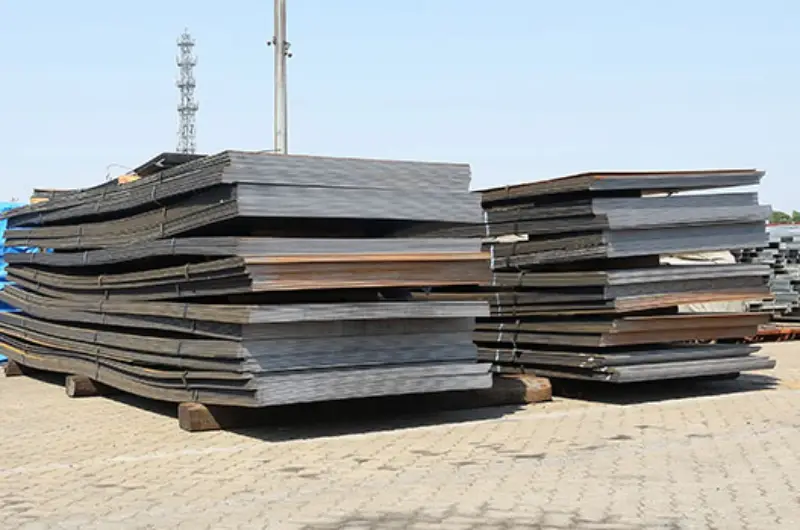
ASTM A131 Grade AH40 High-Strength Shipbuilding Steel Plate
ASTM A131 Grade AH40 High-Strength Shipbuilding Steel Plate: Properties, Equivalents & Applications
Comprehensive technical data for ASTM A131 Grade AH40 shipbuilding steel plate covering chemical composition, mechanical properties, physical characteristics, and international equivalents.
Welding, cutting, cold forming, hot forming, bending, drilling, shot blasting, and corrosion protection coating.
- Phone : +8618037372205
- Email : [email protected]
- WhatsApp: Contact via Whtsapp
- WeChat: +8618037372205
ASTM A131 Grade AH40 High-Strength Shipbuilding Steel Plate Introduction
ASTM A131 Grade AH40 is a high-strength structural steel plate predominantly used in the construction of ships and marine structures. As part of the ASTM A131/A131M standard specification for structural steel for ships, AH40 delivers a minimum yield strength of 390 MPa and provides excellent weldability, toughness, and formability suitable for critical shipbuilding applications. The AH40 designation indicates an "As-rolled/controlled" condition with impact testing at 0°C. This steel is typically supplied in normalized or thermo-mechanically controlled rolled condition and is used for hulls, decks, bulkheads, and other primary structural members in both commercial and naval vessels. It is valued for its high strength-to-weight ratio and reliable performance in low-temperature marine environments.
ASTM A131 Grade AH40 High-Strength Shipbuilding Steel Plate Chemical Composition
The chemical composition is in accordance with ASTM A131/A131M for Grade AH40. Fine-grain practice and controlled alloying elements are used to achieve required strength with excellent weldability and toughness. For ladle analysis, the maximum allowable levels for some elements may be higher than product analysis limits. Microalloying with Nb, V, Ti, and Al is typical for grain refinement.
| Element | Requirement (max, unless range given) | Remarks |
|---|---|---|
| Carbon (C) | 0.18% | Ladle analysis |
| Manganese (Mn) | 0.90 - 1.60% | Depending on thickness |
| Silicon (Si) | 0.10 - 0.50% | Typical range |
| Phosphorus (P) | 0.025% | |
| Sulfur (S) | 0.025% | |
| Aluminum (Al) | min. 0.015% total | For grain refining |
| Niobium (Nb) | 0.02 - 0.05% | When used alone or in combination |
| Vanadium (V) | 0.05 - 0.10% | When used alone or in combination |
| Titanium (Ti) | 0.007 - 0.05% | For grain refining |
| Copper (Cu) | 0.35% | If specified |
| Chromium (Cr) | 0.25% | If specified |
| Nickel (Ni) | 0.40% | If specified |
| Molybdenum (Mo) | 0.08% | If specified |
| Nitrogen (N) | 0.012% | For product analysis |
ASTM A131 Grade AH40 High-Strength Shipbuilding Steel Plate Physical and Thermal Properties
These properties are not specified in ASTM A131 but are typical for carbon-manganese high-strength structural steel at room temperature. They are provided for general engineering reference only. Actual values can vary slightly with composition and heat treatment.
| Property | Typical Value | Unit | Condition |
|---|---|---|---|
| Density (ρ) | 7.85 | g/cm³ | At 20°C |
| Elastic Modulus (E) | 205 - 210 | GPa | Ambient |
| Shear Modulus (G) | 79 - 81 | GPa | Ambient |
| Poisson's Ratio (ν) | 0.29 - 0.30 | — | |
| Coefficient of Thermal Expansion (α) | 11.7 × 10⁻⁶ / K | /K | 20 - 100°C; 12.5 ×10⁻⁶ at 20-200°C |
| Thermal Conductivity (λ) | 52 | W/(m·K) | At 20°C |
| Specific Heat Capacity | 460 - 500 | J/(kg·K) | At 20°C |
| Electrical Resistivity (ρ_e) | 0.15 - 0.25 | µΩ·m | At 20°C |
ASTM A131 Grade AH40 High-Strength Shipbuilding Steel Plate Mechanical Properties
Tensile and impact properties are per ASTM A131/A131M. Values vary with plate thickness. AH40 requires impact test at 0°C (32°F). The mechanical test specimens are taken transverse to rolling direction. Bending tests can be agreed upon between purchaser and manufacturer.
| Property | Required Value | Unit | Test Condition |
|---|---|---|---|
| Yield Strength (ReH) | ≥ 390 | MPa | Upper yield, for all thicknesses |
| Tensile Strength (Rm) | 510 - 650 | MPa | All thicknesses |
| Elongation (A) | ≥ 20% | % | Gauge length 200 mm, thickness ≤ 50 mm; for 50-70 mm: ≥ 19%; for 70-100 mm: ≥ 18% |
| Elongation (A) | ≥ 19% | % | Thickness > 50 mm and ≤ 70 mm |
| Elongation (A) | ≥ 18% | % | Thickness > 70 mm and ≤ 100 mm |
| Charpy Impact (KV2) at 0°C | ≥ 34 | J | Average of 3 specimens, transverse; min single value 24 J |
| Bend Test (D = bend diameter, a = thickness) | 180° bend, D = 3a | — | For thickness ≤ 25 mm; if agreed |
ASTM A131 Grade AH40 High-Strength Shipbuilding Steel Plate Exact Equivalent Material Standards and Replacement Grades
| Country / Region | Standard | Grade | Remark |
|---|---|---|---|
| International | ABS (American Bureau of Shipping) | AH40 | Identical requirements |
| International | BV (Bureau Veritas) | AH40 | Identical requirements |
| International | LR (Lloyd's Register) | AH40 | Identical requirements |
| International | DNV (Det Norske Veritas) | NV A40 | Equivalent; A40, same tensile/impact temperature |
| International | CCS (China Classification Society) | AH40 | Same chemical and mechanical requirements |
| International | KR (Korean Register) | AH40 | Equivalent |
| International | NK (Nippon Kaiji Kyokai) | KH40 | Equivalent; AH40 equivalent |
| International | RINA (Registro Italiano Navale) | AH40 | Equivalent |
| International | RS (Russian Maritime Register) | A40 | Equivalent; tensile 510-650 MPa, yield 390 MPa, 0°C impact |
| Europe | EN 10025-4 | S420G1+M | Close, but check C-Mn fine grain requirements |
| Japan | JIS G3106 | SM490YB (modified) | Impact temperature and tensile values similar |
ASTM A131 Grade AH40 High-Strength Shipbuilding Steel Plate Application Introduction
ASTM A131 Grade AH40 is designed for primary structural components in shipbuilding and offshore engineering where high strength and reliable notch toughness at 0°C are essential. The steel's weldability and formability allow it to be used in a wide range of fabricated structural elements. It is often supplied with inspection certificates from classification societies.
Product Applications: Hull shell plates, Deck plates and deck stiffeners, Bulkheads and longitudinal girders, Web frames and brackets, Keel and bottom plates, Superstructure components, Column and brace members for offshore platforms, Heavy load-bearing beams and profiles in marine structures
Processed into products: Plates cut, rolled, and welded into hull modules, Longitudinals and T-bar stiffeners fabricated from plate, Flanged brackets and connection plates, Penetration collars and doublers, Mast houses and staging platforms, Caisson components and mud mats for offshore rigs
Application industries: Shipbuilding (commercial ships, naval vessels), Offshore engineering (fixed platforms, jack-up rigs, FPSO modules), Port and harbor infrastructure (lock gates, dock walls), Heavy machinery (structures exposed to marine environments), Bridge construction (where require marine conditions approval)
ASTM A131 Grade AH40 High-Strength Shipbuilding Steel Plate Similar / Closely Related Substitute Materials
| Country / Region | Standard | Grade | Remark / Differences |
|---|---|---|---|
| USA | ASTM A131 | DH40 | Same strength, impact test at -20°C (better toughness) |
| USA | ASTM A131 | EH40 | Same strength, impact test at -40°C (superior low-temp toughness) |
| USA | ASTM A131 | FH40 | Same strength, impact test at -60°C (best low-temp toughness) |
| USA | ASTM A572 | Grade 65 (Type 3) | Similar yield (450 MPa) but not shipbuilding certified; may require agreement |
| Europe | EN 10025-4 | S420M/ML (S420M) | Thermo-mechanically rolled, yield 420 MPa, impact 0°C or -20°C, may substitute with approval |
| Europe | EN 10025-3 | S420N | Normalized, similar strength, but not specifically ship approved |
| Japan | JIS G3106 | SM490A / SM490B | Yield ≥ 325-365 MPa, lower than AH40; not a direct substitute |
| China | GB/T 712 | AH40 | Identical designation, same requirements |
Notes:
ASTM A131 Grade AH40 must be produced by an approved manufacturer and typically requires material certification to the satisfied classification society (ABS, BV, LR, etc.). When thickness exceeds 25 mm, normalizing or thermo-mechanical rolling is mandatory. Welding should follow approved procedures with low-hydrogen electrodes. Supplementary requirements (e.g., Z-grade through-thickness properties, CTOD testing) can be added by agreement. To avoid brittle fracture, hot forming must be followed by appropriate heat treatment.
- Share



