
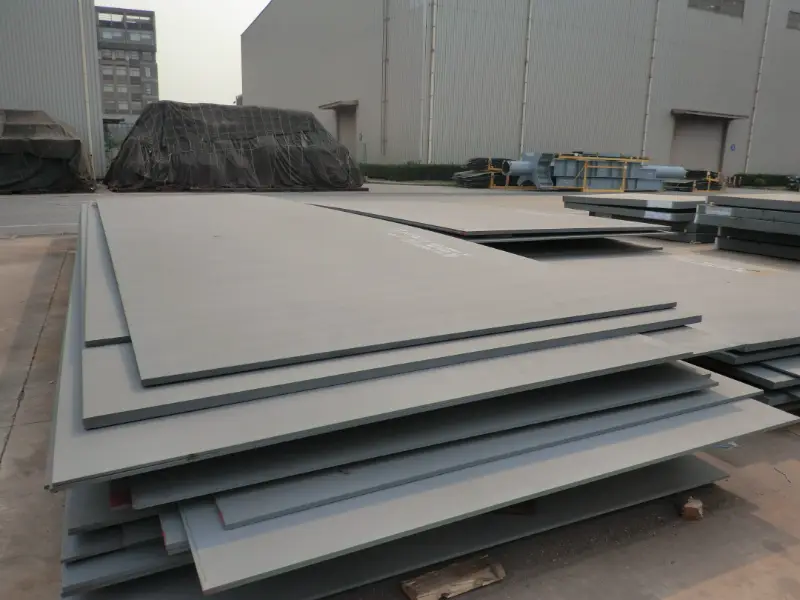
ASTM A131 Grade DH40 Shipbuilding Steel Plate
ASTM A131 Grade DH40 Shipbuilding Steel Plate: High-Strength, Low-Temperature Toughness for Marine Structures
Comprehensive technical data for ASTM A131 Grade DH40 steel plates: chemical composition, mechanical properties, physical properties, and international equivalents. Ideal for shipbuilding and offshore engineering applications requiring high strength and impact toughness at -20°C.
Hot rolling, normalizing, TMCP, welding, cutting, cold forming
- Phone : +8618037372205
- Email : [email protected]
- WhatsApp: Contact via Whtsapp
- WeChat: +8618037372205
ASTM A131 Grade DH40 Shipbuilding Steel Plate Introduction
ASTM A131 Grade DH40 is a high-strength hull structural steel with a minimum yield strength of 390 MPa (56 ksi) in thicknesses up to 50 mm. It is produced by normalized or thermo-mechanical controlled processing (TMCP) to ensure consistent mechanical properties and fine grain structure. The "D" designation indicates low-temperature impact testing at -20°C, making it suitable for ice-strengthened vessels and cold-climate marine operations. Excellent weldability, good toughness, and resistance to brittle fracture are key features. It is widely used in ship hulls, decks, bulkheads, and offshore platforms. The steel meets the requirements of ASTM A131/A131M and is recognized by all major classification societies.
ASTM A131 Grade DH40 Shipbuilding Steel Plate Chemical Composition
Chemical composition limits according to ASTM A131/A131M. Elements are controlled to achieve desired strength and toughness. Carbon equivalent (CEV) is typically limited to ensure good weldability. Trace elements (Nb, V, Ti) are used for grain refinement and precipitation strengthening. Maximum values are given unless a range is specified.
| Element | Standard Value (max. unless range) | Remarks |
|---|---|---|
| Carbon (C) | 0.18 | Maximum |
| Manganese (Mn) | 0.90 - 1.60 | Range; higher Mn improves strength and toughness |
| Silicon (Si) | 0.50 | Maximum; deoxidizer |
| Phosphorus (P) | 0.035 | Maximum; ensures ductility |
| Sulfur (S) | 0.035 | Maximum; improves machinability but not critical |
| Aluminum (Al, acid-soluble) | 0.015 min | Minimum for grain refinement; total Al≥0.020 also accepted |
| Niobium (Nb) | 0.05 | Maximum; microalloying for strength |
| Vanadium (V) | 0.10 | Maximum; microalloying element |
| Titanium (Ti) | 0.02 | Maximum; grain refinement |
| Copper (Cu) | 0.35 | Maximum; residual element |
| Chromium (Cr) | 0.20 | Maximum; may be present |
| Nickel (Ni) | 0.40 | Maximum; residual/bridge element |
| Molybdenum (Mo) | 0.08 | Maximum; optional alloying |
| Carbon Equivalent (CEV) | ≤0.40 (typical) | Based on thickness and product specification; CEV = C+Mn/6+(Cr+Mo+V)/5+(Ni+Cu)/15 |
ASTM A131 Grade DH40 Shipbuilding Steel Plate Thermal and Electrical Physical Properties
Physical properties are not part of the ASTM A131 specification but are provided as typical reference data for structural steel of this strength class. These values are useful for design calculations such as welding preheat, insulation, and weight estimation. Values are at room temperature unless otherwise noted. Thermal expansion and conductivity vary with temperature.
| Property | Standard Value | Unit | Test Condition / Remarks |
|---|---|---|---|
| Density (ρ) | 7.85 | g/cm³ | At 20°C |
| Poisson's ratio (ν) | 0.30 | - | In elastic range |
| Elastic modulus (E) | 200 - 210 | GPa | At 20°C |
| Shear modulus (G) | approx. 80 | GPa | Calculated from E and ν |
| Thermal expansion coefficient (α) | 12.0 | 10⁻⁶/K | Average for 20–100°C |
| Thermal expansion coefficient (α) | 12.5 | 10⁻⁶/K | Average for 20–200°C |
| Thermal expansion coefficient (α) | 13.0 | 10⁻⁶/K | Average for 20–300°C |
| Thermal conductivity (λ) | 50 | W/(m·K) | At 20°C |
| Thermal conductivity (λ) | 45 | W/(m·K) | At 200°C |
| Thermal conductivity (λ) | 38 | W/(m·K) | At 400°C |
| Specific heat capacity (cp) | 460 | J/(kg·K) | At 20°C |
| Specific heat capacity (cp) | 500 | J/(kg·K) | At 200°C |
| Specific heat capacity (cp) | 600 | J/(kg·K) | At 400°C |
| Electrical resistivity (ρ_e) | 0.18 | µΩ·m | At 20°C, typical for carbon-manganese steel |
ASTM A131 Grade DH40 Shipbuilding Steel Plate Mechanical Properties
Mechanical properties are determined on normalized or TMCP plates in the transverse or longitudinal direction. Impact testing at -20°C is mandatory for grade DH40. Values are valid for thickness ranges as indicated. Yield strength and tensile strength decrease slightly with increasing thickness. All specimens are prepared according to ASTM A370.
| Property | Standard Requirement | Unit | Test Condition / Remarks |
|---|---|---|---|
| Yield Strength (ReH) | 390 | MPa | Thickness ≤ 50 mm |
| Yield Strength (ReH) | 370 | MPa | Thickness 50-70 mm |
| Yield Strength (ReH) | 360 | MPa | Thickness 70-100 mm |
| Yield Strength (ReH) | 350 | MPa | Thickness 100-150 mm |
| Tensile Strength (Rm) | 510 - 650 | MPa | Thickness ≤ 100 mm |
| Tensile Strength (Rm) | 490 - 650 | MPa | Thickness 100-150 mm |
| Elongation (A) | 20 | % | Gauge length 50 mm, thickness ≤ 50 mm, longitudinal |
| Elongation (A) | 19 | % | Gauge length 50 mm, thickness 50-150 mm, longitudinal |
| Charpy Impact (KV₂) | 34 (average) / 27 (single) | J | At -20°C, longitudinal, thickness ≤ 50 mm |
| Charpy Impact (KV₂) | 34 (average) / 27 (single) | J | At -20°C, longitudinal, thickness 50-70 mm |
| Charpy Impact (KV₂) | 34 (average) / 27 (single) | J | At -20°C, longitudinal, thickness 70-100 mm |
| Charpy Impact (KV₂) | 27 (average) / 20 (single) | J | At -20°C, longitudinal, thickness 100-150 mm (if applicable); consult standard |
| Bend Test (180°) | No flaws | - | Diameter = 3 × thickness for t ≤ 50 mm; test at room temperature |
ASTM A131 Grade DH40 Shipbuilding Steel Plate Identical Material Standards and Replaceable Grades
| Country/Region | Standard | Grade | Remarks |
|---|---|---|---|
| International | ASTM A131/A131M | DH40 | Original specification |
| American Bureau of Shipping | ABS Rules | DH40 | Direct equivalent |
| DNV (Norway/Germany) | DNV Rules | NV D40 | Direct equivalent |
| Lloyd's Register (UK) | LR Rules | DH40 | Direct equivalent |
| Bureau Veritas (France) | BV Rules | D40 | Direct equivalent |
| China Classification Society | CCS Rules | D40 | Direct equivalent |
| Korean Register | KR Rules | D40 | Direct equivalent |
| Class NK (Japan) | NK Rules | D40 | Direct equivalent |
| RINA (Italy) | RINA Rules | D40 | Direct equivalent |
| EN 10025-4 | EN 10025-4:2019 | S420ML | Very close match; M=TMCP, L=low temperature toughness (-50°C); verify impact temperature |
ASTM A131 Grade DH40 Shipbuilding Steel Plate Application Introduction
ASTM A131 DH40 steel is engineered for marine environments where a combination of high strength, excellent weldability, and low-temperature toughness is essential. Typical applications include:
Product Applications: Primary structural frames of large ships (longitudinals, girders), Hull plates and shell strakes, Weather decks and bottom structures, Bulkhead panels, Ice-breaking belt plates (ice-strengthened), Floating production storage and offloading (FPSO) units, Jack-up rig legs and spudcans, Heavy-lift crane booms and structures
Processed into products: Welded beams and stiffeners, Hatch coamings and covers, Brackets and web frames, Skegs and rudder horns, Stern frames, Transverse bulkhead panels, Collision bulkheads, Deck machinery foundations, Mooring winch supports, Hydro-cyclone supports, Pipe supports and process skids
Application industries: Commercial and naval shipbuilding, Offshore oil and gas platforms (jackets, decks, topsides), Arctic and ice-class vessels, Marine containers and LNG carriers, Heavy equipment for port and harbor construction, Renewable energy offshore structures (wind turbine towers, substructures)
ASTM A131 Grade DH40 Shipbuilding Steel Plate Similar/Alternative Materials Recommendation
| Country/Region | Standard | Grade | Remarks |
|---|---|---|---|
| International | ASTM A131/A131M | EH40 | Higher toughness: impact test at -40°C; similar strength; suitable for colder service |
| International | ASTM A131/A131M | FH40 | Impact test at -60°C; for arctic applications |
| Europe | EN 10025-4 | S420ML | Thermo-mechanically rolled; impact at -50°C; yield 420 MPa; close alternative |
| Europe | EN 10025-3 | S420N | Normalized; impact at -20°C; similar strength but different delivery condition |
| China | GB 712 | D40 | High-strength shipbuilding steel; equivalent to DH40, impact at -20°C |
| Russia | GOST R 52927 | D40 | Shipbuilding steel similar in strength and toughness |
Notes:
Welding: Preheating may be required depending on plate thickness and carbon equivalent (typically 0.40% max). Common arc welding processes (SMAW, SAW, GMAW, FCAW) are suitable. Consumables should match the yield strength level.
Cold forming: Good formability in normalized condition; TMCP plates may require larger bend radii. Hot forming above 600°C may alter properties and retesting is advised.
Ultrasonic testing: Plates are often supplied with UT to ASTM A578 or A435 standards, as per buyer's requirement.
Certification: The steel is usually accompanied by a 3.1 or 3.2 certificate per EN 10204 or mill test reports.
- Share



