
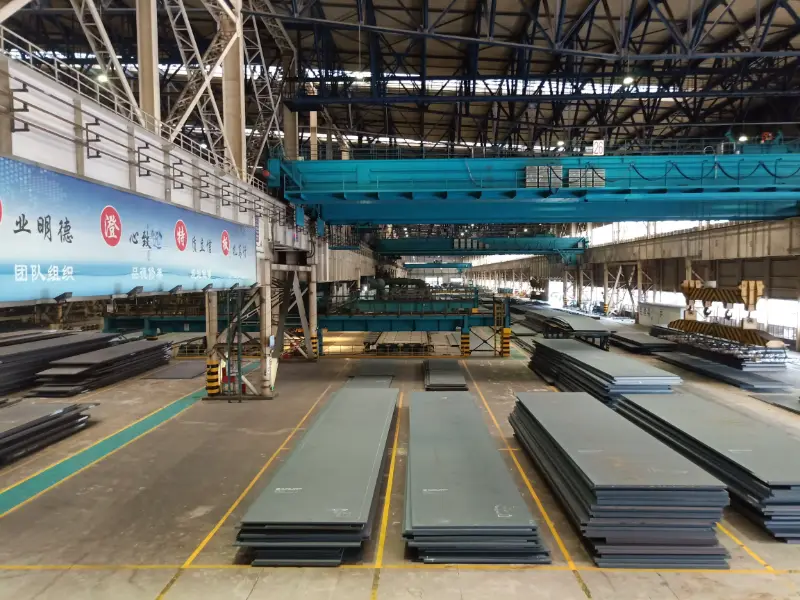
ASTM A131 Grade EH40 Shipbuilding Steel
ASTM A131 Grade EH40 Shipbuilding Steel: High Strength & Low-Temperature Toughness for Marine Engineering
Explore ASTM A131 Grade EH40 shipbuilding steel plate with comprehensive chemical composition, mechanical and physical properties, international equivalents, and application guidance for ship hulls and offshore structures.
Hot rolling, normalizing, thermo-mechanical control process (TMCP), welding, cutting, forming.
- Phone : +8618037372205
- Email : [email protected]
- WhatsApp: Contact via Whtsapp
- WeChat: +8618037372205
ASTM A131 Grade EH40 Shipbuilding Steel Introduction
ASTM A131 Grade EH40 is a high-strength, normalized or thermo-mechanically controlled processed (TMCP) shipbuilding steel plate under specification ASTM A131/A131M. This grade belongs to the Higher Strength Hull Structural Steel category, with minimum yield strength of 390 MPa (40 ksi). The 'E' designation indicates it is certified for impact toughness at -40°C, ensuring reliable performance in cold marine environments. It offers an excellent combination of strength, weldability, and low-temperature notch toughness, making it a preferred material for critical structural components in modern shipbuilding and offshore engineering. Typical thicknesses range from 6 mm to 100 mm. The steel is produced with fine grain practice and often microalloyed with Nb, V, or Ti to meet mechanical requirements.
ASTM A131 Grade EH40 Shipbuilding Steel Chemical Composition per ASTM A131/A131M-19
The following chemical requirements apply to Grade EH40. The steel is fully killed and made to fine grain practice. Elements like Nb, V, Ti, and Al are added to refine grain size and improve toughness. Carbon equivalent (CEV) may be calculated to ensure good weldability. The sum of Cr, Ni, Mo, and Cu shall not exceed 0.80%.
| Element | Composition (max, unless range) | Remarks |
|---|---|---|
| Carbon (C) | 0.18 | |
| Manganese (Mn) | 0.90 - 1.60 | |
| Silicon (Si) | 0.10 - 0.50 | |
| Phosphorus (P) | 0.025 | |
| Sulfur (S) | 0.025 | |
| Aluminum (Al) acid soluble | 0.015 min | Required for fine grain practice |
| Niobium (Nb) | 0.05 | Microalloying element, when used |
| Vanadium (V) | 0.10 | Microalloying element, when used |
| Titanium (Ti) | 0.02 | Microalloying element, when used |
| Copper (Cu) | 0.35 | |
| Chromium (Cr) | 0.20 | |
| Nickel (Ni) | 0.40 | |
| Molybdenum (Mo) | 0.08 | |
| Nitrogen (N) | 0.009 | Applicable when nitrogen-binding elements are added |
ASTM A131 Grade EH40 Shipbuilding Steel Thermal and Electrical Physical Properties
Physical properties are typical for normalized high-strength low-alloy steel and are not part of the ASTM A131 specification. These values are provided for general engineering reference. Variations may occur depending on exact composition and processing route. All data at room temperature unless otherwise noted.
| Property | Typical Value | Unit | Test Condition |
|---|---|---|---|
| Density (ρ) | 7.85 | g/cm³ | 20°C |
| Modulus of Elasticity (E) | 205 | GPa | 20°C |
| Shear Modulus (G) | 80 | GPa | 20°C (calculated) |
| Poisson's Ratio (ν) | 0.3 | 20°C | |
| Thermal Expansion Coefficient (α) | 11.5 × 10⁻⁶ | 1/K | 20 - 200°C |
| Thermal Expansion Coefficient (α) | 12.2 × 10⁻⁶ | 1/K | 20 - 400°C |
| Thermal Conductivity (λ) | 45 | W/(m·K) | 20°C |
| Specific Heat Capacity (cp) | 460 | J/(kg·K) | 20°C |
| Electrical Resistivity (ρe) | 0.20 × 10⁻⁶ | Ω·m | 20°C |
ASTM A131 Grade EH40 Shipbuilding Steel Mechanical Properties per ASTM A131/A131M-19
Mechanical properties are determined from transverse test pieces, unless otherwise specified. Yield strength and tensile strength apply for plate thicknesses up to 50 mm; for thicker sections, lower strength values may apply as per the standard. The bend test requires no cracks on the outside of the bent portion. Impact tests are performed on Charpy V-notch specimens, longitudinal orientation, with energy absorption requirements at -40°C (E grade).
| Property | Requirement | Unit | Test Condition / Thickness |
|---|---|---|---|
| Yield Strength (ReH) | 390 min | MPa | t ≤ 50 mm |
| Yield Strength (ReH) | 370 min | MPa | 50 < t ≤ 70 mm |
| Tensile Strength (Rm) | 510 - 650 | MPa | t ≤ 100 mm |
| Elongation (A) | 19 min | % | Gauge length 200 mm, t ≤ 50 mm |
| Elongation (A) | 18 min | % | Gauge length 200 mm, t > 50 mm |
| Bend Test (180°) | d = 3a | t ≤ 25 mm | |
| Bend Test (180°) | d = 4a | t > 25 mm | |
| Charpy Impact (KV, -40°C) | 27 min (average) | J | Longitudinal, t ≤ 50 mm |
| Charpy Impact (KV, -40°C) | 27 min (average) | J | Longitudinal, t > 50 mm (as agreed) |
ASTM A131 Grade EH40 Shipbuilding Steel Fully Equivalent Material Standards and Direct Substitute Grades
The following international ship classification society grades are considered identical to ASTM A131 Grade EH40, with minor variations in certification procedures. They are produced under their own rules but meet equivalent mechanical and impact test requirements.
| Country / Society | Standard / Rules | Grade | Remarks |
|---|---|---|---|
| American Bureau of Shipping | ABS Rules | EH40 | Identical requirements |
| DNV (Norway/Germany) | DNV Rules | EH40 | Identical requirements |
| Lloyd's Register (UK) | LR Rules | EH40 | Identical requirements |
| Bureau Veritas (France) | BV Rules | EH40 | Identical requirements |
| Nippon Kaiji Kyokai (Japan) | NK Rules | EH40 | Identical requirements |
| Registro Italiano Navale | RINA Rules | EH40 | Identical requirements |
| China Classification Society | CCS Rules | EH40 | Identical requirements |
| Korean Register | KR Rules | EH40 | Identical requirements |
ASTM A131 Grade EH40 Shipbuilding Steel Application Introduction
ASTM A131 Grade EH40 is extensively used in shipbuilding and marine engineering due to its superior combination of strength and low-temperature notch toughness. It is suitable for critical structural components subjected to high stress and Arctic or cold-water service conditions. The steel is readily weldable using common shipbuilding procedures, provided low-hydrogen practices and proper preheating are followed. Typical products include steel plates for hulls, decks, bulkheads, and stiffeners. It can be formed, cut, and machined to fabricate a wide range of parts. When specifying, attention should be paid to thickness-dependent property variations and supplementary testing (e.g., through-thickness properties) if needed.
Product Applications: Ship hull plates (side shells, bottom plates, deck plates), Bulkhead and watertight door panels, Offshore platform structural beams, columns, and braces, Marine crane booms and heavy lift structures, Ice-strengthened ship structures
Processed into products: Longitudinal and transverse stiffeners, Keel and stem plates, Deck stringers and hatch coamings, Rudder and propeller brackets, Brackets, flanges, and gusset plates, Bilge keels and skegs
Application industries: Shipbuilding and repair, Offshore oil & gas platforms, Marine engineering and port construction, Heavy structural fabrication (bridges, pressure vessels), Renewable energy (offshore wind turbine foundations)
ASTM A131 Grade EH40 Shipbuilding Steel Similar / Closely Related Substitute Materials
These materials offer similar mechanical properties or low-temperature toughness but may differ in certification, alloy design, or intended application. They are not direct substitutes for ASTM A131 EH40 unless recertified.
| Country / Standard | Standard | Grade | Remarks |
|---|---|---|---|
| ASTM A131 | ASTM A131 | EH36 | Lower strength (min YS 355 MPa), but similar low-temp toughness; may be used where strength requirement is reduced. |
| ASTM A131 | ASTM A131 | EH47 | Higher strength (min YS 460 MPa), higher alloy content; suitable for heavy-duty marine structures. |
| EN 10025-4 | EN 10025-4 | S420ML | Thermo-mechanically rolled weldable fine grain structural steel, low-temperature toughness guaranteed at -50°C; not specifically for shipbuilding but often used in offshore. |
| EN 10025-6 | EN 10025-6 | S460QL | Quenched and tempered structural steel with high strength; not ship classification society certified in standard delivery. |
Notes:
- Thickness effect: For plates thicker than 50 mm, yield strength and elongation may be reduced; consult the standard or mill certificate.
- Weldability: Carbon equivalent (CEV) is usually controlled to a maximum of 0.38-0.43% to avoid cold cracking. Preheat and interpass temperatures should be defined by the welding procedure specification.
- Supplementary requirements: Through-thickness tensile testing, ultrasonic testing, and vacuum treatment may be specified under ASTM A131 supplementary requirements S1, S2, etc.
- Surface condition: Plates are usually delivered with mill finish; shot blasting and primer coating are common in shipyard practice.
- Certification: Mill test certificates are issued according to EN 10204 Type 3.1 or equivalent, endorsed by the inspecting classification society when required.
- Share



