
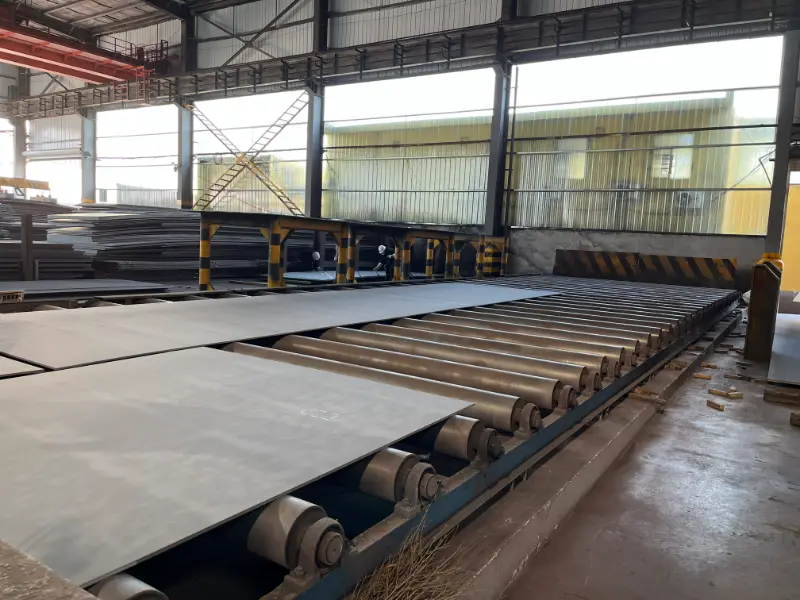
ASTM A131 Grade DH36 Shipbuilding Steel Plate
ASTM A131 Grade DH36 Shipbuilding Steel Plate: High-Strength Hull Structural Steel for Arctic and Open-Water Vessels
Comprehensive data sheet of ASTM A131 Grade DH36, a normalized high-strength shipbuilding steel with superior low-temperature toughness, used for hull structures, decks, and offshore constructions.
Cutting, forming, welding, machining, bending, and rolling
- Phone : +8618037372205
- Email : [email protected]
- WhatsApp: Contact via Whtsapp
- WeChat: +8618037372205
ASTM A131 Grade DH36 Shipbuilding Steel Plate Introduction
ASTM A131 Grade DH36 is a high-strength, low-alloy structural steel specifically designed for shipbuilding and marine applications. It belongs to the higher-strength hull structural steel category defined in ASTM A131/A131M. The designation 'DH' indicates a guaranteed minimum impact energy of 34 J at -20°C, making it suitable for service in cold environments. With a minimum yield strength of 355 MPa and excellent weldability, DH36 is widely used in the construction of hulls, decks, bulkheads, and offshore platforms. It offers a balanced combination of strength, ductility, and toughness, ensuring structural integrity under dynamic loads and harsh marine conditions. The steel is typically supplied in normalized condition or controlled-rolled and is approved by major classification societies.
ASTM A131 Grade DH36 Shipbuilding Steel Plate Chemical Composition
The chemical composition conforms to ASTM A131/A131M Grade DH36. Alloying elements contribute to strength and low-temperature toughness. Grain-refining elements such as niobium, vanadium, or aluminum are typically added. The carbon equivalent (CE) is controlled to ensure good weldability, usually CE ≤ 0.38%.
| Element | Standard Value | Remarks |
|---|---|---|
| Carbon (C) | ≤ 0.18 | Maximum |
| Manganese (Mn) | 0.90 ~ 1.60 | Depending on thickness |
| Silicon (Si) | 0.10 ~ 0.50 | |
| Phosphorus (P) | ≤ 0.035 | |
| Sulfur (S) | ≤ 0.035 | |
| Aluminum (Al, acid-soluble) | ≥ 0.015 | When used as grain-refining element |
| Niobium (Nb) | 0.02 ~ 0.05 | Optional; may be added for refining |
| Vanadium (V) | 0.05 ~ 0.10 | Optional |
| Titanium (Ti) | ≤ 0.02 | Optional |
| Nitrogen (N) | ≤ 0.012 | When using Ti to refine |
| Copper (Cu) | ≤ 0.35 | Residual |
| Chromium (Cr) | ≤ 0.20 | Residual |
| Nickel (Ni) | ≤ 0.40 | Residual |
| Molybdenum (Mo) | ≤ 0.08 | Residual |
| Carbon Equivalent (CE) | ≤ 0.38 | CE = C + Mn/6 + (Cr+Mo+V)/5 + (Ni+Cu)/15 |
ASTM A131 Grade DH36 Shipbuilding Steel Plate Physical Properties
Physical properties are based on typical data for low-carbon high-strength structural steel. Values may vary slightly depending on exact composition and heat treatment. These properties are essential for design calculations involving thermal loading and heat transfer.
| Property | Typical Value | Unit | Test Condition |
|---|---|---|---|
| Density (ρ) | 7.85 | g/cm³ | Room temperature |
| Elastic Modulus (E) | 200 | GPa | Room temperature |
| Shear Modulus (G) | 80 | GPa | Calculated from E and Poisson's ratio |
| Poisson's Ratio (ν) | 0.3 | Elastic range | |
| Coefficient of Thermal Expansion (α) | 11.5 | 10−⁹ /K | 20 °C to 100 °C |
| Coefficient of Thermal Expansion (α) | 12.5 | 10−⁹ /K | 20 °C to 200 °C |
| Coefficient of Thermal Expansion (α) | 13.5 | 10−⁹ /K | 20 °C to 400 °C |
| Thermal Conductivity (λ) | 51 | W/(m·K) | At 100 °C |
| Thermal Conductivity (λ) | 42 | W/(m·K) | At 300 °C |
| Specific Heat Capacity (c) | 460 | J/(kg·K) | Room temperature |
| Electrical Resistivity (ρe) | 0.15 | μΩ·m | Room temperature |
ASTM A131 Grade DH36 Shipbuilding Steel Plate Mechanical Properties
Mechanical tests are carried out in accordance with ASTM A131/A131M. Tensile and impact specimens are taken in the transverse direction unless otherwise agreed. Charpy V-notch impact values apply to full-size (10×10 mm) specimens. For sub-sized specimens, adjusted minimum energies per the standard apply.
| Property | Standard Requirement | Unit | Test Condition |
|---|---|---|---|
| Yield Strength (ReH) | ≥ 355 | MPa | For thickness ≤ 100 mm; thicker plates may be slightly lower |
| Tensile Strength (Rm) | 490 ~ 620 | MPa | For all thicknesses |
| Elongation (A) | ≥ 21 | % | Gauge length 200 mm (8 in), transverse, thickness ≤ 50 mm |
| Elongation (A) | ≥ 24 | % | Gauge length 50 mm (2 in), transverse, thickness ≤ 50 mm |
| Charpy Impact Energy (KV2) | ≥ 34 (longitudinal) | J | At -20 °C, full-size specimen |
| Charpy Impact Energy (KV2) | ≥ 24 (transverse) | J | At -20 °C, full-size specimen |
| Bend Test (Bend Diameter) | 3t | 180° bend over pin of diameter 3 times plate thickness (t), no cracks |
ASTM A131 Grade DH36 Shipbuilding Steel Plate Fully Equivalent Standards and Grades for Direct Replacement
| Country / Region | Standard | Grade | Remarks |
|---|---|---|---|
| International | Classification Societies | DH36 | ABS, LR, DNV, BV, CCS, NK, RINA, etc. (as per respective rules) |
| China | GB/T 712 | DH36 | Identical in chemical and mechanical requirements |
| Japan | JIS G 3106 | SM490YA | Close match; verify impact temperature and CE requirements |
| Europe | EN 10025-2 | S355J2+N | Comparable strength and toughness; additional marine approval may be required |
| Europe | EN 10225 | S355G10+N | Weldable structural steel for offshore structures; matches DH36 properties |
| USA | ASTM A131/A131M | Grade DH36 | Original standard |
| Korea | KS D 3515 | SM490YA | Similar to JIS; confirm DH36 specification |
ASTM A131 Grade DH36 Shipbuilding Steel Plate Application Introduction
ASTM A131 DH36 is predominantly used in the maritime and offshore sectors. Its excellent combination of strength and toughness at sub-zero temperatures makes it indispensable for hull structures, superstructures, and critical components subjected to dynamic and impact loads. It is supplied in plate form and is easily fabricated using standard welding and cutting methods.
Product Applications: Hull shells and decks of container ships, tankers, bulk carriers, and passenger vessels, Structural members of FPSOs (Floating Production Storage and Offloading units), Semi-submersible drilling rigs, Jack-up rig legs and spudcans, Ice-strengthened vessel hulls and icebreaker ships, Sea-crossing bridge components (when approved)
Processed into products: Ship frames, stiffeners, and girders, Bulkhead plates and bracket plates, Rudder horn and rudder plates, Engine foundation plates, Bilge keels, Hawse pipe reinforcements, Crane pedestals on offshore structures, Padeyes, pin plates, and lifting lugs for heavy marine lifting
Application industries: Shipbuilding and ship repair, Offshore oil and gas platforms, Marine engineering, Arctic and ice-class vessel construction, Port and harbor machinery, Bridge construction (subject to project specification)
ASTM A131 Grade DH36 Shipbuilding Steel Plate Closely Similar Materials and Near Equivalents
| Country / Region | Standard | Grade | Remarks |
|---|---|---|---|
| USA | ASTM A131 | AH36 | Same strength, higher impact test temperature (0 °C) - suitable for less cold conditions |
| USA | ASTM A131 | EH36 | Same strength, lower impact test temperature (-40 °C) - for extreme cold service |
| USA | ASTM A131 | FH36 | Same strength, impact at -60 °C; ultra-low temperature ductility |
| Europe | EN 10025-3 | S355NL | Fine-grain normalized steel with similar strength and low-temperature toughness |
| Europe | EN 10025-4 | S355ML | Thermomechanically rolled, good low-temperature toughness |
| Japan | JIS G 3106 | SM490B | Similar strength, but verify impact test temperature (0 °C typically) |
| International | IACS UR W | High-Strength DH36 | Unified requirement for shipbuilding; fully equivalent for classification |
Notes:
- All mechanical properties are based on standard transverse specimens unless otherwise stated. For thickness above 100 mm (4 in), supplementary requirements apply.
- The steel is capable of being welded by all common welding processes, but pre-heating may be required for thick sections.
- Ultrasonic testing (UT) can be ordered per ASTM A578/A578M or classification society standards.
- Surface condition: shot-blasted and shop-primed with welding-compatible primer if agreed.
- All data are based on ASTM A131/A131M-19 edition. Verify with the latest revision for project-specific requirements.
- Share



