
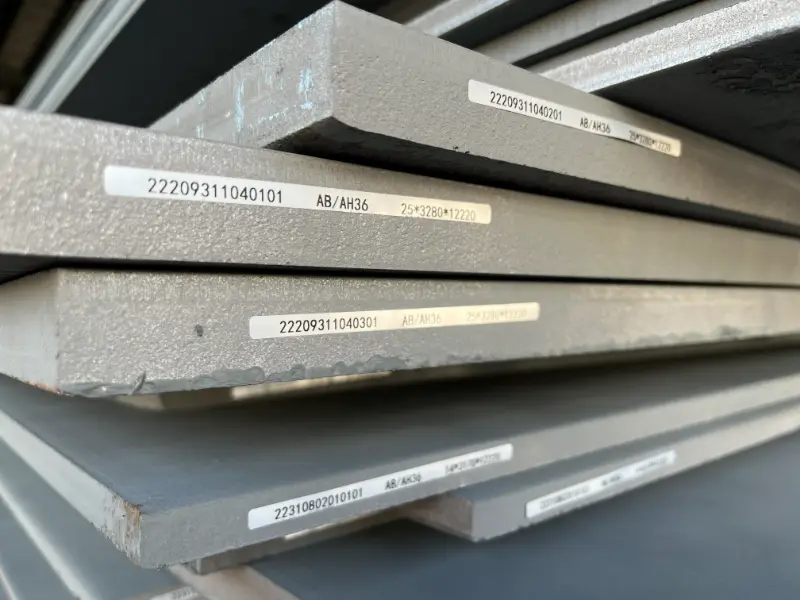
ASTM A131 Grade AH36 Shipbuilding Steel Plate
ASTM A131 Grade AH36 Shipbuilding Steel Plate: High-Strength Structural Steel for Marine Applications
Complete technical data for ASTM A131 Grade AH36 steel including chemical composition, mechanical properties, thermal properties, cross-reference equivalents, and application guidance.
Hot rolling, controlled rolling (TMCP), normalizing, quenching and tempering (as specified). Suitable for welding, cold forming, and machining.
- Phone : +8618037372205
- Email : [email protected]
- WhatsApp: Contact via Whtsapp
- WeChat: +8618037372205
ASTM A131 Grade AH36 Shipbuilding Steel Plate Introduction
ASTM A131 Grade AH36 is a high-strength structural steel plate primarily used in the construction of ships and marine vessels. It is defined by the ASTM A131/A131M standard, with a minimum yield strength of 355 MPa (51 ksi) and excellent toughness at low temperatures. This grade is designed for critical structural components such as hulls, decks, and bulkheads, offering good weldability and formability. Key features include controlled rolling or normalized delivery condition and Charpy V-notch impact testing at 0 °C to ensure reliability in harsh marine environments. Typical delivery condition: as-rolled, controlled rolled (TMCP), normalized, or normalized rolled.
International equivalents: ABS AH36, DNV NV A36, LR AH36, BV AH36, CCS AH36, NK AH36, KR AH36, RINA AH36, GL-A36.
ASTM A131 Grade AH36 Shipbuilding Steel Plate Chemical Composition
The chemical composition of AH36 steel shall conform to the ladle analysis limits specified in ASTM A131/A131M. The steel is usually aluminum-killed and may contain grain-refining elements such as niobium, vanadium, or titanium. Elements shown below are the maximum limits unless a range is given. Values are for product analysis unless otherwise indicated.
| Element | Standard Value (max %) | Remarks |
|---|---|---|
| Carbon (C) | 0.18 | Ladle analysis |
| Manganese (Mn) | 0.90–1.60 | For thickness ≤ 100 mm; for thicker products, Mn may be increased by agreement. |
| Phosphorus (P) | 0.035 | |
| Sulfur (S) | 0.035 | |
| Silicon (Si) | 0.10–0.50 | If aluminum is used as a grain refiner, Si may be as low as 0.10%. |
| Aluminum (Al) | ≥ 0.015 (total) | Acid-soluble or total, as agreed. Typically used for grain refining. |
| Niobium (Nb) | 0.02–0.05 | Optional grain refiner; may be present alone or in combination with V or Ti. |
| Vanadium (V) | 0.05–0.10 | Optional grain refiner. |
| Titanium (Ti) | 0.007–0.05 | May be added for grain refinement; maximum limit may be higher. |
| Nitrogen (N) | 0.012 (max) | Not generally specified, but if present, limit may apply. |
ASTM A131 Grade AH36 Shipbuilding Steel Plate Thermal and Electrical Physical Properties
The following physical properties are typical for carbon-manganese structural steels and are provided for design reference. They are not mandatory requirements of ASTM A131. Values are valid at room temperature unless otherwise noted. These data are representative for general engineering calculations.
| Property | Typical Value | Unit | Temperature / Conditions |
|---|---|---|---|
| Density (ρ) | 7850 | kg/m³ | At 20°C |
| Modulus of Elasticity (E) | 205 | GPa | At 20°C |
| Shear Modulus (G) | 80 | GPa | Calculated from E and ν |
| Poisson's Ratio (ν) | 0.3 | — | At 20°C |
| Thermal Expansion Coefficient (α) | 11.7 × 10⁻⁶ | 1/K | 20–100 °C |
| Thermal Expansion Coefficient (α) | 12.5 × 10⁻⁶ | 1/K | 20–200 °C |
| Thermal Expansion Coefficient (α) | 13.6 × 10⁻⁶ | 1/K | 20–300 °C |
| Thermal Conductivity (λ) | 52 | W/(m·K) | At 20°C |
| Specific Heat Capacity (c) | 460 | J/(kg·K) | At 20°C |
| Electrical Resistivity (ρ_e) | 0.15 | µΩ·m | At 20°C |
ASTM A131 Grade AH36 Shipbuilding Steel Plate Mechanical Properties
The mechanical properties of ASTM A131 Grade AH36 are determined by tensile and impact testing according to ASTM A370. The values below are minimum requirements for plates in the as-rolled or normalized condition. Yield strength and tensile strength apply to transverse specimens. Elongation is measured on a 200 mm gauge length for thickness ≥ 3 mm. Charpy tests are performed at 0 °C for AH36 designation.
| Property | Required Value | Unit | Test Condition / Remarks |
|---|---|---|---|
| Yield Strength (ReH) | ≥ 355 | MPa | Transverse test specimens; applies to all thicknesses. |
| Tensile Strength (Rm) | 490–620 | MPa | Transverse test specimens. |
| Elongation (A) | ≥ 21 | % | Gauge length = 200 mm; for thickness > 3 mm ≤ 50 mm. |
| Elongation (A) | ≥ 20 | % | Gauge length = 200 mm; for thickness > 50 mm ≤ 70 mm. |
| Elongation (A) | ≥ 19 | % | Gauge length = 200 mm; for thickness > 70 mm ≤ 100 mm. |
| Charpy V-Notch Impact (KV, longitudinal) | ≥ 34 (average of 3 tests, minimum single 24) | J | At 0 °C; standard size 10×10 mm specimen. |
| Charpy V-Notch Impact (KV, transverse) | ≥ 24 (average of 3 tests, minimum single 17) | J | At 0 °C; when specified. |
| Bend Test | D = 3a (for thickness ≤ 25 mm); D = 4a (thickness > 25 to 50 mm) | — | 180° bend; d = bend diameter, a = specimen thickness. No cracks. |
ASTM A131 Grade AH36 Shipbuilding Steel Plate Fully Equivalent Materials: Classification Society Acceptances
| Country / Region | Standard | Grade | Remarks |
|---|---|---|---|
| International | ABS Rules | AH36 | American Bureau of Shipping – identical mechanical and impact requirements. |
| International | DNV GL Rules | NV A36 | DNV (formerly DNV GL) equivalent; also accepted as GL-A36. |
| International | LR Rules | AH36 | Lloyd's Register equivalent. |
| International | BV Rules | AH36 | Bureau Veritas equivalent. |
| International | CCS Rules | AH36 | China Classification Society equivalent. |
| International | NK Rules | AH36 | Nippon Kaiji Kyokai equivalent. |
| International | KR Rules | AH36 | Korean Register equivalent. |
| International | RINA Rules | AH36 | Registro Italiano Navale equivalent. |
ASTM A131 Grade AH36 Shipbuilding Steel Plate Application Introduction
ASTM A131 Grade AH36 is engineered for high-stress structural applications in marine environments. Its combination of strength, toughness, and weldability makes it the material of choice for primary ship hull components and offshore structures. The steel can be formed, cut, and welded using standard shipyard practices. Consider supplementary specifications for through-thickness properties (Z-quality) or ultrasonic testing when used in highly restrained joints.
Product Applications: Hull plates, Deck plates, Bulkhead panels, Stiffeners, Girders, Offshore platform decks and legs, Wind turbine tower flanges (offshore)
Processed into products: Ship frames and longitudinals, Shell plates (side and bottom), Watertight bulkheads, Hatch covers and coamings, Bitts, chocks, and fairleads, Offshore module support structures, Brackets, web frames, and floors, Rudder horn castings (when fabricated from plate)
Application industries: Shipbuilding, Offshore oil and gas, Marine engineering, Port and harbor construction, Bridge construction, Heavy machinery
ASTM A131 Grade AH36 Shipbuilding Steel Plate Similar / Alternative Materials
| Country / Region | Standard | Grade | Remarks |
|---|---|---|---|
| European Union | EN 10025-2 | S355J2+N | 355 MPa yield, impact test at -20 °C; not specifically marine-graded but structurally similar. |
| European Union | EN 10025-3 | S355N/NL | Normalized fine-grain steel; good toughness, used in offshore structures. |
| European Union | EN 10225 | S355G7+N | Weldable structural steel for fixed offshore structures; similar strength, enhanced toughness. |
| Japan | JIS G3106 | SM490B | 490 MPa tensile, impact test at 0 °C; used in welded structures, not specifically for shipbuilding but comparable. |
| USA | ASTM A572/A572M | Grade 50 | 345 MPa yield, general structural steel; no mandatory impact test, but can be supplied with Charpy requirements. |
| USA | API 2H | Grade 50 | For offshore platforms; similar strength and toughness, suitable for marine environments. |
Notes:
Delivery condition shall be specified in the purchase order. Supplementary requirements such as through-thickness properties (Z35, Z25), ultrasonic testing per ASTM A578/A578M, or increased impact toughness may be agreed upon. Normative reference: ASTM A131/A131M latest edition. Always verify actual material certification for compliance with classification society rules.
- Share



