
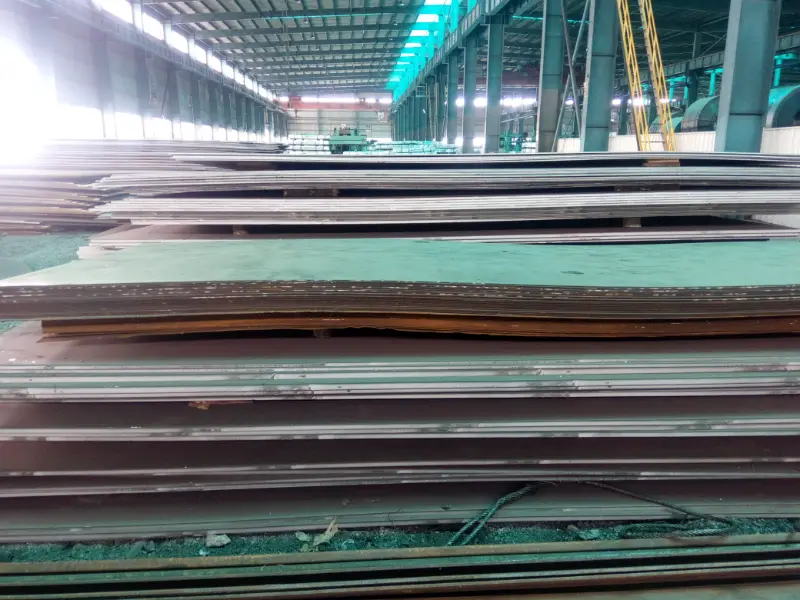
ASTM A131 FH32 Shipbuilding Steel
ASTM A131 FH32 Shipbuilding Steel - High-Strength Arctic-Grade Plate for Extreme Cold
Detailed material data for ASTM A131 Grade FH32, a normalised or quenched-and-tempered high-strength shipbuilding steel with minimum yield strength of 315 MPa and guaranteed impact toughness at -60°C, specifically designed for hull structures and offshore applications in polar and low-temperature environments.
Hot rolling, normalising (N), quenching and tempering (QT), thermo-mechanical controlled processing (TMCP) as applicable
- Phone : +8618037372205
- Email : [email protected]
- WhatsApp: Contact via Whtsapp
- WeChat: +8618037372205
ASTM A131 FH32 Shipbuilding Steel Introduction
ASTM A131 Grade FH32 is a high-strength shipbuilding steel plate defined under the ASTM A131/A131M standard. It belongs to the high-strength hull structural steel family and is produced in a normalised or quenched-and-tempered condition. The letter 'F' indicates its certification for the most severe low-temperature service with impact testing at -60°C, while 'H32' designates the minimum yield strength class of 315 MPa. Key characteristics:
- Excellent combination of strength and toughness at cryogenic temperatures
- Low-carbon and fine-grained microstructure for superior weldability and crack arrest capability
- Controlled chemical composition with micro-alloying elements (Nb, V, Ti) to meet strict notch toughness requirements
- Compliant with major classification society rules (ABS, DNV, LR, BV, CCS, KR, NK) ensuring global acceptance
- Available in plate form suitable for primary structural members of ice-going vessels, offshore platforms, and Arctic marine equipment
ASTM A131 FH32 Shipbuilding Steel Chemical composition
The chemical composition of FH32 is carefully balanced to guarantee strength, weldability and exceptional low-temperature toughness. Carbon equivalent (CEV) is typically kept low to avoid cold cracking. Micro-alloying with niobium, vanadium and titanium provides grain refinement and precipitation strengthening.
- Acid-soluble aluminium is mandatory for grain refinement.
- Residual elements such as copper, chromium, nickel and molybdenum are limited to maintain weldability and resistance to brittle fracture.
- When nitrogen-binding elements are present, nitrogen contents higher than the specified limit may be accepted subject to agreement.
| Element | Limit (max or range) wt% | Notes |
|---|---|---|
| Carbon (C) | ≤ 0.18 | Ladle analysis |
| Manganese (Mn) | 0.90 – 1.60 | Higher Mn for strength and toughness |
| Silicon (Si) | ≤ 0.50 | Deoxidation element |
| Phosphorus (P) | ≤ 0.035 | Low for toughness |
| Sulfur (S) | ≤ 0.035 | Low for ductility |
| Aluminium (Al, acid soluble) | ≥ 0.020 | Grain refinement |
| Niobium (Nb) | ≤ 0.05 | Micro-alloying |
| Vanadium (V) | ≤ 0.10 | Micro-alloying |
| Titanium (Ti) | ≤ 0.02 | Grain refinement |
| Copper (Cu) | ≤ 0.35 | Residual element |
| Chromium (Cr) | ≤ 0.20 | Residual element |
| Nickel (Ni) | ≤ 0.40 | Improves toughness |
| Molybdenum (Mo) | ≤ 0.08 | Residual element |
| Nitrogen (N) | ≤ 0.009 | Unless tied up with nitrogen-binding elements |
ASTM A131 FH32 Shipbuilding Steel Thermal and electrical physical properties
The following physical property data are typical for low-carbon high-strength structural steels and are not mandatory requirements of ASTM A131. They may vary slightly depending on exact composition and heat treatment condition.
- Density is standard for steel.
- Elastic modulus decreases with temperature; values given at ambient.
- Thermal expansion coefficient is an average between 20°C and 100°C.
- Thermal conductivity and electrical resistivity are approximate and useful for welding and heating calculations.
| Property | Typical value | Unit | Condition / temperature |
|---|---|---|---|
| Density (ρ) | 7850 | kg/m³ | Room temperature |
| Modulus of elasticity (E) | 207 | GPa | Room temperature |
| Shear modulus (G) | 80 | GPa | Calculated from E and ν |
| Poisson's ratio (ν) | 0.3 | – | Elastic range |
| Thermal expansion coefficient (α) | 12.2 | ×10⁻⁶ /K | 20–100°C |
| Thermal conductivity (λ) | 50 | W/(m·K) | Room temperature |
| Specific heat capacity (c) | 460 | J/(kg·K) | Room temperature |
| Electrical resistivity (ρ_e) | 0.2 | ×10⁻⁶ Ω·m | Room temperature |
ASTM A131 FH32 Shipbuilding Steel Mechanical properties
The mechanical properties of FH32 are valid for plate thickness ≤ 50 mm. For thicker plates, slight reduction in yield strength may apply. All tests are conducted at room temperature except Charpy V-notch impact tests performed at -60°C.
- Tensile testing: transverse specimens.
- Charpy impact: longitudinal specimens, average of three tests ≥ 27 J, with one individual value permitted to be not less than 70% of the specified average.
- Bend test: 180° around a former, no cracks.
| Property | Required value (minimum unless noted) | Unit | Test condition / notes |
|---|---|---|---|
| Yield strength (ReH) | ≥ 315 | MPa | Room temperature; thickness ≤ 50 mm |
| Tensile strength (Rm) | 440 – 590 | MPa | Room temperature |
| Elongation (A) | ≥ 22 | % | Gauge length 200 mm (or proportional); thickness ≤ 50 mm |
| Elongation (A) | ≥ 19 | % | Gauge length 50 mm; thickness > 50 mm up to 70 mm (informative) |
| Charpy V-notch impact (KV) at -60°C, longitudinal | ≥ 27 (average) | J | Specimen 10×10 mm; test temperature -60°C |
| Charpy V-notch impact (KV) at -60°C, longitudinal | ≥ 19 (individual min.) | J | Single value not below 70% of average |
| Bend test (180°) | No cracks | – | Former diameter = 3 × plate thickness (3a) |
ASTM A131 FH32 Shipbuilding Steel Directly equivalent material grades from international standards and classification societies
| Country / Region | Standard / Society | Equivalent grade | Remarks |
|---|---|---|---|
| International | ASTM A131/A131M | FH32 | Base standard |
| International | ABS (American Bureau of Shipping) | FH32 | Identical requirements |
| International | DNV (Det Norske Veritas) | NV F32 | Grade F32 under DNV rules |
| International | LR (Lloyd's Register) | FH32 | LR grade FH32 |
| International | BV (Bureau Veritas) | FH32 | BV grade FH32 |
| International | CCS (China Classification Society) | FH32 | CCS grade FH32 |
| International | KR (Korean Register) | FH32 | Korean Register grade |
| International | NK (ClassNK) | FH32 | Nippon Kaiji Kyokai grade |
| International | RINA (Registro Italiano Navale) | FH32 | RINA grade |
| International | RS (Russian Maritime Register of Shipping) | FH32 | RS grade F32 |
ASTM A131 FH32 Shipbuilding Steel Application Introduction
FH32 steel is specifically designed for the most demanding structural applications in shipbuilding and offshore engineering where both high strength and guaranteed low-temperature toughness are required. It is particularly suited for ice-class vessels and Arctic service.
- The -60°C impact requirement ensures safe operation in ambient temperatures well below freezing.
- Good weldability and formability allow for efficient fabrication of complex structural details.
- Available in wide plate dimensions and various thicknesses to suit different design needs.
- Always verify specific classification society acceptance and project specifications before substitution.
Product Applications: Hull envelope plates for ice-class vessels, Main deck and inner bottom plates, Longitudinal and transverse bulkheads, Web frames and stiffeners, Brackets and knuckle plates, Structural parts of ice belting, Offshore module structural components, Cold-service storage tanks (with ship class approval)
Processed into products: Ship shell plating (side and bottom), Ice strengthening plates (ice belt area), Upper deck stringer plates, Transverse watertight bulkhead plates, Engine room structural members, Pedestals and crane base plates on ships, Offshore helideck support structures, Structural nodes in jacket legs and bracings (offshore)
Application industries: Shipbuilding (icebreakers, polar research vessels, LNG carriers), Offshore oil and gas (FPSO, North Sea / Arctic platforms), Marine engineering (jack-up rigs, heavy-lift crane vessels), Port and harbor construction (coastal structures), Renewable energy (offshore wind foundations in cold regions)
ASTM A131 FH32 Shipbuilding Steel Similar or neighbouring grades for substitution
| Country / Region | Standard | Grade | Remarks |
|---|---|---|---|
| International | ASTM A131/A131M | DH32 | Lower toughness requirement: impact at -20°C instead of -60°C. Same strength level. Suitable for less severe cold conditions. |
| International | ASTM A131/A131M | EH32 | Intermediate toughness: impact at -40°C. More economical than FH32 when -40°C rating suffices. |
| International | ASTM A131/A131M | FH36 | Higher strength grade (yield ≥ 355 MPa) with same -60°C impact requirement. Used when higher strength is needed; weldability adjustment may be necessary. |
| Europe | EN 10025-4 | S355ML / S355G10+M | Thermo-mechanically rolled structural steels with minimum yield 355 MPa and impact down to -50°C (ML) or -60°C (G10). Not a direct replacement for ship classification, but similar strength-toughness profile for offshore structures. |
| Europe | EN 10225 | S355G10+N | Normalised fine-grain steel for fixed offshore structures, yield 355 MPa, impact tested at -60°C. Close in property but classification society approval needed for shipbuilding. |
Notes:
Processing and fabrication notes: FH32 plates are normally delivered with a classification society certificate (e.g., ABS, DNV) and mill test reports including chemical analysis, tensile, bend and Charpy impact results. Preheating is generally not required for welding due to low carbon equivalent, but welding procedures must be qualified according to the applicable ship classification rules. Post-weld heat treatment (PWHT) is not a requirement but may be applied where stress relief is specified. The steel is suitable for shielded metal arc welding (SMAW), submerged arc welding (SAW), gas metal arc welding (GMAW), and flux-cored arc welding (FCAW). Additional testing: Through-thickness (Z-direction) properties and CTOD tests can be supplied by agreement for critical structural applications.
- Share



