
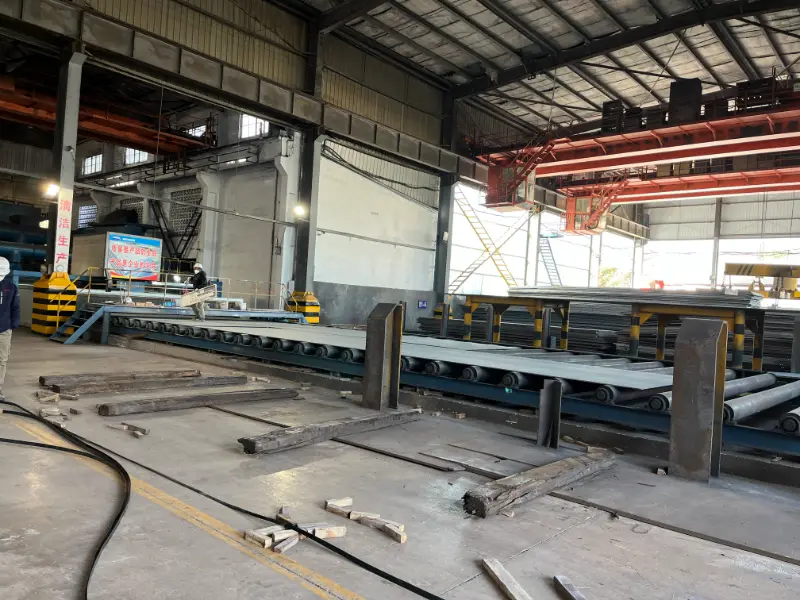
LR Grade DH36 Shipbuilding Steel Plate
LR Grade DH36 Shipbuilding Steel Plate: High-Strength Low-Temperature Toughness Marine Steel
LR DH36 is a high-strength shipbuilding structural steel certified by Lloyds Register, offering excellent weldability, formability, and guaranteed impact toughness at -20°C, widely used in hull construction and offshore structures.
Hot rolling, controlled rolling (thermo-mechanical control process), normalizing, quenching and tempering (depending on thickness and property requirements), welding (all common shipbuilding methods), cutting (flame, plasma, laser), bending and forming.
- Phone : +8618037372205
- Email : [email protected]
- WhatsApp: Contact via Whtsapp
- WeChat: +8618037372205
LR Grade DH36 Shipbuilding Steel Plate Introduction
LR Grade DH36 is a high-strength, low-alloy structural steel plate specifically designed for shipbuilding and marine applications, certified under the Lloyds Register (LR) Rules for the Manufacture, Testing and Certification of Materials. It belongs to the higher-strength category with a minimum yield strength of 355 MPa and provides enhanced notch toughness at low temperatures, tested at -20°C (D-quality). The material combines good weldability, excellent formability, and resistance to brittle fracture, making it suitable for critical structural members such as hull plates, stiffeners, and offshore platform components exposed to cold service conditions. Its fine-grain practice ensures consistent mechanical properties and compliance with stringent maritime safety standards.
LR Grade DH36 Shipbuilding Steel Plate Chemical Composition
The chemical composition of LR DH36 is controlled to achieve the required strength, toughness, and weldability. Limits are according to LR Rules for Materials. Carbon equivalent (CE) values are typically restricted, especially for thicker plates, to ensure good field welding performance. Maximum values unless a range is given.
| Element | Standard Requirement (max, %) | Remarks |
|---|---|---|
| C (Carbon) | 0.18 | If CE is ≤0.38%, higher C may be accepted for thickness ≤25 mm |
| Si (Silicon) | 0.10 – 0.50 | Range; for killed steel made by continuous casting, Si ≥0.10% |
| Mn (Manganese) | 0.90 – 1.60 | Minimum Mn may be reduced to 0.80% for fine grain steel |
| P (Phosphorus) | 0.030 | Maximum; lower values may be specified for improved toughness |
| S (Sulfur) | 0.030 | Maximum; lower values typical for better internal soundness |
| Al (Aluminum) or other grain-refining elements | Al ≥0.015 (total) | Total aluminum when aluminum is used as grain refiner; alternatively Nb, V, or Ti may be used singly or in combination |
| Nb (Niobium) | 0.02 – 0.05 | Optional; if used, content within range |
| V (Vanadium) | 0.05 – 0.10 | Optional; if used |
| Ti (Titanium) | ≤0.02 | Optional; if used, may be restricted |
| Cu (Copper) | ≤0.35 | If Cu content exceeds 0.35%, additional testing may be required |
| Cr (Chromium) | ≤0.20 | Residual element; higher values may be accepted if agreed |
| Ni (Nickel) | ≤0.40 | Residual element; higher values by agreement |
| Mo (Molybdenum) | ≤0.08 | Residual element |
| CE (Carbon Equivalent) | ≤0.38 (typically) | CE = C + Mn/6 + (Cr+Mo+V)/5 + (Ni+Cu)/15. For thickness >25 mm, CE max may be restricted to 0.40%. |
LR Grade DH36 Shipbuilding Steel Plate Typical Physical Properties
The following physical constants are typical for low-alloy carbon-manganese structural steels like DH36. Actual values may vary slightly depending on exact manufacturing process and heat treatment. These data are not part of LR mandatory requirements but are useful for design calculations.
| Property | Typical Value | Unit | Test Condition |
|---|---|---|---|
| Density (ρ) | 7850 | kg/m³ | At 20 °C |
| Youngs Modulus (E) | 205 – 210 | GPa | At room temperature; decreases with increasing temperature |
| Shear Modulus (G) | 79 – 81 | GPa | Approximately E/(2(1+ν)) |
| Poissons Ratio (ν) | 0.29 – 0.30 | - | At room temperature within elastic range |
| Thermal Expansion Coefficient (α) | 11.7 – 12.5 | 10⁻⁶/K | For temperature range 20 – 100 °C; 13.5 at 20-200 °C, 14.4 at 20-400 °C |
| Thermal Conductivity (λ) | 45 – 52 | W/(m·K) | At room temperature; decreases with increasing temperature (e.g., ~40 at 400 °C) |
| Specific Heat Capacity (cp) | 460 – 480 | J/(kg·K) | At room temperature; increases to ~550 J/(kg·K) at 600 °C |
| Electrical Resistivity (ρe) | 0.20 – 0.25 | μΩ·m | At 20 °C; increases with temperature |
LR Grade DH36 Shipbuilding Steel Plate Mechanical Properties
The mechanical properties are determined on test specimens prepared from the plates in the delivery condition. The values below are the minimum requirements according to LR Rules for DH36 steel plates, valid for thickness range up to 100 mm (specific values may vary with thickness). Impact test is carried out at -20°C for transverse specimens; longitudinal values are higher and may be specified.
| Property | Standard Requirement | Unit | Test Condition / Remarks |
|---|---|---|---|
| Yield Strength (ReH) | 355 | MPa | Minimum; for thickness ≤100 mm. For thickness >100 mm, consult LR Rules (may be 315 MPa). |
| Tensile Strength (Rm) | 490 – 630 | MPa | This range applies for most thicknesses |
| Elongation (A5) | 21 | % | Minimum on gauge length 5.65√So; for thickness ≤40 mm |
| Elongation (A5) | 20 | % | For thickness >40 mm ≤100 mm (guideline, varies with thickness) |
| Bend Test (180°) | No cracks | - | Former diameter = 3t (t = specimen thickness). For higher thickness, 4t or as agreed. |
| Charpy V-notch Impact Energy (KV2) at -20°C, transverse | 27 | J | Average of three specimens; single value may not be less than 20 J |
| Charpy V-notch Impact Energy (KV2) at -40°C, transverse | 24 | J | For information; may be specified for applications with lower design temperature |
| Through-thickness reduction of area (Z35) | 35 | % | When specified for improved lamellar tearing resistance (Z-quality) |
LR Grade DH36 Shipbuilding Steel Plate Fully Equivalent Standards and Substitutable Grades
| Country / Region | Standard / Classification Society | Grade | Remarks |
|---|---|---|---|
| International | IACS (Unified Requirement W11) | DH36 | Common standard across IACS members; each society uses its own notation |
| USA | ASTM A131 / ABS Rules | DH36 | American Bureau of Shipping: ABS DH36; ASTM A131 DH36 grade is chemically and mechanically equivalent |
| Germany / Europe | DNV GL Rules (now DNV) | DH36 | DNV DH36 corresponds to same strength and toughness level |
| France | BV Rules | DH36 | Bureau Veritas DH36; identical requirements |
| China | GB 712 / CCS Rules | DH36 | China Classification Society CCS DH36; also GB 712 DH36 |
| Japan | NK Rules | DH36 | ClassNK KD36 or DH36 (grade KDH36 is common) |
| South Korea | KR Rules | DH36 | Korean Register DH36 |
| Italy | RINA Rules | DH36 | Registro Italiano Navale DH36 |
| Russia | RS Rules | DH36 | Russian Maritime Register DH36 |
| Europe | EN 10025-4 | S355ML/MLO | EN designation for thermomechanical rolled weldable fine-grain structural steel with min ReH 355 MPa and impact at -50°C (ML). Closely matches DH36 properties; often dual certified. |
LR Grade DH36 Shipbuilding Steel Plate Application Introduction
LR DH36 steel plates are optimized for shipbuilding and marine structures where a combination of high strength, good weldability, and guaranteed notch toughness at sub-zero temperatures is required. It is extensively used in the construction of large ocean-going vessels and offshore installations. The material can be fabricated using standard welding procedures (preheating may be required for thick sections) and is suitable for corrosion protection coatings.
Product Applications: Hull shell plates and longitudinal stiffeners, Deck stringers and sheer strakes, Watertight bulkheads and deep floors, Bottom and inner bottom longitudinals, Hatch coamings and transverse frames, Legs and chords of self-elevating platforms, Nodes and braces for jacket structures, Transition pieces and monopile components for offshore wind, Barge and pontoon constructions, Repair patches and reinforcement pads
Processed into products: Ship skin (shell expansion) plates, Keel and bilge plate assemblies, Longitudinal girders and keel beams, Web frames and floors (cut by CNC plasma), Bracket plates and panel stiffeners, Padeyes and lifting lugs, Can sections for tubular structures, Stiffened plate panels for deck modules, Rudder stock support plates, Bow thrust tunnel inserts
Application industries: Shipbuilding (commercial and naval vessels), Offshore Oil & Gas (fixed platforms, FPSOs, jack-up rigs), Marine & Port Engineering (dolphins, fenders, dock gates), Renewable Energy (offshore wind turbine foundations and transition pieces), Heavy Lifting and Transport (crane booms, heavy-haul trailer frames), Pressure Vessel and Storage Tank (when approved for non-ship applications)
LR Grade DH36 Shipbuilding Steel Plate Similar / Approximate Substitutes and Related Grades
| Country / Region | Standard | Grade | Remarks |
|---|---|---|---|
| International | LR Rules (Higher toughness) | EH36 | Enhanced notch toughness at -40°C; otherwise same strength; used for more severe cold climates |
| International | LR Rules (Standard toughness) | AH36 | Impact test at 0°C; suitable for ambient temperature applications where low-temperature toughness is not critical |
| International | LR Rules (Higher strength) | DH40, EH40 | Minimum yield strength 390 MPa; thicker sections or weight savings |
| USA | ASTM A131 | AH36, EH36 | Although AH36 tests at 0°C, it is similar in strength; EH36 matches DH36 toughness at -40°C and can be used if DH36 not available |
| Europe | EN 10025-4 | S355M, S355ML | S355M tests at -20°C (M = thermomechanical rolled), very close to DH36; S355ML tests at -50°C, offering extra low-temperature capability |
| Japan | JIS G 3106 | SM490YA/YB | SM490Y has min yield 365 MPa but different impact requirements; not directly equivalent, approximate |
| Russia | GOST 5521 | 09G2S, 10G2S1D | Similar yield strength, but different charpy temperature; may be used after careful evaluation |
Notes:
Additional Notes: All data is based on Lloyds Register Rules for the Manufacture, Testing and Certification of Materials, July 2022 edition (and historically consistent requirements).
- DH36 is typically supplied with LR surveyor inspection and stamping. Material certificates are issued by the classification society.
- For plates exceeding 40 mm thickness, the bend test former diameter may increase to 4t; consult the LR procedure.
- Z-grade steel (e.g., Z25, Z35) can be specified for improved through-thickness ductility when structures experience high restraint or lamellar tearing risk.
- Welding consumables should match the strength and toughness; basic coated electrodes or flux-cored wires with low hydrogen content are recommended.
- Preheat and interpass temperature control depend on carbon equivalent and plate thickness; typically 50-150°C.
- Alternative delivery conditions like QT (quenched and tempered) may be used for thicker sections to obtain properties; normalization is common.
- Share



