
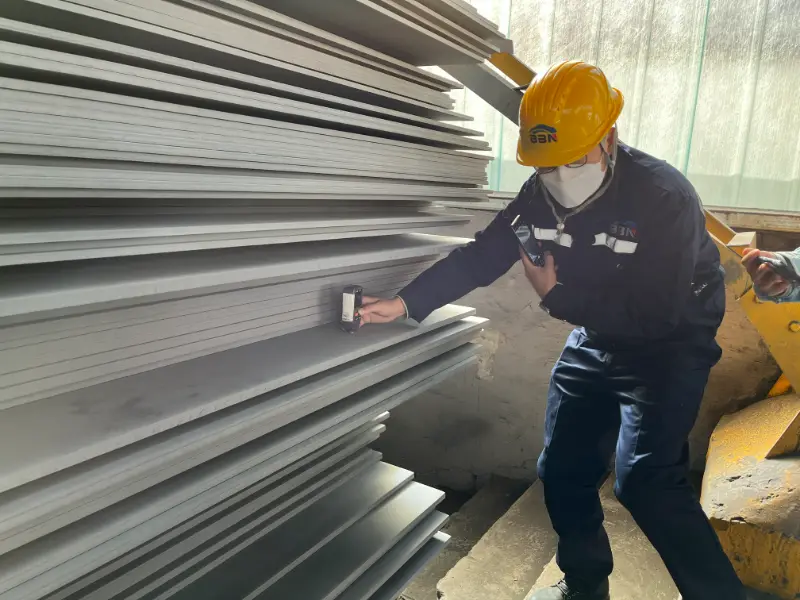
LR Grade AH36 Shipbuilding Steel Plate
LR Grade AH36 Shipbuilding Steel Plate - Properties, Equivalents & Applications
Comprehensive material data for LR Grade AH36 shipbuilding steel plate, including chemical composition, mechanical properties, thermal properties, international equivalents, and application guidance.
Hot rolling, controlled rolling (CR), normalizing (N), thermomechanical control process (TMCP) as agreed
- Phone : +8618037372205
- Email : [email protected]
- WhatsApp: Contact via Whtsapp
- WeChat: +8618037372205
LR Grade AH36 Shipbuilding Steel Plate Introduction
LR Grade AH36 is a high-strength hull structural steel plate certified by Lloyd's Register (LR). It is primarily used in the construction of ships and marine structures where higher strength and good weldability are required. AH36 belongs to the standard high-strength shipbuilding steel series, with a minimum yield strength of 355 MPa and good low-temperature impact toughness, typically tested at 0°C. The steel is produced as fully killed fine-grain steel, often delivered in a controlled-rolled or normalized condition. It meets the requirements of IACS UR W11 and is recognized by all major classification societies. Typical applications include deck plates, shell plates, bulkheads, and structural members in ships and offshore platforms. The material exhibits excellent weldability and formability when proper fabrication procedures are followed.
LR Grade AH36 Shipbuilding Steel Plate Chemical Composition
The chemical composition of LR AH36 is defined by the IACS Unified Requirement UR W11. Carbon equivalent (CEV) is controlled to ensure weldability. Typical micro-alloying elements such as Nb, V, and Ti may be added singly or in combination to achieve the required strength and toughness. Limits are maximum unless a range is given.
| Chemical Element | Standard Value (max or range, %) | Remarks |
|---|---|---|
| Carbon (C) | ≤0.18 | Ladle analysis |
| Manganese (Mn) | 0.90 – 1.60 | Depending on thickness and manufacturing process |
| Silicon (Si) | ≤0.50 | |
| Phosphorus (P) | ≤0.035 | |
| Sulfur (S) | ≤0.035 | |
| Aluminum (Al) | ≥0.015 (total) | Acid soluble Al may be specified |
| Niobium (Nb) | 0.02 – 0.05 | Optional micro-alloying, single or combination |
| Vanadium (V) | 0.05 – 0.10 | Optional micro-alloying |
| Titanium (Ti) | ≤0.02 | Optional, mainly for grain refinement |
| Copper (Cu) | ≤0.35 | Residual element |
| Chromium (Cr) | ≤0.20 | Residual element |
| Nickel (Ni) | ≤0.40 | Residual element |
| Molybdenum (Mo) | ≤0.08 | Residual element |
| Carbon Equivalent (CEV) | ≤0.38 | CEV = C+Mn/6+(Cr+Mo+V)/5+(Ni+Cu)/15 |
LR Grade AH36 Shipbuilding Steel Plate Thermal and Electrical Physical Properties
These physical properties are typical for carbon-manganese structural steels comparable to AH36. They are not part of the mandatory ship classification specification, but are useful for design calculations. Values are representative at room temperature unless specified otherwise. Data gathered from general engineering references for low-carbon high-strength steels.
| Property | Typical Value | Unit | Test Condition / Notes |
|---|---|---|---|
| Density (ρ) | 7850 | kg/m³ | Ambient temperature |
| Modulus of Elasticity (E) | 205 – 210 | GPa | Ambient temperature |
| Shear Modulus (G) | 80 – 81 | GPa | Approximate, calculated from E and Poisson's ratio |
| Poisson's Ratio (ν) | 0.30 | – | In elastic range |
| Thermal Expansion Coefficient (α) | 12.0 x 10⁻⁶ (20–100°C); 13.2 x 10⁻⁶ (20–300°C) | K⁻¹ | Mean linear expansion |
| Thermal Conductivity (λ) | ~50 (at 20°C); ~45 (at 200°C) | W/(m·K) | Approximate, typical steel |
| Specific Heat Capacity (c) | ~470 (at 20–100°C) | J/(kg·K) | Typical for low-carbon steel |
| Electrical Resistivity (ρe) | 0.20 – 0.25 x 10⁻⁶ | Ω·m | At room temperature |
LR Grade AH36 Shipbuilding Steel Plate Mechanical Properties
Mechanical properties are specified according to the Lloyd's Register Rules and IACS UR W11. Values apply to the as-delivered condition (controlled rolled or normalized). Tensile testing is performed in the transverse or longitudinal direction as agreed. Impact testing is performed using Charpy V-notch specimens at 0°C. Values depend on thickness range; standard values for thickness ≤100 mm are shown. For thinner products, slightly higher strength may be obtained.
| Property | Required Value (min or range) | Unit | Test Condition / Remarks |
|---|---|---|---|
| Yield Strength (ReH) | ≥355 | MPa | Transverse or longitudinal, thickness ≤100 mm |
| Tensile Strength (Rm) | 490 – 620 | MPa | Transverse |
| Elongation (A) | ≥21 | % | Gauge length 5.65√So (transverse), for thickness ≤100 mm |
| Impact Energy (KV2) | ≥34 (average), ≥24 (individual) | J | Charpy V-notch at 0°C, longitudinal direction |
| Bend Test (Mandrel diameter) | 3t (t ≤ 25 mm); 4t (t > 25 mm) | 180° bend, no cracks, sample width ≥100 mm |
LR Grade AH36 Shipbuilding Steel Plate Full Equivalents under International Classification Societies
| Country/Region | Standard / Rules | Grade / Designation | Remarks |
|---|---|---|---|
| USA / International | ABS Rules | AH36 | Identical requirements per IACS UR W11 |
| Norway / Germany | DNV Rules | AH36 | Identical requirements |
| France | BV Rules | AH36 | Identical requirements |
| China | CCS Rules | AH36 | Identical requirements |
| South Korea | KR Rules | AH36 | Identical requirements |
| Japan | NK (ClassNK) Rules | AH36 | Identical requirements |
| Italy | RINA Rules | AH36 | Identical requirements |
| Russia | RS Rules | AH36 | Identical requirements |
| India | IRS Rules | AH36 | Identical requirements |
LR Grade AH36 Shipbuilding Steel Plate Application Introduction
LR Grade AH36 is designed for welded ship structures and marine environments. It finds extensive use where higher loading demands exist but excellent weldability and ductile impact properties remain essential. Typical applications include primary structural elements in merchant ships, naval vessels, and offshore platforms. The steel can be formed into plates, stiffeners, and built-up sections. It is also used in bridge construction and heavy machinery where certified toughness at 0°C is required.
Product Applications: Bulk carriers, container ships, tankers, Offshore support vessels, Jack-up rig legs and platforms, Floating production storage and offloading (FPSO) units, Hull shells and long decks of warships
Processed into products: Main deck plates and stringer plates, Shell plates and bottom plates, Bulkhead plating and deep frames, Longitudinal stiffeners and girders, Hatch coamings and companion ways, Offshore structural nodes and tubular connections, Bollard foundations and winch beds
Application industries: Shipbuilding and repair, Offshore oil and gas (jackets, decks, helidecks), Marine engineering (docks, buoys, caissons), Port and harbor construction, Bridges and heavy infrastructure (subject to certification)
LR Grade AH36 Shipbuilding Steel Plate Similar or Near-Equivalent Grades
| Country/Region | Standard | Grade | Remarks |
|---|---|---|---|
| Europe | EN 10025-3 / -4 | S355ML / S355MLO (EN 10225 Annex B) | Marine structural steel with similar strength; additional welding and through-thickness tests may be required for substitution; acceptance by classification society needed. |
| USA | ASTM A131 / A131M | Grade AH36 | Shipbuilding steel specification directly analogous to LR AH36, but verify impact test temperature. |
| Japan | JIS G 3106 | SM490A/B/C | Structural steel of similar strength; SM490C can offer low-temperature toughness but must be qualified for marine use. |
| China | GB 712 | AH36 | Chinese standard for shipbuilding steel, directly equivalent to LR AH36; identical IACS base. |
| International | ISO 4995 / ISO 630-3 | S355G10+N (EN 10225 table) | Weldable structural steel for offshore structures; similar strength and toughness, subject to classification society approval. |
Notes:
This steel is fully killed and produced with fine grain practice. In practical supply, plates may be delivered with through-thickness (Z-direction) testing and additional ultrasonic inspection if required by the classification society and buyer specifications. Thermomechanical controlled rolling (TMCP) can be applied to enhance toughness and weldability without additional heat treatment. Users should confirm the specific manufacturing route and any supplementary requirements from the relevant LR Rules or project specifications. Heat treatment such as post-weld heat treatment (PWHT) should be evaluated for possible impact on mechanical properties. Always refer to the latest edition of Lloyd's Register Rules or the relevant IACS UR.
- Share



