
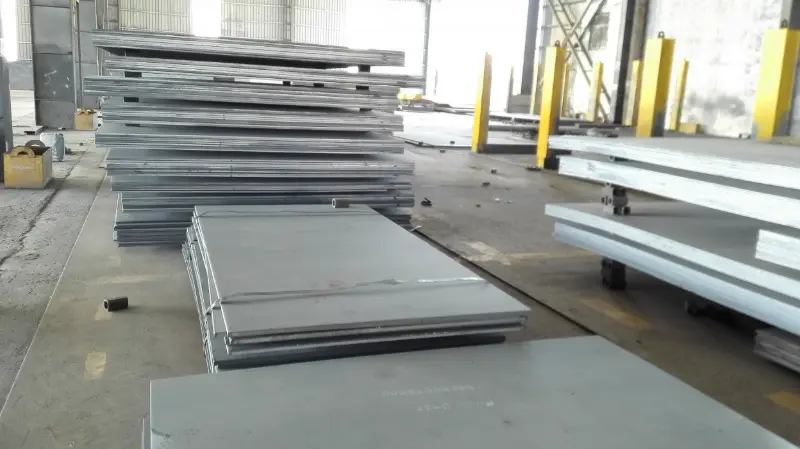
CCS Grade EQ63 Shipbuilding Steel Plate
CCS Grade EQ63 Shipbuilding Steel Plate - High-Strength Quenched and Tempered Steel for Marine Structures
CCS EQ63 is a high-strength quenched and tempered shipbuilding steel plate certified by China Classification Society, with minimum yield strength of 620 MPa, excellent toughness at low temperatures, and good weldability, primarily used in offshore structures, ship hulls, and marine engineering components.
Quenching and tempering (Q&T), controlled rolling (TMCP possible for thinner gauges), cutting, cold forming (limited), hot forming (with heat treatment restoration), welding (with proper preheat and low-hydrogen procedures).
- Phone : +8618037372205
- Email : [email protected]
- WhatsApp: Contact via Whtsapp
- WeChat: +8618037372205
CCS Grade EQ63 Shipbuilding Steel Plate Introduction
CCS Grade EQ63 is a premium high-strength structural steel specified by China Classification Society (CCS) for demanding marine and offshore applications. It belongs to the extra-high strength category with a minimum yield strength of 620 MPa and is produced via quench and temper (Q&T) process to achieve an optimized combination of strength, toughness, and weldability.
Key features:
- Ultra-high strength with yield ≥620 MPa and tensile 720–890 MPa
- Excellent low-temperature impact toughness, typically tested at -40°C
- Good resistance to brittle fracture and fatigue
- Improved weldability through fine grain design and low carbon equivalent
- Available in thickness up to 150 mm
- Fully killed and normalized rolling or Q&T delivery condition
EQ63 plates are used in critical structural parts such as deck, bottom, and side shells of large container ships, offshore platforms, heavy-lift crane booms, and pressure vessels.
CCS Grade EQ63 Shipbuilding Steel Plate Chemical Composition
The chemical composition of CCS EQ63 steel is designed to ensure high strength, superior toughness, and excellent weldability after quenching and tempering. Elements such as Mn, Ni, Cr, Mo, and micro-alloying elements Nb, V, Ti are added for grain refinement and precipitation hardening. Strict limits on P and S minimize embrittlement. Typical ladle analysis is shown; product analysis tolerances apply per CCS regulations.
| Chemical element | Standard value (max, unless range specified) | Remarks |
|---|---|---|
| C | ≤0.20 | Carbon; higher side of range for strength; low CEV required |
| Si | ≤0.55 | Silicon; deoxidizer, aids strength |
| Mn | 0.90–1.70 | Manganese; major hardenability and toughness element |
| P | ≤0.025 | Phosphorus; kept low for toughness |
| S | ≤0.025 | Sulfur; low for ductility and lamellar tearing resistance |
| Cr | ≤0.25 | Chromium; optional for hardenability |
| Ni | ≤0.40 | Nickel; may be higher for thickness >50 mm; improves low-temperature toughness |
| Mo | ≤0.08 | Molybdenum; optional for tempering resistance |
| Cu | ≤0.35 | Copper; residual; may be specified for atmospheric corrosion resistance |
| Nb | 0.02–0.05 | Niobium; grain refinement |
| V | 0.05–0.10 | Vanadium; precipitation strengthening |
| Ti | 0.007–0.012 | Titanium; nitrogen control, grain refinement |
| Als (total Al) | ≥0.015 | Aluminium; deoxidation, grain refinement |
| N | ≤0.012 | Nitrogen; kept low for ageing resistance |
| CEV (IIW) | Typically ≤0.45–0.52 | Carbon equivalent; controlled for weldability, depending on thickness |
CCS Grade EQ63 Shipbuilding Steel Plate Thermal and Electrical Physical Properties
Physical properties are typical for high-strength quenched and tempered steel and are not part of the CCS specification requirements. Values are approximate and can vary slightly with exact composition and heat treatment. These data are useful for design calculations, heat transfer analysis, and processing.
| Property | Standard requirement value | Unit | Test conditions / Remarks |
|---|---|---|---|
| Density (ρ) | ~7.85 | g/cm³ | At 20°C; ambient |
| Modulus of elasticity (E) | 205 – 210 | GPa | At room temperature |
| Shear modulus (G) | ~80 | GPa | Estimated from E and ν |
| Poisson's ratio (ν) | 0.30 | — | Elastic range |
| Thermal expansion (α) | ~12.0 x 10⁻⁶ | /K | 20–100°C; linear coefficient |
| Thermal expansion (α) | ~13.2 x 10⁻⁶ | /K | 20–300°C |
| Thermal expansion (α) | ~14.0 x 10⁻⁶ | /K | 20–500°C |
| Thermal conductivity (λ) | ~42 | W/(m·K) | At 20°C |
| Thermal conductivity (λ) | ~38 | W/(m·K) | At 300°C |
| Specific heat capacity (c) | ~460–480 | J/(kg·K) | 20–100°C |
| Electrical resistivity (ρ_e) | ~0.20–0.25 | μΩ·m | At 20°C |
CCS Grade EQ63 Shipbuilding Steel Plate Mechanical Properties
Mechanical properties are determined on test specimens taken transversely from the plate. Values vary with thickness. The minimum yield strength is 620 MPa and tensile strength 720–890 MPa. Elongation is measured on a gauge length of 5.65√S₀ (50 mm typical). Impact tests are carried out at -40°C using standard Charpy V-notch specimens; minimum average energy is 34 J for thickness ≤50 mm, increasing for thicker sections.
Testing is performed in the as-delivered (Q&T) condition.
| Property | Standard requirement value | Unit | Test conditions / Remarks |
|---|---|---|---|
| Yield strength (ReH) | ≥620 | MPa | Transverse; thickness ≤ 50 mm |
| Yield strength (ReH) | ≥560 | MPa | Transverse; thickness > 50 mm ≤ 100 mm |
| Yield strength (ReH) | ≥530 | MPa | Transverse; thickness > 100 mm ≤ 150 mm |
| Tensile strength (Rm) | 720–890 | MPa | Transverse; all thicknesses |
| Elongation (A5) | ≥15 | % | Thickness ≤ 40 mm, gauge 50 mm |
| Elongation (A5) | ≥14 | % | Thickness > 40 mm ≤ 80 mm |
| Elongation (A5) | ≥13 | % | Thickness > 80 mm ≤ 150 mm |
| Impact energy (KV₂) | ≥34 (average of 3) | J | Longitudinal; -40°C; thickness ≤ 50 mm |
| Impact energy (KV₂) | ≥27 (individual) | J | Longitudinal; -40°C; thickness ≤ 50 mm |
| Impact energy (KV₂) | ≥41 (average of 3) | J | Longitudinal; -40°C; thickness > 50 mm ≤ 100 mm |
| Impact energy (KV₂) | ≥50 (average of 3) | J | Longitudinal; -40°C; thickness > 100 mm ≤ 150 mm |
| Bend test (d = 3a, 180°) | No cracks | — | Transverse; d = mandrel diameter, a = plate thickness |
CCS Grade EQ63 Shipbuilding Steel Plate Completely Equivalent Material Standards and Replaceable Grades
| Country/Region | Standard | Grade | Remarks |
|---|---|---|---|
| International | CCS (China Classification Society) | EQ63 | Original specification; quenched and tempered |
| USA | ABS (American Bureau of Shipping) | EQ63 | Identical strength and toughness requirements |
| Norway / International | DNV (Det Norske Veritas) | E620 | Ferrite-pearlite or tempered martensite; same min. YS 620 MPa |
| France | BV (Bureau Veritas) | E620 | Equivalent grade under BV Rules |
| UK | LR (Lloyd's Register) | EH620 | EH indicates extra-high strength, 620 MPa class |
| Japan | NK (Nippon Kaiji Kyokai) | KE620 | K designation for high-strength ship plates |
| Italy | RINA (Registro Italiano Navale) | E620 | Conforms to similar properties |
| South Korea | KR (Korean Register) | RE620 | R class, 620 MPa yield |
| Germany | GL (Germanischer Lloyd, now DNV GL) | GL-E620 | Now integrated into DNV GL rules |
CCS Grade EQ63 Shipbuilding Steel Plate Application Introduction
CCS EQ63 steel plates are engineered for critical structural components where high strength, superior low-temperature toughness, and reliability are paramount. Thanks to the Q&T process, the material offers an excellent strength-to-weight ratio, enabling weight savings in shipbuilding and offshore engineering.
Typical usage guidelines include:
- Designed primarily for welded structures subjected to high stress and fatigue loading
- Suitable for service temperatures down to -40°C and below
- Must be fabricated according to shipyard specifications, with attention to preheating (150–200°C typical), interpass temperature, and post-weld heat treatment (if required)
- Cold forming limited to R/t ≥ 5; hot forming requires re-heat treatment
- Cutting by plasma or flame with proper preheat to avoid hardening
Product Applications: Ship hull plates (bottom, side, deck, longitudinal bulkheads), Offshore structural modules and decks, Heavy-lift crane booms and pedestals, Ice-strengthened strakes and frames, Pressure vessel shells, Tubular joints and nodes for offshore platforms
Processed into products: Bottom plating and bilge strakes, Sheer strakes and stringer plates, Deck plating and hatch coamings, Longitudinal and transverse frames, beams, floors, Rudder horns and stock plates, Box girders and built-up columns, Crane pedestals and slew rings, Tie-down plates and lifting lugs, Offshore drilling substructures
Application industries: Shipbuilding (commercial and naval vessels), Offshore oil and gas (jack-up rigs, semi-submersibles, FPSO), Marine engineering (port cranes, heavy-lift equipment), Arctic and icebreaking vessels, Structural engineering (bridges, stadiums when certified)
CCS Grade EQ63 Shipbuilding Steel Plate Similar / Closely Matching Grades Recommendation
| Country/Region | Standard | Grade | Remarks |
|---|---|---|---|
| Europe | EN 10025-6 | S690Q / S690QL / S690QL1 | Quenched and tempered structural steel; min. YS 690 MPa; often used in similar heavy fab; requires CEV and toughness adjustment for marine service |
| USA | ASTM A514 / A517 | Grade Q (or other grades) | High-strength structural steel plate, YS ≥ 690 MPa; not specifically marine, but used in offshore; weldability similar |
| USA | ABS | A514 (modified) | When certified to ABS with marine specifications |
| International | API 2W / 2Y | Grade 60 (620 MPa class) | Steel for offshore structures; heat-treated; overlapping chemical and mechanical requirements |
| Europe | EN 10225 | S620Q/S620QL | Weldable structural steels for fixed offshore structures; YS 620 MPa; ultimate marine application, very close to EQ63 |
| China | GB/T 712 | AH690 / DH690 / EH690 / FH690 | China's national standard for hull structural steel; similar 690 MPa yield class, Q&T; EH/FH grades match low-temp toughness |
Notes:
Special requirements:
- Plates may be ordered with through-thickness property (Z-quality) testing per CCS for improved lamellar tearing resistance, e.g., Z25, Z35.
- When used in critical welded joints, qualification of welding procedures (WPQ) is mandatory, including toughness testing at -40°C.
- Surface inspection (ultrasonic testing) is often specified to EN 10160 class S1/E1 or equivalent.
- The steel can be supplied with a mill certificate 3.2 (witnessed testing) if required by regulations.
- For structures exposed to sea water splash zone, additional corrosion allowance or coating must be considered, as EQ63 is not inherently resistant to marine corrosion.
- Avoid prolonged exposure to temperatures above 250°C to maintain temper condition.
- Share



