
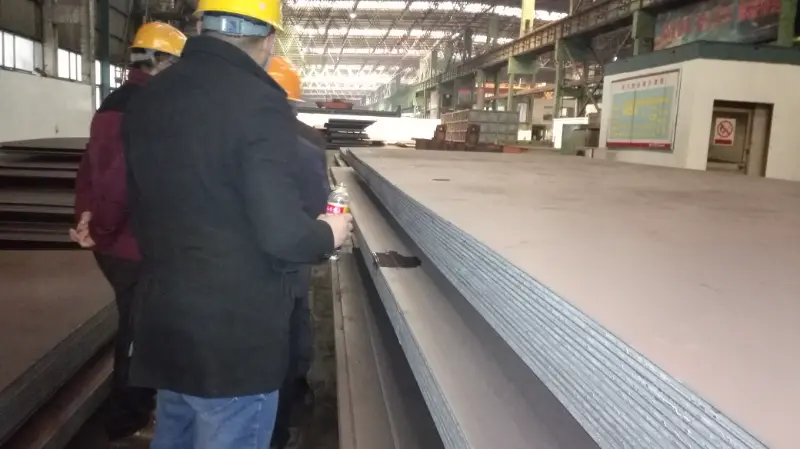
CCS Grade FQ56 Shipbuilding Steel Plate
CCS Grade FQ56 Shipbuilding Steel Plate: Low-Temperature Quenched & Tempered High Strength
Detailed material data for CCS Grade FQ56 quenched and tempered shipbuilding steel plate, including chemical composition, mechanical and physical properties, equivalent standards, and application guidance for marine and offshore engineering.
Hot rolling followed by quenching and tempering; suitable for cold forming, welding, machining, cutting, and shot blasting
- Phone : +8618037372205
- Email : [email protected]
- WhatsApp: Contact via Whtsapp
- WeChat: +8618037372205
CCS Grade FQ56 Shipbuilding Steel Plate Introduction
CCS Grade FQ56 is a high-strength quenched and tempered (Q&T) shipbuilding steel plate certified by China Classification Society. It is designed for critical low-temperature structural applications in marine and offshore environments. Key features:
- Minimum yield strength of 550 MPa, ensuring high load-bearing capacity.
- Excellent low-temperature toughness with guaranteed impact energy at -60°C, suitable for Arctic and harsh sea conditions.
- Fine-grain microalloyed composition (Nb, V, Ti, Al) that improves weldability and resistance to brittle fracture.
- Supplied in quenched and tempered condition to achieve an optimal balance of strength and ductility.
- Complies with CCS Rules for Materials and Welding and is comparable to EN 10225 S550Q offshore grades.
Typical thickness ranges from 6 mm to 100 mm, with larger thicknesses available upon special agreement.
CCS Grade FQ56 Shipbuilding Steel Plate Chemical composition
The chemical requirements comply with CCS Rules and GB/T 712-2011 for F550 grade. Fine-grain practice (Al content) is mandatory to ensure low-temperature toughness. Notes:
- Nb, V and Ti may be added singly or in combination for grain refinement.
- For thickness >50 mm, lower CEV (carbon equivalent) may be required by agreement.
| Chemical element | Standard value | Remarks |
|---|---|---|
| Carbon (C) | ≤0.18 | Heat analysis; lower C improves weldability |
| Silicon (Si) | ≤0.55 | Deoxidation and strength |
| Manganese (Mn) | 0.90–1.60 | Controls hardenability and strength |
| Phosphorus (P) | ≤0.025 | Stricter limit for low-temperature service |
| Sulfur (S) | ≤0.025 | Shape control and low S for toughness |
| Chromium (Cr) | ≤0.25 | Residual or added for strength |
| Nickel (Ni) | ≤0.40 | Beneficial for low-temperature toughness |
| Molybdenum (Mo) | ≤0.08 | Minor addition for hardenability |
| Copper (Cu) | ≤0.35 | Residual element |
| Niobium (Nb) | ≤0.05 | Grain refining; typical 0.02–0.04 |
| Vanadium (V) | ≤0.10 | Precipitation strengthening |
| Titanium (Ti) | ≤0.02 | Micro-alloy for weld metal toughness |
| Aluminum (Total Al) | ≥0.015 | Fine-grain requirement |
| Nitrogen (N) | ≤0.012 | Not specified in all standards but typical |
CCS Grade FQ56 Shipbuilding Steel Plate Thermal and electrical physical properties
Physical properties are similar to those of low-alloy structural steels and are provided as design guidelines. Values may vary slightly depending on exact chemical composition and heat treatment. Note: Thermal conductivity decreases with increasing temperature, and the thermal expansion coefficient applies to the temperature range 20–200 °C.
| Property | Standard requirement value | Unit | Test conditions / Remarks |
|---|---|---|---|
| Density (ρ) | 7.85 | g/cm³ | Typical for quenched and tempered low-alloy steel |
| Modulus of elasticity (E) | 200 – 205 | GPa | At 20 °C; slightly lower at elevated temperatures |
| Shear modulus (G) | ~80 | GPa | Calculated from E and Poisson's ratio |
| Poisson's ratio (ν) | 0.30 | — | At 20 °C |
| Thermal expansion coefficient (α) | 11.5 – 12.5 | x10⁻⁶ /K | Mean coefficient between 20 °C and 100 °C (also applicable up to 200 °C) |
| Thermal conductivity (λ) | 46 – 52 | W/(m·K) | At 20 °C; decreases to ~40 W/(m·K) at 400 °C |
| Specific heat capacity | 460 – 480 | J/(kg·K) | Average between 20 °C and 100 °C |
| Electrical resistivity (ρₑ) | 0.25 – 0.30 | μΩ·m | At 20 °C; typical for Mn-microalloyed steel |
CCS Grade FQ56 Shipbuilding Steel Plate Mechanical properties
The mechanical properties are determined on Charpy V-notch transverse specimens taken from the plate in the as-delivered (quenched and tempered) condition. Important:
- For plates with thickness >50 mm, the minimum yield strength may be reduced by 20 MPa per 10 mm increment above 50 mm (subject to agreement).
- Impact test at -60°C (F-grade) is mandatory; average absorbed energy for 3 specimens ≥34 J, with a single minimum of 24 J.
| Property | Standard requirement | Unit | Test conditions |
|---|---|---|---|
| Yield strength (ReH) | ≥ 550 | MPa | t ≤ 100 mm; transverse, 0.2 % offset |
| Tensile strength (Rm) | 670 – 830 | MPa | t ≤ 100 mm; transverse |
| Elongation (A) | ≥ 16 | % | Gauge length 50 mm (2 in) or 5.65√As; t<50 mm |
| Bend test | 180°, d=3a | — | Mandrel diameter 3 times specimen thickness; no cracks |
| Impact energy (KV2) | ≥ 34 J (average), min single 24 J | J | Charpy V-notch, transverse, -60 °C, t 10–50 mm |
CCS Grade FQ56 Shipbuilding Steel Plate Completely equivalent material standards and substitutable grades
| Country / Region | Standard | Grade | Remarks |
|---|---|---|---|
| China | GB/T 712-2011 | F550 | Identical to CCS FQ56 (F550) with -60 °C impact |
| International | IACS (Unified Requirement W11) | F550 | Harmonized high-strength hull steel; accepted by all members |
| USA | ASTM A131/A131M | FH550 | Quenched and tempered, -60 °C impact, equivalent chemical and mechanical properties |
| ABS | ABS Rules | FQ56 | American Bureau of Shipping grade, fully equivalent in plate and sections |
| DNV | DNV Rules | F550 | Det Norske Veritas high-strength quenched and tempered grade for -60 °C |
| LR | Lloyd's Register Rules | FH56 | Equivalent F-grade with minimum 550 MPa yield, Charpy at -60 °C |
| BV | Bureau Veritas Rules | F550 | F-grade quenched and tempered structural steel for marine use |
| NK | ClassNK Rules | KF56 | Nippon Kaiji Kyokai equivalent, Ke classification for Q&T -60 °C |
| RINA | RINA Rules | F550 | Registro Italiano Navale high-strength grade |
| KR | Korean Register Rules | RF56 | Equivalent to CCS FQ56, strength min 550 MPa, impact -60 °C |
CCS Grade FQ56 Shipbuilding Steel Plate Application Introduction
CCS FQ56 steel plate is predominantly used in the construction of large ocean-going vessels and fixed/mobile offshore structures that require a combination of high strength, excellent weldability, and guaranteed notch toughness at temperatures as low as -60°C. Processing notes:
- Preheating before welding is usually not required for small thicknesses (<30 mm) when using low-hydrogen consumables, but thicker sections may need 75–125 °C preheat.
- Post-weld heat treatment (stress relieving) is normally not required, but if performed, the temperature should remain below the tempering temperature to avoid loss of strength.
- Suitable for hot forming only under controlled conditions and should be re-tempered if the temperature exceeds the original tempering temperature.
Product Applications: Hull structures for icebreakers, Arctic LNG carriers, and heavy-lift vessels, Deck plating and bottom shell of very large crude carriers (VLCCs) and mega-container ships, Primary structural members of semi-submersible and jack-up drilling rigs, Crane pedestals and heavy-lift beams for offshore platforms, Transition piece flanges and structural nodes in offshore wind turbine monopiles
Processed into products: Upper deck plating subjected to high longitudinal stresses, Bottom and side shell plating in ice-strengthened vessels, Skeg and rudder horns, Helideck support structures, Column legs and spudcans of jack-up rigs, Main engine bedplates, Heavy bracings and stiffeners
Application industries: Shipbuilding, Offshore oil & gas, Heavy engineering, Bridge construction, Renewable energy (offshore wind turbine foundations)
CCS Grade FQ56 Shipbuilding Steel Plate Near equivalent and alternative materials
| Country / Region | Standard | Grade | Remarks |
|---|---|---|---|
| China | CCS Rules | FQ47 | Lower strength level (min yield 460 MPa), otherwise similar low-temperature toughness and Q&T treatment |
| China | CCS Rules | FQ63 | Higher strength level (min yield 620 MPa) for weight-critical structures; requires careful welding procedures |
| Europe | EN 10225 | S550QL1 | Offshore structural steel with comparable strength and toughness; chemistry limits may differ (higher Ni, Mo); often used as direct substitute after approval |
| Europe | EN 10025-6 | S550Q | General purpose Q&T steel; not specifically certified for marine classification, but similar mechanical properties; -60 °C impact not guaranteed |
| USA | ASTM A514/A514M | Grade Q | High-strength quenched and tempered alloy steel plate; higher Ni and Cr contents; used in offshore when toughness allows; Charpy may be at -40 °C not -60 °C |
| Japan | JIS G 3106 | SM570 | 570 MPa tensile strength class; not inherently Q&T and may lack -60 °C guarantee; can be compared after supplementary requirements |
Notes:
Supplementary testing: Thicker plates (≥40 mm) are often subject to through-thickness (Z-direction) tensile testing per CCS rules; minimum reduction of area Z25 or Z35 may be required. Carbon equivalent: Typically CEV (IIW) is controlled below 0.45 % for good weldability; actual values are reported on the mill certificate. Ultrasonic testing: Usually performed to Class B or higher acceptance criteria according to CCS requirements. Always verify with the manufacturer that the supplied material meets the specific classification society rules and any additional customer specifications.
- Share



