
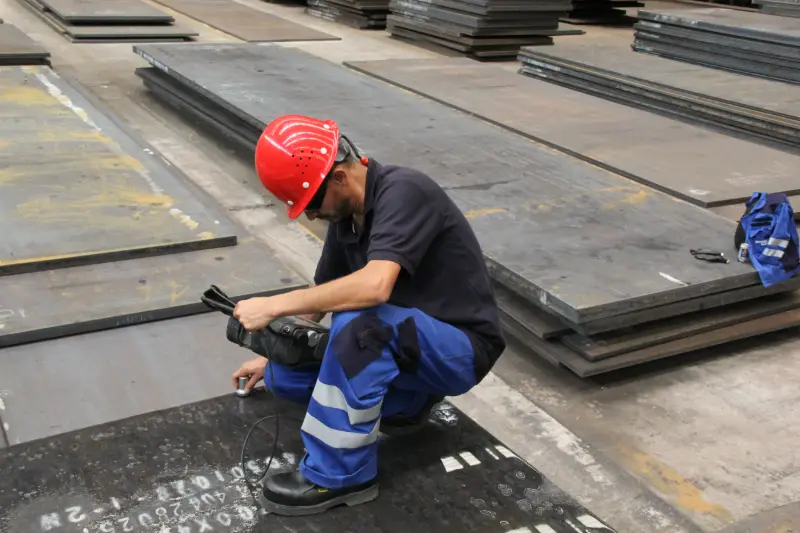
ABS Grade EH40 Shipbuilding Steel Plate
ABS Grade EH40 Shipbuilding Steel Plate: High-Strength, Low-Temperature Toughness for Arctic and Offshore Structures
Comprehensive data sheet for ABS Grade EH40 shipbuilding steel plate, including chemical composition, mechanical properties, physical properties, international equivalents, similar grades, and application guide.
Cutting, Bending, Forming, Welding (all common shipbuilding fabrication processes), Machining with care due to hardness.
- Phone : +8618037372205
- Email : [email protected]
- WhatsApp: Contact via Whtsapp
- WeChat: +8618037372205
ABS Grade EH40 Shipbuilding Steel Plate Introduction
ABS Grade EH40 is a high-strength hull structural steel plate certified by the American Bureau of Shipping (ABS) for use in shipbuilding and offshore engineering. It is designed to provide a minimum yield strength of 390 MPa (40 ksi) in thicknesses up to 100 mm, with excellent toughness down to -40°C, meeting the stringent requirements for low-temperature service in cold climates and Arctic operations. EH40 belongs to the EH (Extra High-strength with low-temperature toughness) family, combining high strength, good weldability, and reliable impact resistance. It is typically delivered in normalized or thermomechanically rolled condition and is suitable for critical structural components subjected to high stress and dynamic loading.
ABS Grade EH40 Shipbuilding Steel Plate Chemical Composition
Chemical composition limits according to ABS Rules, Part 2, Chapter 1, Table 2. The values represent ladle analysis for Grade EH40. When the maximum carbon equivalent (CEV) is specified, it is typically 0.40% for thickness ≤ 50 mm. Elements like Al, Nb, V, Ti may be added singly or in combination for grain refinement and strengthening. All values are maximums unless a range is given.
| Chemical Element | Standard Value (max, %) | Remarks |
|---|---|---|
| Carbon (C) | 0.18 | Max for EH40; depends on thickness and deoxidation practice |
| Manganese (Mn) | 0.90 - 1.60 | Range; higher Mn for thicker plates to maintain strength |
| Silicon (Si) | 0.10 - 0.50 | Typical range; killed steel |
| Phosphorus (P) | 0.025 | Max |
| Sulfur (S) | 0.025 | Max |
| Aluminum (Al) total | ≥ 0.020 | Minimum when used as grain refiner; acid-soluble Al may be specified |
| Niobium (Nb) | 0.02 - 0.05 | Optional microalloying element; if added |
| Vanadium (V) | 0.05 - 0.10 | Optional; if added |
| Titanium (Ti) | ≤ 0.02 | Optional; if added for grain refinement or inclusion control |
| Chromium (Cr) | 0.25 | Max; residual |
| Nickel (Ni) | 0.40 | Max; residual; may be added intentionally for low-temp toughness, up to 0.80% by agreement |
| Molybdenum (Mo) | 0.08 | Max; residual |
| Copper (Cu) | 0.35 | Max; residual |
| Nitrogen (N) | 0.012 | Max; if not bound by Al or Ti |
| Carbon Equivalent (CEV) | ≤ 0.40 | Typical for thickness ≤ 50 mm; CEV = C + Mn/6 + (Cr+Mo+V)/5 + (Ni+Cu)/15 |
ABS Grade EH40 Shipbuilding Steel Plate Thermal and Electrical Physical Properties
Physical properties for EH40 steel are representative for high-strength low-alloy (HSLA) shipbuilding steels. These values are not specified in ABS rules but are based on general data for similar carbon-manganese microalloyed steels. Density, modulus, and thermal properties are essential for design and welding simulation. Slight variations may occur depending on exact composition and processing.
| Property | Typical Value | Unit | Test Conditions / Remarks |
|---|---|---|---|
| Density (ρ) | 7.85 | g/cm³ | At room temperature |
| Elastic Modulus (E) | 205 - 210 | GPa | At room temperature; typical for steel |
| Shear Modulus (G) | 80 | GPa | Calculated from E and ν ~0.3 |
| Poisson's Ratio (ν) | 0.3 | — | In elastic range |
| Thermal Expansion Coefficient (α) | 11.5 - 13.5 | 10⁻⁶/K | Between 20°C and 200°C; typical carbon-manganese steel |
| Thermal Conductivity (λ) | 40 - 50 | W/(m·K) | At room temperature; decreases with increasing temperature |
| Specific Heat Capacity (cp) | 460 - 500 | J/(kg·K) | At room temperature; increases with temperature |
| Electrical Resistivity (ρ_e) | 0.15 - 0.25 | µΩ·m | At room temperature |
ABS Grade EH40 Shipbuilding Steel Plate Mechanical Properties
Tensile and impact properties are required by ABS Rules for Grade EH40. The values apply to plate thicknesses up to 100 mm. Transverse test specimens are normally required unless otherwise agreed. Yield strength and tensile strength may vary slightly with thickness. Impact test temperature is -40°C with specified minimum energy. Bending tests are guided by the standard; typically, no cracks after 180° bending over a mandrel diameter of 3t for tensile strength levels like EH40.
| Property | Standard Requirement Value | Unit | Test Conditions / Remarks |
|---|---|---|---|
| Yield Strength (ReH) min. | 390 | MPa | For thickness t ≤ 100 mm; higher thickness may need agreement |
| Tensile Strength (Rm) | 510 - 660 | MPa | For all thicknesses within the range |
| Elongation (A), min. | 20 | % | On gauge length 5.65√So (ISO 6892-1); transverse specimens |
| Elongation (A), min. | 22 | % | For thickness ≤ 12.5 mm, longitudinal specimen option |
| Bend Test (Mandrel Diameter) | 3t (t = specimen thickness) | — | 180° bend; no cracks; for tensile strength class 510-660 MPa |
| Charpy V-Notch Impact Energy (KV), min. | 41 | J | At -40°C, longitudinal specimens; transverse specimens may require higher energy by agreement |
| Charpy V-Notch Impact Energy (KV), min. | 27 | J | At -40°C, for transverse specimens if permitted; typically higher requested for critical applications |
ABS Grade EH40 Shipbuilding Steel Plate Completely Equivalent Material Standards and Replaceable Grades
| Country / Region | Standard / Classification Society | Grade / Designation | Remarks |
|---|---|---|---|
| International (IACS member societies) | Lloyd's Register (LR) | LR EH40 | Identical strength and toughness requirements; -40°C Charpy energy |
| Norway / International | DNV (Det Norske Veritas) | NV E40 (formerly REH40) | EH40 under DNV rules; sometimes designated as NV E40 |
| France / International | Bureau Veritas (BV) | BV EH40 | Equivalent grade; CEV and micro-alloying requirements harmonized |
| China / International | China Classification Society (CCS) | CCS EH40 | Adopted from IACS UR; identical tensile and impact properties |
| Japan / International | Nippon Kaiji Kyokai (ClassNK) | NK KE40 | KE40 is the NK designation for EH40 equivalent (K=high tensile, E=-40°C) |
| South Korea / International | Korean Register (KR) | KR REH40 | REH40 indicates EH40 equivalent (R=Refined, EH=extra high at -40°C) |
| Italy / International | Registro Italiano Navale (RINA) | RINA E40 | Grade E40, requiring impact at -40°C, same strength |
| European Union | EN 10025-4 | S420ML | Thermomechanical rolled structural steel with min 420 MPa yield, -50°C charpy; slightly higher strength and lower temperature, suitable substitute |
| United States | ASTM A131/A131M | Grade EH40 | Standard specification for structural steel for ships; directly corresponds to ABS EH40 |
ABS Grade EH40 Shipbuilding Steel Plate Application Introduction
ABS EH40 steel plate is engineered for critical, heavy-duty marine and offshore structures exposed to low ambient temperatures and severe sea conditions. Its high yield strength allows design with thinner sections, reducing structural weight and fabrication costs while maintaining safety. The excellent low-temperature toughness ensures resistance to brittle fracture even in polar environments. Typical applications cover a wide range of primary structural members that demand high reliability and long service life under fatigue, impact, and dynamic loading. Processing note: Welding must follow ABS-approved procedures with preheat and interpass temperature control to avoid hydrogen cracking, given its carbon equivalent. Forming should be performed at temperatures above the ductile-to-brittle transition region; hot forming may require re-normalizing if properties are altered.
Product Applications: Hull plates and shell plating for icebreakers, LNG carriers, and naval vessels, Deck plating and hatch covers requiring high strength-to-weight ratio, Main frames, girders, and transverse web frames in ship hulls, Offshore platform legs, jackets, and nodes, Pressure hulls for submarines and submersibles, Piles and main structural elements for offshore wind farms, Mooring equipment and foundations subject to high stress
Processed into products: Longitudinal stiffeners and T-bars in bottom and side shell constructions, Bilge keels and rudder horns, Transverse bulkhead plates and stringers, Crane pedestals and slewing rings, Column splices and brace connections for semi-submersibles, Shear plates and gusset plates in heavy structural nodes, RoRo vessel ramp parts and door frames, Eyebolts and padeyes for heavy lifting operations
Application industries: Shipbuilding (naval and commercial), Offshore oil and gas (platforms, FPSOs, jack-ups, and subsea structures), Renewable energy (offshore wind turbine foundations, transition pieces), Heavy engineering (crane booms, heavy-lift vessels), Arctic and ice-class vessel construction, Bridge building (specialized movable bridges or ferry ramps in cold regions)
ABS Grade EH40 Shipbuilding Steel Plate Similar or Alternative Material Recommendations
| Country / Region | Standard | Grade | Remarks |
|---|---|---|---|
| European Union | EN 10025-3 | S420N/NL | Normalized fine grain steel; S420N (-20°C), S420NL (-50°C). S420NL can be used as alternative for EH40 with enhanced toughness; yield 420 MPa. |
| European Union | EN 10025-6 | S460QL | Quenched and tempered steel; higher strength 460 MPa, low-temperature toughness down to -50°C; requires qualification for ship use. |
| Russia / CIS | GOST R 52927 | D40W or E40W | Shipbuilding steels with similar mechanical properties; suitability must be confirmed against ABS rules. |
| China | GB/T 712 | EH40 | Identical designation; GB EH40 would be an alternative but must comply with ABS certification if used on ABS-classed vessels. |
| Japan | JIS G 3106 | SM490B/YC | SM490B with yield 325 MPa is lower; SM490Y has yield 365 MPa; not direct substitute but may be considered for less demanding applications. For EH40 full replacement, JIS G 3106 SM520B/C or JIS G 3128 SHY685 may be closer depending on strength. |
| International | API 2H Grade 50 | API 2H-50 | Offshore structural steel plate with 345-517 MPa yield, Charpy at -40°C; lower minimum yield than EH40 (50 ksi ~345 MPa), but alternative for offshore platforms with adjustment in design. |
Notes:
Certification: EH40 steel must be produced by ABS-approved mills and delivered with ABS inspection certificates (material certificate type 3.1 or 3.2 as per EN 10204). Each plate is stamped with the ABS brand, grade, heat number, and the surveyor's mark. Testing frequency: Tensile and impact tests are performed per cast and per rolling unit as per ABS rules. Additional requirements may apply for thickness above 50 mm, such as ultrasonic testing (UT) to EN 10160 or ASTM A435. Weldability: The CEV typically ≤ 0.40% ensures good weldability, but a welding procedure specification (WPS) is mandatory. For thickness > 30 mm, a minimum preheat of 100-150°C is often recommended. Post-weld heat treatment (PWHT) is not normally required unless specified for thick components to relieve residual stress. Corrosion resistance: As a carbon-manganese steel, EH40 is not inherently corrosion-resistant; suitable coating and cathodic protection systems must be applied for marine service. Supply condition: Plates are usually supplied with shot-blasting and shop primer coating to protect against corrosion during storage and construction.
- Share



