
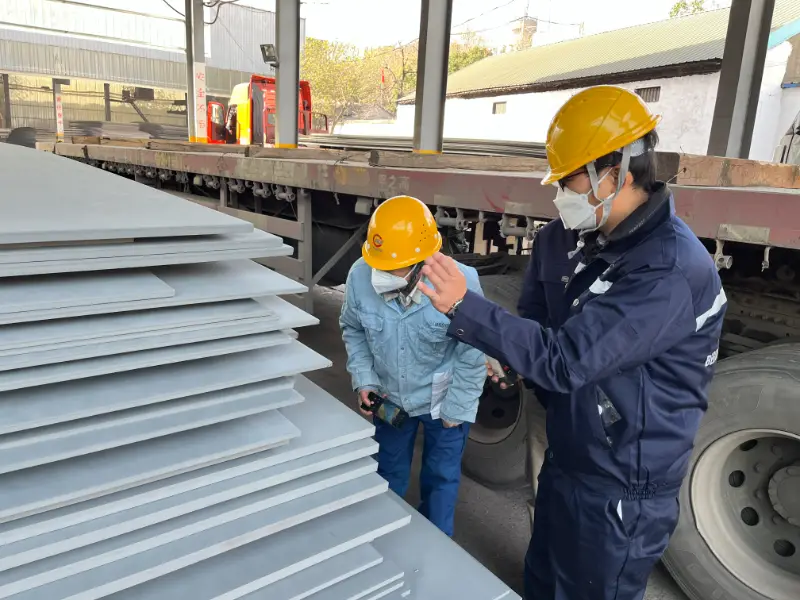
CCS Grade FH36 Shipbuilding Steel Plate
CCS Grade FH36 Shipbuilding Steel Plate - High Strength Hull Structural Steel for Icy & Severe Conditions
CCS FH36 is a high-strength hull structural steel plate with a minimum yield strength of 355 MPa and excellent low-temperature toughness down to -60°C, certified by China Classification Society. Ideal for critical ship structures in ice-class vessels and harsh environments.
Hot rolling, Normalizing (N), Thermo-mechanical Controlled Processing (TMCP), Quenching and Tempering (Q+T) as agreed
- Phone : +8618037372205
- Email : [email protected]
- WhatsApp: Contact via Whtsapp
- WeChat: +8618037372205
CCS Grade FH36 Shipbuilding Steel Plate Introduction
CCS Grade FH36 is a high-strength hull structural steel plate classified under China Classification Society rules for shipbuilding. It belongs to the EH/FH family, providing a minimum yield strength of 355 MPa and tensile strength between 490 and 620 MPa, with a focus on superior low-temperature impact toughness. The F designation indicates impact testing at -60°C, making it especially suitable for ice-going vessels, Arctic structures, and other demanding cold-climate marine applications. FH36 steel is fully killed and fine-grain treated, often microalloyed with elements like Nb, V, Ti, and Al to ensure consistent mechanical properties in thick sections. It is supplied in normalized or thermo-mechanically controlled processed (TMCP) condition, ensuring excellent weldability and formability. This steel complies with CCS Part 2, Chapter 1 for hull structural steels and has international equivalents under IACS unified requirements.
CCS Grade FH36 Shipbuilding Steel Plate Chemical Composition
The chemical composition of FH36 steel is controlled to ensure high strength and excellent low-temperature toughness. Maximum limits are specified for carbon, phosphorus, and sulfur to enhance weldability. Microalloying elements such as niobium, vanadium, and titanium are typically added for grain refinement and precipitation strengthening. Carbon equivalent (CEQ) is usually restricted to ≤0.38% for weldability. The values below comply with CCS Rules for FH36.
| Element | Specification Value (max, unless range) | Remarks |
|---|---|---|
| C | ≤0.18% | Carbon |
| Mn | 0.90–1.60% | Manganese |
| Si | ≤0.50% | Silicon |
| P | ≤0.025% | Phosphorus |
| S | ≤0.025% | Sulfur |
| Al (acid soluble) | ≥0.015% (total Al typically ≥0.020%) | Grain refining element |
| Nb | 0.02–0.05% | Niobium (columbium), optional but common |
| V | 0.05–0.10% | Vanadium, optional |
| Ti | ≤0.02% | Titanium, optional |
| Cu | ≤0.35% | Copper, if specified |
| Cr | ≤0.20% | Chromium, if specified |
| Ni | ≤0.40% | Nickel, if specified |
| Mo | ≤0.08% | Molybdenum, if specified |
| CEQ (IIW) | ≤0.38% (typical) | Carbon equivalent for weldability |
CCS Grade FH36 Shipbuilding Steel Plate Thermal and Electrical Properties
These physical properties are typical for carbon-manganese and microalloyed shipbuilding steels in the FH36 category. Actual values may vary slightly depending on the exact composition and heat treatment. Data based on standard engineering references for low-carbon structural steel at room temperature unless noted.
| Property | Typical Value | Unit | Test Condition / Remarks |
|---|---|---|---|
| Density (ρ) | 7850 | kg/m³ | At 20°C |
| Modulus of Elasticity (E) | 205 | GPa | Tension, at 20°C |
| Shear Modulus (G) | 80 | GPa | Calculated from E and ν |
| Poisson's Ratio (ν) | 0.29 | - | Elastic range, at 20°C |
| Thermal Expansion Coefficient (α) | 11.7 × 10⁻⁶ | /K | Mean coefficient for 20–100°C |
| Thermal Expansion Coefficient (α) | 12.5 × 10⁻⁶ | /K | Mean coefficient for 20–200°C |
| Thermal Expansion Coefficient (α) | 13.2 × 10⁻⁶ | /K | Mean coefficient for 20–300°C |
| Thermal Conductivity (λ) | 52 | W/(m·K) | At 20°C |
| Thermal Conductivity (λ) | 46 | W/(m·K) | At 200°C |
| Specific Heat Capacity | 480 | J/(kg·K) | At 20°C |
| Electrical Resistivity (ρe) | 0.18–0.22 | μΩ·m | At 20°C (typical for C-Mn steel) |
CCS Grade FH36 Shipbuilding Steel Plate Mechanical Properties
FH36 steel plates must meet both tensile and impact requirements. Yield strength (ReH) is guaranteed for thicknesses up to 100 mm. Charpy V-notch impact energy is tested at -60°C with a minimum average value specified for longitudinal specimens. Testing is performed in accordance with CCS requirements. Values may vary with thickness and rolling condition.
| Property | Standard Requirement | Unit | Test Condition / Remarks |
|---|---|---|---|
| Yield Strength (ReH) | ≥355 | MPa | For thickness ≤100 mm |
| Tensile Strength (Rm) | 490–620 | MPa | For thickness ≤100 mm |
| Elongation (A) | ≥21 | % | Gauge length 5.65√So (200 mm)*; minimum for thickness ≤50 mm, may reduce for thicker |
| Charpy V-notch Impact Energy (KV) | ≥34 (average of 3 specimens), ≥24 (individual) | J | Longitudinal specimens at -60°C |
| Bend Test (Bend angle 180°) | No cracks | - | Mandrel diameter: 3×thickness for t≤25 mm, 4×t for t>25 mm, based on CCS |
CCS Grade FH36 Shipbuilding Steel Plate Identical Material Standards and Replaceable Grades
| Country/Region | Standard | Grade | Remarks |
|---|---|---|---|
| China | CCS Rules | FH36 | Original grade; IACS member certification |
| USA | ABS Rules | FH36 | Identical IACS UR W11 specification |
| Norway/Germany | DNV Rules | FH36 | DNV GL (now DNV) high-strength ship steel FH36 |
| UK | LR Rules | FH36 | Lloyd's Register FH36 |
| France | BV Rules | FH36 | Bureau Veritas FH36 |
| Japan | NK Rules (ClassNK) | FH36 | Nippon Kaiji Kyokai FH36 |
| South Korea | KR Rules | FH36 | Korean Register FH36 |
| Italy | RINA Rules | FH36 | Registro Italiano Navale FH36 |
| Russia | RS Rules | FH36 | Russian Maritime Register FH36 |
CCS Grade FH36 Shipbuilding Steel Plate Application Introduction
CCS FH36 steel is engineered for critical hull structures requiring high strength and exceptional notch toughness at very low temperatures. Its typical uses are in ice-class vessels and Arctic offshore structures where service temperatures reach -40°C and below. The TMCP condition ensures excellent weldability without preheating in many cases, reducing fabrication costs. Plates can be formed, cut, and welded using standard procedures for shipbuilding. Common applications include:
Product Applications: Ice-class container ships and tankers, LNG carriers with ice strengthening, Offshore supply vessels (PSV, AHTS) for Arctic, Floating production storage and offloading (FPSO) hulls in cold regions, Icebreakers and icebreaking tugboats, Arctic patrol vessels
Processed into products: Main deck plates and shell plating subject to ice impact, Side shell strake at ice belt (reinforced ice belt), Longitudinal and transverse bulkheads in cargo area, Bottom and bilge plates in high-stress regions, Web frames, stringers, and stiffeners, Hatch coamings and crane pedestals, Bow and stern thruster foundations
Application industries: Shipbuilding and marine engineering, Offshore oil & gas upstream (platforms, FPSO hulls), Arctic and polar research vessels, Naval defense (ice-strengthened ships), Heavy civil construction (ice barriers, lock gates), Renewable offshore wind (substructures for cold waters)
CCS Grade FH36 Shipbuilding Steel Plate Close/Similar Alternative Material Recommendations
| Country/Region | Standard | Grade | Remarks |
|---|---|---|---|
| China | GB/T 712 | FH36 | Chinese national standard for hull structural steel; identical to CCS FH36 |
| International | EN 10025 | S355ML/S355G10+M (modified) | Structural steel for offshore and shipbuilding; low-temperature toughness may be achieved with option (-50°C or -60°C). Not fully equivalent, but provides similar yield strength and improved toughness; requires agreement on impact test temperature. |
| International | API 2W | Grade 50T (TMCP) | Steel for offshore platforms; similar strength and impact at -40°C to -60°C depending on class; additional chemistry limits for weldability. |
| Japan | JIS G 3106 | SM490B/C/YC (special option) | Welded structural steel; needs low-temperature impact test supplement to match FH36 toughness; typically only down to -20°C in standard. |
| USA | ASTM A131 | FH36 | ASTM standard for shipbuilding, FH36 is identical by IACS UR. Direct replacement. |
Notes:
- For thickness above 50 mm, elongation may be reduced by 1% per 12.5 mm reduction in gauge length; consult CCS Rules for exact requirements.
- The required impact energy of 34 J is an average over three specimens; if one specimen gives a value lower than 24 J but the average is ≥34 J, the test is acceptable; otherwise retest rules apply.
- TMCP (Thermo-Mechanical Controlled Process) delivery is preferred for improved toughness and weldability; hot forming or high heat input welding may require supplementary testing to confirm properties after fabrication.
- CEQ limits should be agreed upon between purchaser and manufacturer; a typical maximum of 0.38% (IIW) is applied for good weldability, but lower values may be specified for severe cold service.
- This steel is generally not intended for elevated temperature service, as strength decreases rapidly above approximately 400°C.
- Share



