
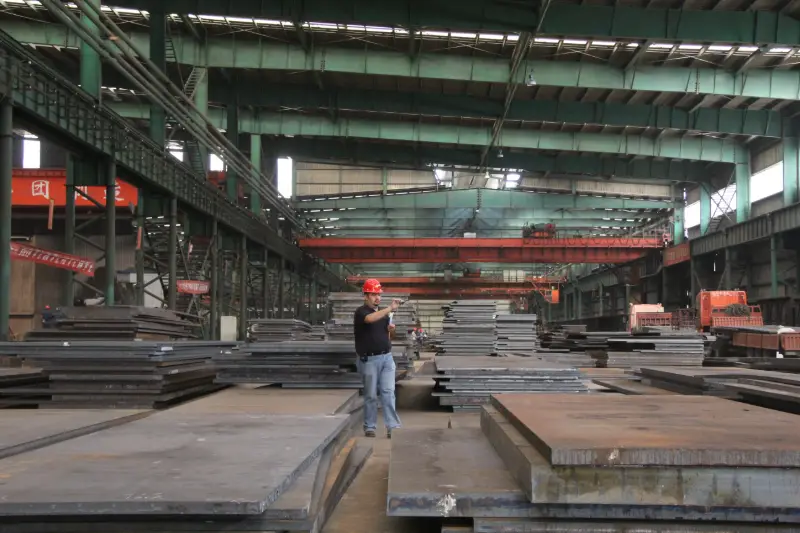
CCS Grade AH40 Shipbuilding Steel Plate
CCS Grade AH40 Shipbuilding Steel Plate – Composition, Properties & Equivalent Standards
Comprehensive data sheet for CCS Grade AH40 shipbuilding steel plate: chemical composition, mechanical properties, thermal and electrical physical properties, fully equivalent international grades, and application guide.
Cutting, cold forming, hot forming, welding, bending, edge preparation
- Phone : +8618037372205
- Email : [email protected]
- WhatsApp: Contact via Whtsapp
- WeChat: +8618037372205
CCS Grade AH40 Shipbuilding Steel Plate Introduction
CCS Grade AH40 is a high-strength hull structural steel specified by the China Classification Society (CCS). It is categorized under the AH (normal-temperature impact test at 0 °C) series with a minimum yield strength of 390 MPa, providing excellent weldability and toughness for shipbuilding and offshore structures. The steel is typically supplied in normalized, thermomechanical control process (TMCP), or as-rolled condition, and is suitable for critical structural components such as deck plates, bottom shells, and transverse bulkheads in marine environments.
CCS Grade AH40 Shipbuilding Steel Plate Chemical Composition
The following table summarizes the ladle analysis limits for CCS Grade AH40 steel. The values are in accordance with the CCS Rules for Materials and Welding for high-strength hull structural steels. All values are maximum unless a range is stated.
| Element | Standard Value (max, unless range) | Remarks |
|---|---|---|
| Carbon (C) | ≤ 0.18 | Ladle analysis |
| Silicon (Si) | ≤ 0.50 | |
| Manganese (Mn) | 0.90 – 1.60 | |
| Phosphorus (P) | ≤ 0.035 | |
| Sulfur (S) | ≤ 0.035 | |
| Niobium (Nb) | 0.02 – 0.05 | |
| Vanadium (V) | 0.05 – 0.10 | |
| Titanium (Ti) | ≤ 0.02 | |
| Aluminum (Altot or Als) | ≥ 0.015 (acid soluble) | Minimum requirement |
| Chromium (Cr) | ≤ 0.20 | Residual element (unless intentionally added) |
| Nickel (Ni) | ≤ 0.40 | Residual element (unless intentionally added) |
| Copper (Cu) | ≤ 0.35 | Residual element (unless intentionally added) |
| Molybdenum (Mo) | ≤ 0.08 | Residual element (unless intentionally added) |
CCS Grade AH40 Shipbuilding Steel Plate Thermal and Electrical Physical Properties
Typical physical property data for CCS AH40 steel at ambient and elevated temperatures. These values are for general engineering calculations and are not mandatory specification requirements, unless the steel is ordered for special service. Properties are similar to those of carbon-manganese structural steels.
| Property | Typical Value | Unit | Test Condition / Remarks |
|---|---|---|---|
| Density (ρ) | 7.85 | g/cm³ | At 20 °C |
| Modulus of Elasticity (E) | 206 | GPa | At 20 °C |
| Shear Modulus (G) | 80 | GPa | At 20 °C |
| Poisson's Ratio (ν) | 0.30 | – | At 20 °C |
| Thermal Expansion Coefficient (α) | 11.7 × 10⁻⁶ | K⁻¹ | 20 – 100 °C |
| Thermal Expansion Coefficient (α) | 12.3 × 10⁻⁶ | K⁻¹ | 20 – 200 °C |
| Thermal Expansion Coefficient (α) | 13.0 × 10⁻⁶ | K⁻¹ | 20 – 300 °C |
| Thermal Conductivity (λ) | 52 | W/(m·K) | At 20 °C |
| Thermal Conductivity (λ) | 49 | W/(m·K) | At 100 °C |
| Specific Heat Capacity (cp) | 460 | J/(kg·K) | At 20 °C |
| Electrical Resistivity (ρe) | 0.22 × 10⁻⁶ | Ω·m | At 20 °C |
CCS Grade AH40 Shipbuilding Steel Plate Mechanical Properties
Mechanical test requirements for CCS Grade AH40 plates are based on the CCS Rules. Tensile and impact values apply to specimens taken transverse to the rolling direction, unless longitudinal impact values are specified. All values are minimum unless stated otherwise.
| Property | Standard Required Value | Unit | Test Condition / Remarks |
|---|---|---|---|
| Yield Strength (ReH) | ≥ 390 | MPa | Plate thickness ≤ 50 mm |
| Yield Strength (ReH) | ≥ 370 | MPa | Plate thickness > 50 mm ≤ 70 mm |
| Yield Strength (ReH) | ≥ 350 | MPa | Plate thickness > 70 mm ≤ 100 mm |
| Tensile Strength (Rm) | 510 – 650 | MPa | All thickness grades |
| Elongation after fracture (A) | ≥ 20 (L0 = 5.65√S0) | % | Thickness ≤ 50 mm |
| Elongation after fracture (A) | ≥ 19 (L0 = 5.65√S0) | % | Thickness > 50 mm ≤ 70 mm |
| Elongation after fracture (A) | ≥ 18 (L0 = 5.65√S0) | % | Thickness > 70 mm ≤ 100 mm |
| Bend Test (Bend diameter) | 3t (thickness t ≤ 25 mm) | – | 180° bending, mandrel diameter; no cracks |
| Bend Test (Bend diameter) | 4t (thickness t > 25 mm) | – | 180° bending, mandrel diameter; no cracks |
| Charpy Impact Energy (KV) Long. | ≥ 34 | J | At 0 °C, longitudinal specimens |
| Charpy Impact Energy (KV) Trans. | ≥ 24 | J | At 0 °C, transverse specimens (informative) |
CCS Grade AH40 Shipbuilding Steel Plate Fully Equivalent Material Standards and Replaceable Grades
| Country / Region | Standard / Rule | Grade | Remarks |
|---|---|---|---|
| International | IACS Unified Requirement UR W11 | AH40 | Common base standard for classification societies |
| USA | ABS Rules | AH40 | American Bureau of Shipping – identical mechanical requirements |
| Norway / Germany | DNV Rules | AH40 | DNV GL (now DNV) high-strength hull steel |
| UK | LR Rules | AH40 | Lloyd's Register – equivalent grade |
| France | BV Rules | AH40 | Bureau Veritas |
| Japan | NK Rules | AH40 | ClassNK – fully interchangeable |
| Italy | RINA Rules | AH40 | Registro Italiano Navale |
| South Korea | KR Rules | AH40 | Korean Register – same minimum properties |
| Russia | RMRS Rules | A40 (AH40 equivalent) | Russian Maritime Register of Shipping; may be designated with different impact temperature suffix |
CCS Grade AH40 Shipbuilding Steel Plate Application Introduction
CCS Grade AH40 is widely used in marine and offshore construction. Its combination of high strength, good weldability, and guaranteed impact toughness at 0 °C makes it ideal for primary structural members. Typical delivery conditions (TMCP or normalized) facilitate cold and hot forming operations. The steel can be processed by:
- Flame cutting, plasma cutting, and waterjet cutting
- Cold bending and roll forming
- Welding with low-hydrogen consumables (preheating may be required for thick sections)
- Shot blasting and primer coating for corrosion protection
Product Applications: Hull plates (side shell, bottom shell, deck plating), Transverse and longitudinal bulkheads, Deck girders and longitudinals, Bottom floors and web frames, Jacket legs and bracing for offshore structures, Caissons and subsea templates
Processed into products: Rolled and welded stiffened panels, Transverse frames and brackets, Rudder horns and stem plates, Boat landing fender supports, Padeyes and lifting lugs, Module support stools
Application industries: Shipbuilding and ship repair, Offshore oil & gas platforms, Marine renewable energy (offshore wind foundations), Port and harbor infrastructure, Heavy engineering and fabrication
CCS Grade AH40 Shipbuilding Steel Plate Similar / Alternative Materials with Comparable Performance
| Country / Region | Standard / Specification | Grade | Remarks |
|---|---|---|---|
| International | CCS Rules | DH40 | Same strength, but impact tested at -20 °C; can replace AH40 in lower-temperature service |
| International | CCS Rules | EH40 | Same strength, impact tested at -40 °C; superior toughness |
| International | CCS Rules | AH36 / DH36 / EH36 | Lower yield strength (≥ 355 MPa); for applications requiring less strength |
| China | GB 712-2011 | AH40 | Chinese national standard for shipbuilding steel; identical chemical and mechanical requirements |
| Europe | EN 10025-4 | S420M / S420ML | Thermo-mechanical rolled weldable fine grain structural steel with min. yield 420 MPa; not certified for classification but usable in offshore structures where rules permit |
| USA | ASTM A131 / A131M | AH40 (Grade AH40) | ASTM standard for shipbuilding steel, equivalent strength, but certification must be validated per classification society |
Notes:
Certification: Material must be supplied with CCS or alternative classification society certification. General manufacturing tolerances follow the applicable CCS Rules or IACS Recommendation. Weldability: Carbon equivalent (CEV) is typically controlled to ≤ 0.40% to ensure crack-free welding; CEV formula: C + Mn/6 + (Cr+Mo+V)/5 + (Ni+Cu)/15. Non-destructive testing: Ultrasonic or radiographic inspection may be specified depending on application criticality.
- Share



