
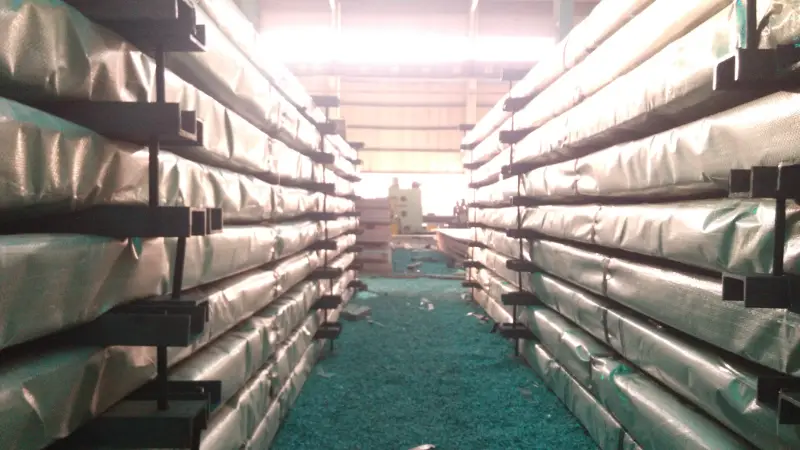
ABS Grade FQ51 Shipbuilding Steel Plate
ABS Grade FQ51 Quenched & Tempered High-Strength Shipbuilding Steel – Data Sheet & Equivalents
Complete material data for ABS Grade FQ51 shipbuilding steel: chemical composition, mechanical properties, thermal & electrical physical properties, international equivalents, and application guide.
Hot rolling, quenching and tempering, welding, cutting, forming (cold or hot)
- Phone : +8618037372205
- Email : [email protected]
- WhatsApp: Contact via Whtsapp
- WeChat: +8618037372205
ABS Grade FQ51 Shipbuilding Steel Plate Introduction
ABS Grade FQ51 is a high-strength quenched and tempered shipbuilding steel plate with a minimum yield strength of 51 ksi (355 MPa). It is certified by the American Bureau of Shipping (ABS) for use in marine and offshore structures. The 'F' denotes that the steel can be used at extremely low temperatures with guaranteed impact toughness at -60 °C. The 'Q' indicates quenching and tempering heat treatment, which refines the grain structure to achieve high strength while maintaining excellent ductility and notch toughness. This grade offers superior weldability and is typically supplied in normalized or quenched and tempered condition. It is widely used in critical structural components such as hulls, decks, and offshore platform legs, where reliability under severe service conditions is paramount.
ABS Grade FQ51 Shipbuilding Steel Plate Chemical Composition
The chemical composition conforms to ABS Rules Part 2, Table 2 for Grade FQ51. The steel is fully killed and fine grain treated. Microalloying elements such as Nb, V, Ti may be added singly or in combination to refine grain size.
- Maximum limits for P and S ensure high cleanliness.
- Al is required as grain refiner.
- CE (Carbon Equivalent) is usually controlled to ensure weldability, typically ≤ 0.43% (by agreement).
| Element | Standard Value (wt%) | Remarks |
|---|---|---|
| Carbon (C) | ≤ 0.18 | Ladle analysis |
| Manganese (Mn) | 0.90 – 1.60 | For thickness ≤ 25.4 mm; may be adjusted for thicker plates |
| Silicon (Si) | 0.10 – 0.50 | Killing element |
| Phosphorus (P) | ≤ 0.025 | Maximum |
| Sulfur (S) | ≤ 0.025 | Maximum |
| Chromium (Cr) | ≤ 0.20 | Residual |
| Nickel (Ni) | ≤ 0.40 | Residual |
| Molybdenum (Mo) | ≤ 0.08 | Residual |
| Copper (Cu) | ≤ 0.35 | Residual |
| Aluminum (Al, acid-soluble) | ≥ 0.015 | Minimum for fine grain practice |
| Niobium (Nb) | 0.02 – 0.05 | Grain refiner |
| Vanadium (V) | 0.05 – 0.10 | Optional grain refiner |
| Titanium (Ti) | ≤ 0.02 | Optional grain refiner |
| Nitrogen (N) | ≤ 0.009 | Maximum |
ABS Grade FQ51 Shipbuilding Steel Plate Thermal and Electrical Physical Properties
The following values are typical reference data for quenched and tempered low-alloy carbon steel at room temperature unless otherwise noted. These are not part of the ABS specification but are useful for engineering calculations.
- Density variation is negligible for this grade.
- Thermal conductivity decreases slightly with increasing temperature; the given value is at 20 °C.
- Electrical resistivity is based on common structural steel data.
| Property | Typical Value | Unit | Test Condition |
|---|---|---|---|
| Density (ρ) | 7.85 | g/cm³ | Room temperature |
| Elastic Modulus (E) | 205 | GPa | Room temperature; tension |
| Shear Modulus (G) | 80 | GPa | Calculated from E and ν |
| Poisson's Ratio (ν) | 0.3 | — | Room temperature, elastic range |
| Thermal Expansion Coefficient (α) | 12.0 × 10⁻⁶ | K⁻¹ | Average 20 – 100 °C |
| Thermal Expansion Coefficient (α) | 13.0 × 10⁻⁶ | K⁻¹ | Average 20 – 200 °C |
| Thermal Expansion Coefficient (α) | 13.7 × 10⁻⁶ | K⁻¹ | Average 20 – 300 °C |
| Thermal Conductivity (λ) | 50 | W/(m·K) | At 20 °C |
| Specific Heat Capacity (cp) | 460 | J/(kg·K) | Room temperature |
| Electrical Resistivity (ρe) | 0.20 – 0.25 | µΩ·m | At 20 °C |
ABS Grade FQ51 Shipbuilding Steel Plate Mechanical Properties
Mechanical properties are specified in ABS Rules Part 2, Chapter 1, Section 3. Values apply to quenched and tempered plates tested in the transverse direction unless otherwise agreed.
- Tensile and yield requirements depend on plate thickness. For thickness > 100 mm, properties shall be agreed between the manufacturer and ABS.
- Charpy V-notch impact tests are performed at -60 °C for Grade F. Minimum average absorbed energy is 27 J for thickness ≤ 50 mm; for thicker plates, the requirement may be increased or agreed.
- Bend test mandates no cracks on the outside of the bent specimen.
| Property | Specified Value | Unit | Test Condition / Remarks |
|---|---|---|---|
| Yield Strength (ReH) | ≥ 355 | MPa | Upper yield or 0.2% proof strength; plate thickness ≤ 100 mm |
| Tensile Strength (Rm) | 490 – 620 | MPa | Plate thickness ≤ 100 mm |
| Elongation (A) | ≥ 21 | % | Gauge length 5.65√S₀; thickness ≤ 50 mm |
| Elongation (A) | ≥ 19 | % | Thickness > 50 mm ≤ 70 mm |
| Elongation (A) | ≥ 17 | % | Thickness > 70 mm ≤ 100 mm |
| Charpy Impact Energy (KV) | ≥ 27 (average) | J | Longitudinal; -60 °C; thickness ≤ 50 mm |
| Charpy Impact Energy (KV) | ≥ 19 (individual) | J | Longitudinal; -60 °C; thickness ≤ 50 mm |
| Charpy Impact Energy (KV) | As agreed | J | Thickness > 50 mm; minimum values scaled to thickness |
| Bend Test (D = mandrel diameter, t = specimen thickness) | No cracks | — | D = 3t (thickness ≤ 50 mm); D = 4t (thickness > 50 mm ≤ 100 mm); 180° bend |
ABS Grade FQ51 Shipbuilding Steel Plate Fully Equivalent Material Standards and Replaceable Grades
| Country/Region | Standard / Classification Society | Grade | Remarks |
|---|---|---|---|
| International | DNV GL Rules for Ships | FQ51 | Identical yield and impact requirements; subject to individual society approval |
| International | Lloyd's Register (LR) Rules | FQ51 | Equivalent high-strength Q&T steel |
| International | Bureau Veritas (BV) Rules | FQ51 | Same designation |
| International | China Classification Society (CCS) Rules | FQ51 | Same designation |
| International | ClassNK (NK) Rules | FQ51 | Same designation |
| International | RINA Rules | FQ51 | Same designation |
ABS Grade FQ51 Shipbuilding Steel Plate Application Introduction
ABS FQ51 steel is designed for the most demanding marine and offshore environments where high strength, excellent low-temperature toughness, and reliable weldability are essential. The quenched and tempered microstructure provides a uniform balance of strength and ductility, making it suitable for critical structural components subjected to high stress, fatigue, and impacts.
- Preheating and post-weld heat treatment (PWHT) practices should follow ABS guidelines to avoid hydrogen cracking.
- Can be cut and formed using standard methods; cold forming may require stress relief.
Product Applications: Hull plates and shell plating, Strength decks and stringers, Bottom and side longitudinal frames, Transverse bulkheads and web frames, Jack-up rig legs and spudcans, Deck modules and helidecks, Mooring system structures, Icebreaker belts and bow sections
Processed into products: Ship hull main deck plates, Stiffeners and girders, Rudder horns and stern frames, Offshore jacket braces and nodes, Padeyes and lifting lugs (subject to through-thickness properties), Fatigue-sensitive weld details, Structural inserts at hatch corners, Towing and mooring brackets
Application industries: Shipbuilding (commercial and naval), Offshore oil & gas platforms, Renewable energy (offshore wind turbine foundations), Polar and ice-class vessels, Marine heavy lifting and crane structures
ABS Grade FQ51 Shipbuilding Steel Plate Similar / Comparable Material Recommendations
| Country/Region | Standard / Specification | Grade | Remarks |
|---|---|---|---|
| Europe | EN 10225 | S355G10+Q | Similar yield (355 MPa), Q&T condition, but minimum Charpy temperature -40 °C vs. -60 °C for ABS FQ51 |
| USA | ASTM A514 / A514M | Grade F or Q | Higher strength (690 MPa); not directly equivalent but used in offshore structures; requires careful weld procedure |
| USA | ABS Rules | FH51 | Same strength level and -60 °C impact, but processed by thermo-mechanical controlled rolling (TMCP) instead of Q&T |
| USA | API 2W | Grade 50T | Offshore structural steel with yield 50 ksi (345 MPa); impact test at -40 °C; similar plate applications |
Notes:
Additional notes:
- Through-thickness properties (Z-quality) may be specified according to ABS Rules for improved lamellar tearing resistance.
- Plates are normally supplied with ABS survey, including ultrasonic testing (UT) per the material specification.
- Weldability equivalent carbon (CE) formula: CE = C + Mn/6 + (Cr+Mo+V)/5 + (Ni+Cu)/15. For FQ51, CE is typically below 0.43% when ordered with weldability guarantee.
- For service temperatures below -60 °C, additional Charpy tests may be required and agreed upon case by case.
- All data provided are based on the latest ABS Rules for Materials and Welding (2024 edition) and typical steel reference properties.
- Share



