
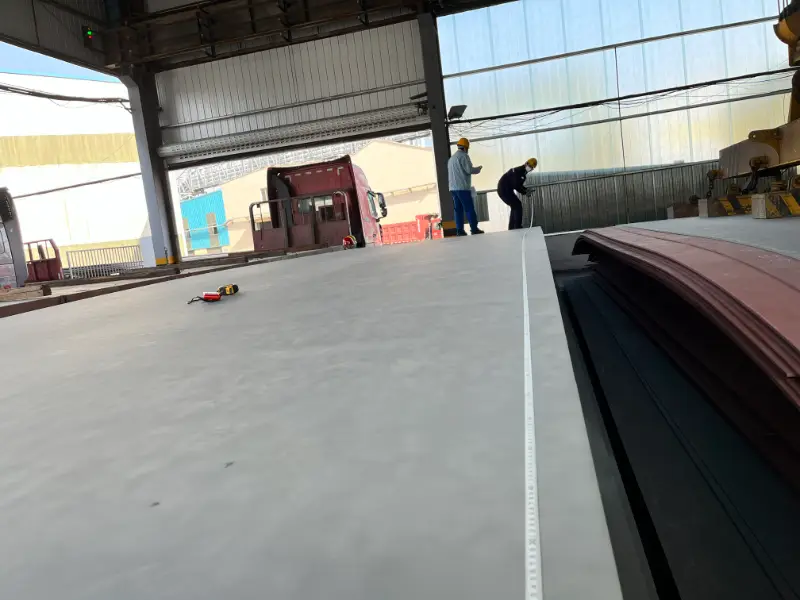
ABS Grade AQ70 Quenched & Tempered High-Strength Shipbuilding Steel
ABS Grade AQ70 Shipbuilding Steel Plate – Quenched & Tempered 690 MPa Yield Strength Marine Steel
Comprehensive technical data for ABS Grade AQ70 shipbuilding steel plate including chemical composition, mechanical and physical properties, international equivalents, and application guidance.
Hot rolling, quenching, tempering; suitable for welding, cutting, cold forming (with precautions), and machining.
- Phone : +8618037372205
- Email : [email protected]
- WhatsApp: Contact via Whtsapp
- WeChat: +8618037372205
ABS Grade AQ70 Quenched & Tempered High-Strength Shipbuilding Steel Introduction
ABS Grade AQ70 is a high-strength, quenched and tempered shipbuilding steel with a minimum yield strength of 690 MPa. It belongs to the ABS (American Bureau of Shipping) Rules for Materials and Welding, Part 2, Chapter 1, for higher-strength hull structural steels. This grade is designed for critical load-bearing components in offshore structures and naval vessels where weight reduction and high structural integrity are essential. The steel exhibits excellent toughness at low temperatures down to -40 °C, good weldability through controlled carbon equivalent, and uniform mechanical properties through thickness. Key characteristics:
- High yield strength (≥690 MPa) enabling lightweight designs
- Excellent low-temperature impact toughness (≥50 J at -40 °C)
- Controlled composition for improved weldability
- Quenched and tempered condition for optimum strength-toughness balance
- Stringent ultrasonic testing per ABS requirements
ABS Grade AQ70 Quenched & Tempered High-Strength Shipbuilding Steel Chemical Composition
Chemical composition according to ABS Rules for Materials and Welding for Grade AQ70. The steel is micro-alloyed with Nb, V, Ti, or Al to achieve fine grain size and high strength after quenching and tempering. Carbon equivalent (CEV) is controlled to ensure weldability.
- Values are maximum unless a range is indicated.
- Titanium may be used for grain refinement, with a minimum of 0.007% if added.
- Aluminum is added as a grain refiner and deoxidizer, acid-soluble Al ≥ 0.015% is typically required.
| Element | Specified Value (max, %) | Remarks |
|---|---|---|
| Carbon (C) | 0.20 | Max |
| Manganese (Mn) | 1.70 | Max |
| Silicon (Si) | 0.10 - 0.55 | Range |
| Phosphorus (P) | 0.025 | Max |
| Sulfur (S) | 0.025 | Max |
| Chromium (Cr) | 1.50 | Max |
| Nickel (Ni) | 2.00 | Max |
| Molybdenum (Mo) | 0.70 | Max |
| Copper (Cu) | 0.50 | Max |
| Vanadium (V) | 0.12 | Sum of Nb+V+Ti ≤ 0.12%; V max 0.10% |
| Niobium (Nb) | 0.05 | Sum of Nb+V+Ti ≤ 0.12%; Nb max 0.05% |
| Titanium (Ti) | 0.05 | Sum of Nb+V+Ti ≤ 0.12%; if added, Ti ≥ 0.007% |
| Aluminum (Al) | ≥ 0.015 (acid-soluble) | Usually required for fine grain practice |
| Nitrogen (N) | 0.012 | Max when V is used |
| Boron (B) | 0.005 | Max, if added |
ABS Grade AQ70 Quenched & Tempered High-Strength Shipbuilding Steel Thermal and Electrical Physical Properties
Physical properties are typical for quenched and tempered low-alloy steel of approximately 690 MPa yield strength. These values are for guidance and may vary slightly with exact composition and heat treatment.
- Density and elastic moduli are measured at room temperature unless stated otherwise.
- Thermal expansion coefficient is averaged over the indicated temperature range.
| Property | Typical Value | Unit | Test Condition / Remarks |
|---|---|---|---|
| Density (ρ) | 7.85 | g/cm³ | 20 °C |
| Elastic Modulus (E) | 205 | GPa | 20 °C |
| Shear Modulus (G) | 80 | GPa | 20 °C, calculated from E and ν |
| Poisson's Ratio (ν) | 0.28 | - | 20 °C |
| Thermal Expansion Coefficient (α) | 12.0 | 10⁻⁶/K | 20 - 100 °C |
| Thermal Expansion Coefficient (α) | 12.5 | 10⁻⁶/K | 20 - 200 °C |
| Thermal Expansion Coefficient (α) | 13.0 | 10⁻⁶/K | 20 - 300 °C |
| Thermal Conductivity (λ) | 38 | W/(m·K) | 20 °C |
| Thermal Conductivity (λ) | 36 | W/(m·K) | 200 °C |
| Thermal Conductivity (λ) | 34 | W/(m·K) | 400 °C |
| Specific Heat Capacity (c_p) | 460 | J/(kg·K) | 20 °C |
| Specific Heat Capacity (c_p) | 520 | J/(kg·K) | 200 °C |
| Electrical Resistivity (ρ_e) | 0.25 | µΩ·m | 20 °C |
ABS Grade AQ70 Quenched & Tempered High-Strength Shipbuilding Steel Mechanical Properties
Mechanical properties for ABS AQ70 plates up to 100 mm thickness range. Testing is performed in the quenched and tempered condition.
- Values are minimum unless specified.
- Absorbed energy values are for longitudinal Charpy V-notch specimens.
- Through-thickness reduction of area (Z) testing may be required for critical applications per ABS.
| Property | Specified Value | Unit | Test Condition |
|---|---|---|---|
| Yield Strength (ReH) | 690 | MPa | Ambient; thickness ≤ 100 mm, transverse |
| Tensile Strength (Rm) | 770 to 940 | MPa | Ambient; thickness ≤ 100 mm, transverse |
| Elongation (A) | ≥ 14 | % | Gauge length 5.65√S₀; transverse |
| Charpy V-notch Impact Energy (KV₂) | ≥ 50 (longitudinal) | J | -40 °C |
| Charpy V-notch Impact Energy (KV₂) | ≥ 34 (transverse) | J | -40 °C |
| Bend Test (mandrel diameter) | No cracks | - | 180° bending, d = 3a (a = plate thickness; stricter when specified) |
ABS Grade AQ70 Quenched & Tempered High-Strength Shipbuilding Steel Completely Equivalent Material Standards and Substitute Grades
| Country / Region | Standard | Grade | Remarks |
|---|---|---|---|
| International | ABS Rules | AQ70 | Base standard |
| Norway / Germany | DNV GL Rules | E690 | Full equivalent; quenched and tempered |
| United Kingdom | Lloyd's Register Rules | E690 | Full equivalent |
| France | Bureau Veritas Rules | E690 | Full equivalent |
| South Korea | Korean Register Rules | E690 | Full equivalent |
| Japan | ClassNK Rules | E690 | Full equivalent |
| Italy | RINA Rules | E690 | Full equivalent |
| China | CCS Rules | E690 | Full equivalent; also designated as EQ70 |
ABS Grade AQ70 Quenched & Tempered High-Strength Shipbuilding Steel Application Introduction
ABS AQ70 is purpose-developed for the most demanding marine and offshore structural applications. Its high strength allows for reduced plate thickness, lowering weight while maintaining structural integrity. The steel is designed for welded fabrication and is often used in cold-climate operations due to its excellent low-temperature toughness. Key considerations:
- Preheat and interpass temperature control during welding are essential to avoid hydrogen cracking.
- Minimum bending radius in cold forming must be observed; hot forming may require re-ausforming and re-tempering.
- Fatigue-sensitive designs should refer to applicable classification society guidelines with appropriate S-N curves.
Product Applications: Heavy-lift crane booms and pedestals, Legs of self-elevating platforms (jack-up rigs), Deck and bottom structures of ice-class ships, Pressure hulls of submarines (when certified), Offshore structural modules subject to high stress
Processed into products: Heavy plates for welded box girders and brackets, Machined pins, connectors, and load-transition parts, Fatigue-critical welds at tubular joints, Gear rings and slewing bearing housings for marine cranes, Reinforcement pads and doubler plates on hulls
Application industries: Shipbuilding (naval vessels, icebreakers, heavy-lift ships), Offshore oil & gas (jack-up rig legs, platform upper structures, flare booms), Offshore wind (transition pieces, lifting equipment), Marine engineering (crane pedestals, A-frames, mooring components)
ABS Grade AQ70 Quenched & Tempered High-Strength Shipbuilding Steel Similar / Closest Alternative Material Recommendations
| Country / Region | Standard | Grade | Remarks |
|---|---|---|---|
| Europe | EN 10025-6 | S690QL | Quenched and tempered structural steel; similar strength and toughness; requires approval for marine use. |
| Europe | EN 10025-6 | S690QL1 | Low-temperature toughness variant; similar to AQ70 with Charpy at -40 °C. |
| USA | ASTM A514 / A514M | Grade Q | High-yield-strength, quenched and tempered alloy steel plate; yield 690 MPa, but chemistry and toughness may differ; subject to marine specification. |
| USA | ASTM A709 / A709M | Grade HPS 100W | High-performance structural steel; strength close to 690 MPa; not directly for shipbuilding but similar mechanical level. |
| Russia | GOST R 52927 | E690 (Э690) | Marine steel grade similar to E690; manufacturing to Russian Maritime Register of Shipping. |
| International | API 2W / 2Y | Grade 60 / 70 | Offshore structural steel plates; strength up to 690 MPa, similar high toughness requirements. |
Notes:
- Ultrasonic testing (UT) per ABS requirements is mandatory for plates >50 mm or as specified by the purchaser.
- Through-thickness properties (Z35) may be ordered for heavily loaded joints; these require additional testing and special steelmaking practices.
- The carbon equivalent (CEV) is usually limited to ≤0.50% (for thickness ≤50 mm) or ≤0.52% (for thickness >50 mm) to ensure weldability.
- Delivery condition markings include grade, heat number, plate number, and ABS stamp.
- This steel is not recommended for applications requiring sustained exposure above 250 °C without consultation, due to potential loss of temper.
- Share



