
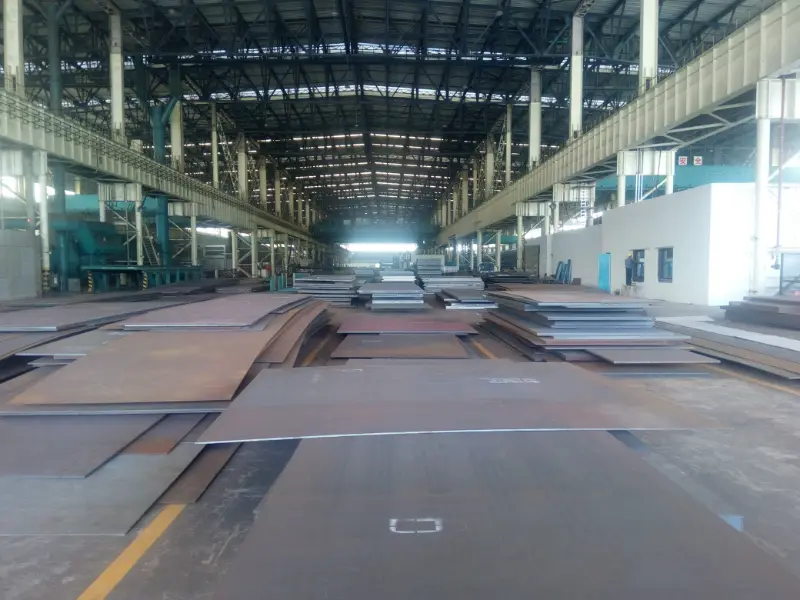
ABS Grade DQ70 Shipbuilding Steel Plate
ABS Grade DQ70 Shipbuilding Steel Plate: High-Strength Quenched & Tempered Marine Steel
Comprehensive technical data for ABS DQ70 shipbuilding steel plate including chemical composition, mechanical properties, physical properties, equivalent standards, and application guidance.
Quenching and tempering (Q&T), thermo-mechanical controlled processing (TMCP) optional for thinner gauges
- Phone : +8618037372205
- Email : [email protected]
- WhatsApp: Contact via Whtsapp
- WeChat: +8618037372205
ABS Grade DQ70 Shipbuilding Steel Plate Introduction
ABS Grade DQ70 is a high-strength quenched and tempered steel plate certified by the American Bureau of Shipping (ABS) for shipbuilding and offshore structural applications. With a minimum yield strength of 690 MPa, it offers exceptional strength-to-weight ratio, excellent weldability, and good low-temperature toughness. Key characteristics include:
- Minimum yield strength of 690 MPa
- Excellent toughness at sub-zero temperatures (down to -40°C or -60°C)
- Good through-thickness properties when specified (Z35)
- Superior weldability with proper preheating and consumables
- Used in critical structural components of ships and offshore platforms
ABS Grade DQ70 Shipbuilding Steel Plate Chemical Composition
The chemical composition of ABS DQ70 steel is carefully controlled to achieve the required mechanical properties and weldability. Maximum limits, unless a range is given. Carbon equivalent (CEV) is typically limited to 0.52-0.55% depending on thickness to ensure good weldability.
| Element | Standard Value (%) | Remarks |
|---|---|---|
| Carbon (C) | ≤ 0.20 | Higher carbon can increase strength but reduce toughness and weldability |
| Silicon (Si) | ≤ 0.55 | Deoxidizer and strength contributor |
| Manganese (Mn) | 1.00 - 1.70 | Enhances hardenability and toughness |
| Phosphorus (P) | ≤ 0.025 | Strict control for low-temperature toughness |
| Sulfur (S) | ≤ 0.025 | Low sulfur for through-thickness ductility |
| Chromium (Cr) | ≤ 0.25 | Minor alloying element for strength |
| Nickel (Ni) | ≤ 0.80 | Improves toughness and hardenability |
| Molybdenum (Mo) | ≤ 0.50 | Increases high-temperature strength and hardenability |
| Copper (Cu) | ≤ 0.30 | May be present from scrap |
| Niobium (Nb) | ≤ 0.06 | Grain refiner |
| Vanadium (V) | ≤ 0.10 | Precipitation strengthening |
| Titanium (Ti) | ≤ 0.02 | Grain refinement and inclusion control |
| Aluminum (Al), total | ≥ 0.020 | Fine grain practice; acid soluble Al minimum |
| Nitrogen (N) | ≤ 0.012 | Controlled to avoid strain aging |
| Boron (B) | ≤ 0.0005 | Optional for increasing hardenability |
ABS Grade DQ70 Shipbuilding Steel Plate Thermal and Electrical Physical Properties
Physical properties are typical for quenched and tempered high-strength low-alloy steel. Values are representative at room temperature unless otherwise noted. Actual properties may vary based on exact composition and heat treatment.
| Property | Typical Value | Unit | Condition / Temperature |
|---|---|---|---|
| Density (ρ) | 7.85 | g/cm³ | 20°C |
| Modulus of Elasticity (E) | 205 - 210 | GPa | 20°C |
| Shear Modulus (G) | 80 | GPa | 20°C |
| Poisson's Ratio (ν) | 0.28 - 0.30 | - | 20°C |
| Thermal Expansion Coefficient (α) | 11.0 - 12.5 | 10⁻⁶/K | 20 - 100°C |
| Thermal Conductivity (λ) | 25 - 30 | W/(m·K) | 20°C |
| Specific Heat Capacity (cp) | 460 - 500 | J/(kg·K) | 20°C |
| Electrical Resistivity (ρ_e) | 0.20 - 0.25 | µΩ·m | 20°C |
ABS Grade DQ70 Shipbuilding Steel Plate Mechanical Properties
Tensile and impact properties are tested in accordance with ABS requirements. Specimens are prepared transverse to the rolling direction. Impact tests are performed on Charpy V-notch specimens at the specified temperature. Properties may vary with thickness; values below apply to thicknesses up to 50 mm unless noted.
| Property | Required Value | Unit | Test Condition |
|---|---|---|---|
| Yield Strength (ReH) | ≥ 690 | MPa | Transverse, Ambient |
| Tensile Strength (Rm) | 770 - 940 | MPa | Transverse, Ambient |
| Elongation (A5) | ≥ 14 | % | Gauge length 5.65√So, transverse |
| Bending Test (Mandrel Diameter) | 3t (t = plate thickness) | - | 180° bend, no cracks; optional |
| Charpy Impact Energy (KV) | ≥ 69 (longitudinal) / ≥ 46 (transverse) | J | -40°C (standard), option -60°C |
| Charpy Impact Energy (KV) | ≥ 69 (longitudinal) / ≥ 46 (transverse) | J | -60°C for DQ70E grade if specified |
ABS Grade DQ70 Shipbuilding Steel Plate Exact Equivalent Material Standards and Replaceable Grades
| Country / Region | Standard | Grade | Remarks |
|---|---|---|---|
| International | DNV GL | E690 | Offshore and shipbuilding; identical mechanical requirements |
| International | Bureau Veritas | EH69 | High strength structural steel for marine; -40°C impact |
| International | Lloyd's Register | EH69 | Equivalent for ship and offshore structures |
| International | Nippon Kaiji Kyokai (ClassNK) | KE690 | Identical strength and toughness class |
| International | RINA | KE690 | Italian classification society equivalent |
| China | China Classification Society (CCS) | E690 | High strength hull structural steel |
| Korea | Korean Register (KR) | RE690 | Equivalent grade for high strength shipbuilding |
| International | ISO 19901-1 (Petroleum) | S690Q | Similar strength, not always certified for marine service |
ABS Grade DQ70 Shipbuilding Steel Plate Application Introduction
ABS DQ70 steel is primarily used in heavy construction where high strength, low weight, and superior toughness are critical. Typical applications require classification society approval. Processing notes:
- Preheating (100-150°C) recommended for thicknesses > 20 mm before welding
- Post-weld heat treatment (PWHT) generally avoided to preserve mechanical properties
- Machining: good machinability with carbide tools and high cutting speeds; avoid hydrogen embrittlement
Product Applications: Hull stiffeners and girders, Deck plates and bottom shell plates, Lift ship panels, Jack-up rig leg chords and racks, Offshore platform nodes and tubular joints, Crane pedestals and booms, Breakwater gates and sluice structures
Processed into products: Ship frames and beams, Welded tubular joints (Y, K, and T connections), Flange plates for built-up sections, Bearing plates and mounting brackets, Reinforcement rings and bulkhead sections, Shear pin cases and high-stress connectors, Structural transition joints
Application industries: Shipbuilding (naval vessels, container ships, icebreakers), Offshore oil and gas (jack-up rigs, semi-submersibles, FPSO modules), Marine engineering (dock gates, heavy-lift cranes, barge structures), Renewable energy (offshore wind turbine foundations, transition pieces), Heavy civil engineering (bridge components, pressure vessels)
ABS Grade DQ70 Shipbuilding Steel Plate Similar or Alternative Material Grades for Comparison
| Country / Region | Standard | Grade | Remarks |
|---|---|---|---|
| USA | ASTM A514/A517 | Grade E or F | Quenched & tempered high yield strength plate; similar strength but no marine certification; max thickness limited |
| USA | MIL-S-16216 | HY-100 | Military specified steel, higher nickel, superior toughness; limited availability |
| Europe | EN 10025-6 | S690QL / S690QL1 | Structural steel; similar mechanical properties, but not approved by classification societies without additional certification |
| China | GB/T 712 | E690 | National standard for shipbuilding steel, nearly identical to ABS DQ70 |
| Japan | JIS G 3128 | YUS 700 | High yield point steel for welded structures, similar strength |
Notes:
Certification: All plates must be stamped with ABS certification marks and accompanied by 3.1 or 3.2 mill test certificates. Through-thickness testing (Z35) can be ordered as supplementary.
- Plates are normally ultrasonic tested in accordance with ASTM A578 Level B or equivalent.
- Heat treatment: Quenching from 900-930°C, followed by tempering in the range 580-670°C depending on thickness and required properties.
- Crack tip opening displacement (CTOD) testing may be specified for critical offshore applications.
- Share



