
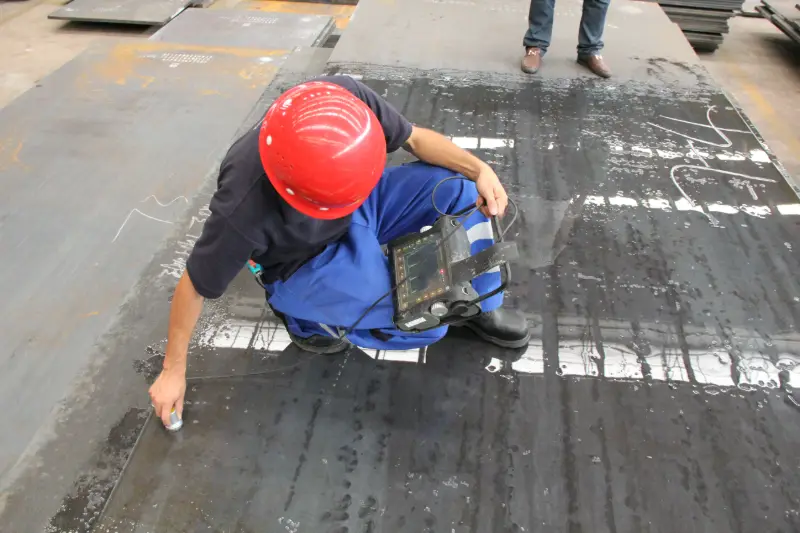
LR Grade E Shipbuilding Steel Plate
LR Grade E Shipbuilding Steel Plate - Full Data & Equivalents Guide
Comprehensive material data sheet for LR Grade E shipbuilding steel: chemical composition, mechanical & thermal properties, international equivalents and application guidance.
Hot rolling, normalizing, controlled rolling, thermo‑mechanical control process (TMCP)
- Phone : +8618037372205
- Email : [email protected]
- WhatsApp: Contact via Whtsapp
- WeChat: +8618037372205
LR Grade E Shipbuilding Steel Plate Introduction
LR Grade E is a normal-strength hull structural steel certified by Lloyd's Register (LR). It is primarily designed for ship and offshore structures requiring reliable low‑temperature toughness, with a guaranteed minimum impact energy of 27 J at -40°C (longitudinal). Key characteristics include outstanding weldability, good ductility and uniform mechanical properties attained through fine grain practice using aluminium and, for heavier gauges, optional microalloying additions such as niobium, vanadium and titanium.
- Excellent low‑temperature notch toughness
- Class‑approved chemical control for weldability
- Wide range of delivery conditions: normalized (N) or thermo‑mechanical control process (TMCP)
- Satisfies all major classification society rules for Grade E
The steel is typically supplied as plates, but sections and bars are also available. The maximum carbon equivalent (Ceq) is kept below 0.40 % to guarantee crack‑free welding under standard shipyard conditions. Dimensional tolerances, surface quality and non‑destructive testing are governed by the LR Rules Chapter 3 and any supplementary requirements agreed at the time of order.
LR Grade E Shipbuilding Steel Plate Chemical Composition
The chemical composition is defined by the LR Rules. Aluminium (acid‑soluble or total) is compulsory as a grain‑refining element. For plates with thickness >25 mm, further grain‑refining elements such as Nb, V or Ti shall be added in sufficient amounts to meet the desired fine‑grain practice.
- Carbon equivalent Ceq is typically ≤0.40 % to ensure good weldability.
- Low phosphorus and sulphur levels improve toughness and resistance to hot cracking.
| Element | Specification (%) | Remarks |
|---|---|---|
| Carbon (C) | ≤ 0.18 | Ladle analysis |
| Manganese (Mn) | 0.70 – 1.50 | |
| Silicon (Si) | ≤ 0.50 | |
| Phosphorus (P) | ≤ 0.035 | |
| Sulfur (S) | ≤ 0.035 | |
| Aluminium (Acid‑soluble, Als) | ≥ 0.015 | Mandatory for grain size control |
| Aluminium (Total Al) | ≥ 0.020 | Alternative to acid‑soluble |
| Niobium (Nb) | 0.02 – 0.05 | Optional / required for t > 25 mm |
| Vanadium (V) | 0.05 – 0.10 | Optional, frequently combined with Nb |
| Titanium (Ti) | ≤ 0.02 | Optional grain refiner |
| Carbon Equivalent (Ceq) | ≤ 0.40 (typical) | Ceq = C + Mn/6 + (Cr+Mo+V)/5 + (Ni+Cu)/15 |
LR Grade E Shipbuilding Steel Plate Thermal and Electrical Physical Properties
The following physical values are typical for a fine‑grained carbon‑manganese shipbuilding steel like LR Grade E. They are based on room‑temperature measurements unless stated. Actual values may vary slightly due to composition and processing details. The data is suitable for engineering calculations such as heat transfer, expansion allowances and electrical earthing design.
| Property | Typical Value | Unit | Condition / Temperature |
|---|---|---|---|
| Density (ρ) | 7.85 | g/cm³ | 20 °C |
| Elastic Modulus (E) | 205 | GPa | 20 °C |
| Shear Modulus (G) | 80 | GPa | 20 °C |
| Poisson's Ratio (ν) | 0.30 | — | 20 °C |
| Thermal Expansion Coefficient (α) | 12.0 | 10⁻⁶/K | 20–100 °C |
| Thermal Conductivity (λ) | 50 | W/(m·K) | 20 °C |
| Specific Heat Capacity (c) | 470 | J/(kg·K) | 20 °C |
| Electrical Resistivity (ρ_e) | 0.16 | Ω·mm²/m | 20 °C |
LR Grade E Shipbuilding Steel Plate Mechanical Properties
Mechanical properties depend on plate thickness. Yield strength is constant (≥235 MPa) for thicknesses up to 100 mm. Elongation values vary with thickness. Impact testing is conducted at -40°C; longitudinal specimens are mandatory, transverse impacts are required for plates over 25 mm. Bending tests are performed at 180° with specific mandrel diameters.
- All values refer to transverse tensile specimens except elongation.
- For Charpy V‑notch tests, sub‑size specimens (e.g. 7.5 mm or 5 mm) may be used for thin materials; minimum energy values are reduced proportionally.
| Property | Specified Value | Unit | Test Condition |
|---|---|---|---|
| Yield Strength (ReH) | ≥ 235 | MPa | Transverse, thickness ≤ 100 mm |
| Tensile Strength (Rm) | 400 – 520 | MPa | Transverse, all thicknesses |
| Elongation (A5) | ≥ 22 | % | Longitudinal, 5.65√So gauge, t ≤ 50 mm |
| Elongation (A5) | ≥ 21 | % | Longitudinal, t > 50 ≤ 70 mm |
| Elongation (A5) | ≥ 20 | % | Longitudinal, t > 70 ≤ 100 mm |
| Impact Energy (KV2) | ≥ 27 | J | Longitudinal, -40°C, 10×10 mm, t ≥ 12 mm |
| Impact Energy (KV2) | ≥ 20 | J | Transverse, -40°C, 10×10 mm, t > 25 mm |
| Bend Test (180°) | d = 2a | — | Mandrel diameter, thickness ≤ 25 mm |
| Bend Test (180°) | d = 3a | — | Mandrel diameter, thickness > 25 mm |
LR Grade E Shipbuilding Steel Plate Fully Equivalent Standards and Substitutable Grades
| Country / Region | Standard / Classification Society | Grade | Remarks |
|---|---|---|---|
| Worldwide | American Bureau of Shipping (ABS) | ABS Grade E | Identical requirements |
| Worldwide | Bureau Veritas (BV) | BV Grade E | Identical |
| Worldwide | DNV | DNV Grade E | Identical |
| Worldwide | China Classification Society (CCS) | CCS Grade E | Identical |
| Worldwide | Nippon Kaiji Kyokai (ClassNK) | NK Grade E | Identical |
| Worldwide | Korean Register (KR) | KR Grade E | Identical |
| Worldwide | Registro Italiano Navale (RINA) | RINA Grade E | Identical |
| Worldwide | Indian Register of Shipping (IRS) | IRS Grade E | Identical |
| Europe | EN 10025-4 | S275ML | Comparable thermomechanical fine‑grain steel with -50°C impact; strength is slightly higher (min 275 MPa) |
LR Grade E Shipbuilding Steel Plate Application Introduction
LR Grade E steel is the backbone material for ship hulls and offshore structures that must remain fracture‑tough in cold waters. Its reliable low‑temperature performance and good fabricability make it a preferred choice for critical, highly stressed components. Typical sectors:
- Shipbuilding (commercial and naval)
- Offshore oil and gas platforms
- Marine renewable energy (offshore wind turbine foundations)
- Heavy civil engineering in coastal environments
Product Applications: Bulk carriers, Tankers (crude oil, product, LNG), Container ships, Roll‑on/roll‑off vessels (Ro‑Ro), Passenger and cruise ships, Jack‑up drilling rigs, Semi‑submersible production platforms, Offshore wind turbine substructures (monopiles, jackets), Living quarter modules
Processed into products: Main deck and bottom shell plating, Side shell and inner bottom plating, Longitudinal and transverse bulkheads, Web frames and stiffeners, Bracket floors and girders, Hull structural nodes, Jack‑up leg chords and braces, Caisson and conductor pipe supports, Fatigue‑prone details in cold climate
Application industries: Shipbuilding, Offshore Oil & Gas, Marine Engineering, Port & Harbor Construction, Renewable Energy (Offshore Wind)
LR Grade E Shipbuilding Steel Plate Similar / Alternative Grades for Consideration
| Country / Region | Standard / Classification Society | Grade | Remarks |
|---|---|---|---|
| Worldwide | LR Rules | LR Grade D | Same base chemistry; impact tested at -20°C instead of -40°C; suitable for less severe conditions. |
| Worldwide | ABS Rules | ABS Grade D | Equivalent to LR D. |
| Worldwide | LR Rules | LR Grade EH36 | High‑strength hull steel (yield ≥355 MPa) with -40°C impact; use where weight savings are essential. |
| Europe | EN 10025-4 | S355ML | Thermomechanically rolled steel with min. 355 MPa yield and -50°C impact; suitable for offshore structures. |
| Worldwide | API Spec 2W | API 2W Grade 50T | Tmcp‑treated offshore structural steel with -40°C impact; higher strength alternative. |
Notes:
Additional properties such as through‑thickness (Z‑direction) tensile test can be specified, leading to designations like LR Grade E Z25 or Z35 for improved lamellar tearing resistance. Ultrasonic testing according to LR rules or EN 10160 is usually required for thicker plates. Weldability assessments should consider the CEV and joint heat input. All mechanical tests must be witnessed by the surveyor of the classification society. Material certificates (e.g., LR 3.1 or 3.2) are issued as per the purchase order requirements. For cold‑formed sections a subsequent stress‑relieving treatment may be needed depending on the degree of deformation.
- Share



