
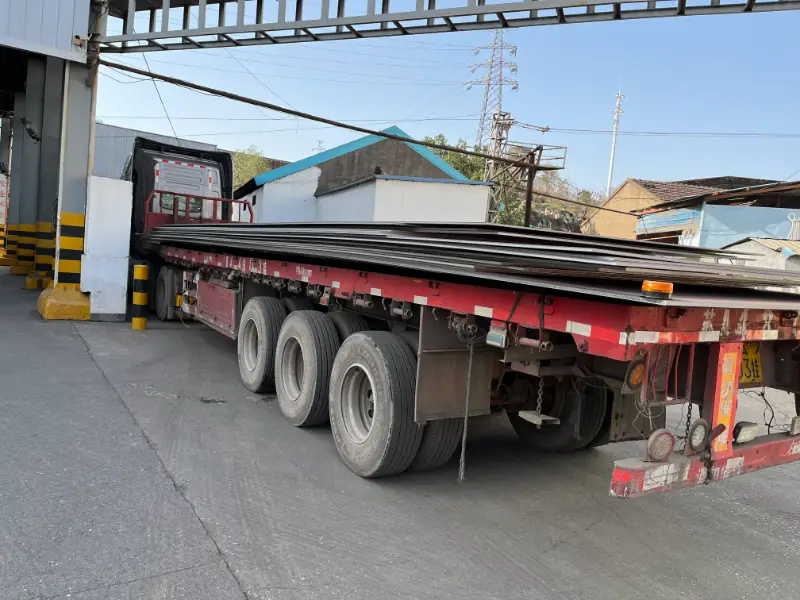
LR Grade AH32 Shipbuilding Steel Plate
LR Grade AH32 Shipbuilding Steel Plate Datasheet: Chemical Composition, Mechanical Properties & International Equivalents
Comprehensive datasheet for LR Grade AH32 shipbuilding steel plate to Lloyd's Register Rules. Covers chemical composition, mechanical properties (yield & tensile strength, impact energy), thermal properties, international cross-reference equivalents, and application guidance for ship and offshore structures.
Cutting (thermal & mechanical), welding (all common processes), bending, forming, and machining
- Phone : +8618037372205
- Email : [email protected]
- WhatsApp: Contact via Whtsapp
- WeChat: +8618037372205
LR Grade AH32 Shipbuilding Steel Plate Introduction
LR Grade AH32 is a high-strength hull structural steel certified by Lloyd's Register (LR) for use in shipbuilding and marine engineering. It offers a minimum yield strength of 315 MPa and excellent weldability and notch toughness at 0°C, making it suitable for critical ship hull components. The steel is typically supplied in the normalized, controlled-rolled, or thermo-mechanically controlled processed (TMCP) condition. LR AH32 complies with the requirements of Lloyd's Register Rules for Materials, Chapter 3, and is internationally equivalent to grades such as ABS AH32, DNV AH32, BV AH32, CCS AH32, and others under the IACS UR W11 standard for high-strength hull structural steels. Its balanced chemistry with fine-grain practice ensures reliable performance in welded ship structures, offshore platforms, and marine equipment exposed to low-temperature environments.
LR Grade AH32 Shipbuilding Steel Plate Chemical Composition
Typical heat analysis requirements for LR Grade AH32 according to LR Rules. Fine-grain practice is mandatory; aluminum is used as a grain refiner (acid-soluble Al ≥0.015%) or other suitable grain-refining elements (Nb, V, Ti) may be applied. Optional microalloying elements (Nb, V, Ti) are often present to improve strength and toughness. Values represent ladle analysis limits; product analysis tolerances apply per the standard.
| Chemical Element | Nominal Value (wt%) | Remarks |
|---|---|---|
| Carbon (C) | ≤0.18 | |
| Silicon (Si) | ≤0.50 | |
| Manganese (Mn) | 0.90 – 1.60 | |
| Phosphorus (P) | ≤0.035 | |
| Sulfur (S) | ≤0.035 | |
| Aluminum (Alsol) | ≥0.015 | Acid-soluble; required for fine-grain practice |
| Niobium (Nb) | 0.02 – 0.05 | Optional; grain refiner and strengthening |
| Vanadium (V) | 0.05 – 0.10 | Optional; grain refiner and strengthening |
| Titanium (Ti) | ≤0.02 | Optional; if used, may refine grain |
| Nitrogen (N) | ≤0.009 | Undeoxidized steel; if Ti added for nitrogen fixation, limits may adjust |
| * Carbon equivalent (CEV) | Typically ≤0.38 | Calculated as C+Mn/6+(Cr+Mo+V)/5+(Ni+Cu)/15; limits vary by thickness and shipyard specification |
LR Grade AH32 Shipbuilding Steel Plate Physical Properties
The following thermal and electrical properties are typical for high-strength shipbuilding steel with similar carbon-manganese composition. These values are not specified in the LR Rules but are commonly used for design calculations (e.g., thermal expansion, heat transfer, weight estimation). Where applicable, data conforms to room temperature conditions unless noted.
| Property | Typical Value | Unit | Test Conditions / Remarks |
|---|---|---|---|
| Density (ρ) | 7.85 | g/cm³ | At 20°C |
| Modulus of elasticity (E) | 205 | GPa | At 20°C, longitudinal |
| Shear modulus (G) | 80 | GPa | At 20°C |
| Poisson's ratio (ν) | 0.30 | - | Elastic range |
| Coefficient of thermal expansion (α) | 11.5 × 10⁻⁴ | 1/K | 20°C to 100°C |
| Coefficient of thermal expansion (α) | 12.2 × 10⁻⁴ | 1/K | 20°C to 200°C |
| Coefficient of thermal expansion (α) | 13.0 × 10⁻⁴ | 1/K | 20°C to 300°C |
| Thermal conductivity (λ) | 50 | W/(m·K) | At 20°C |
| Specific heat capacity (c) | 460 | J/(kg·K) | At 20°C |
| Electrical resistivity (ρe) | 0.20 × 10⁻⁶ | Ω·m | At 20°C |
LR Grade AH32 Shipbuilding Steel Plate Mechanical Properties
Mechanical properties comply with LR Rules, based on tensile tests (transverse or longitudinal), Charpy V-notch impact tests at 0°C, and 180° cold bend tests. Impact energy values depend on specimen orientation and plate thickness. Below are the minimum required values. Testing is performed in accordance with LR's acceptance criteria; actual supplied properties often exceed these minima.
| Property | Required Value | Unit | Test Conditions / Remarks |
|---|---|---|---|
| Upper yield strength (ReH) | 315 | MPa | Thickness ≤100 mm; transverse test pieces |
| Tensile strength (Rm) | 440 – 590 | MPa | Transverse; all thicknesses |
| Elongation after fracture (A) | ≥22 | % | Gauge length 5.65√S₀; transverse test |
| Charpy V-notch impact energy, longitudinal | ≥34 (t ≤50 mm) | J | At 0°C; average of three tests, one individual min 70% of average |
| Charpy V-notch impact energy, longitudinal | ≥41 (50 < t ≤70 mm) | J | At 0°C; individual min ≥70% of average |
| Charpy V-notch impact energy, longitudinal | ≥50 (70 < t ≤100 mm) | J | At 0°C; individual min ≥70% of average |
| Charpy V-notch impact energy, transverse | ≥24 (t ≤50 mm) | J | At 0°C; average of three tests, one individual min 70% of average |
| Charpy V-notch impact energy, transverse | ≥27 (50 < t ≤70 mm) | J | At 0°C; individual min ≥70% of average |
| Charpy V-notch impact energy, transverse | ≥34 (70 < t ≤100 mm) | J | At 0°C; individual min ≥70% of average |
| Bend test (180° cold bend) | No cracks or defects | - | Bend diameter = 3a (a = specimen thickness); for thickness ≤25 mm; wider bends apply for thicker plates as per LR Rules |
LR Grade AH32 Shipbuilding Steel Plate Full Equivalent Standards & Grades
| Country / Classification Society | Standard / Specification | Grade / Designation | Remarks |
|---|---|---|---|
| American Bureau of Shipping (ABS) | ABS Rules, Part 2, Chapter 1 | ABS AH32 | High-strength hull structural steel, impact test at 0°C |
| DNV (Norway/Germany) | DNV Rules, Pt.2 Ch.2 | DNV AH32 (NV A32) | Previously designated NV A32; same strength and toughness class |
| Bureau Veritas (BV) | BV Rules, Pt.2, Ch.1 | BV AH32 | Identical mechanical and chemical requirements |
| China Classification Society (CCS) | CCS Rules, Part 2, Chapter 1 | CCS AH32 | Same grade under IACS UR W11 |
| Nippon Kaiji Kyokai (ClassNK) | NK Rules, Part K | NK AH32 (KA32) | Formerly designated KA32; now AH32 |
| Korean Register (KR) | KR Rules, Pt.2 | KR AH32 | Fully aligns with IACS UR W11 |
| Registro Italiano Navale (RINA) | RINA Rules, Pt.B | RINA AH32 | Identical to LR AH32 requirements |
| Indian Register of Shipping (IRS) | IRS Rules, Part 2 | IRS AH32 | Equivalent high-strength shipbuilding grade |
| Russian Maritime Register of Shipping (RMRS) | RMRS Rules, Part II | RMRS AH32 | Same strength level and 0°C impact class |
LR Grade AH32 Shipbuilding Steel Plate Application Introduction
LR Grade AH32 steel plates are primarily employed in ship hull construction and offshore marine structures. The combination of good weldability, moderate high strength, and guaranteed notch toughness at 0°C makes it a cost-effective choice for many structural components. It is ideal for building vessels, barges, and offshore platforms where weight savings and structural integrity are essential. The steel can be easily cut, formed, and welded using standard shipyard practices, and is often delivered with class society certification and supplementary testing (e.g., Z-quality through-thickness properties) for critical joints.
Product Applications: Ship hull plates (deck plating, bottom shell, side shell), Longitudinal stiffeners and stringers, Transverse bulkheads and web frames, Offshore platform deck plates and module support structures, Jack-up rig leg chords and rack plates
Processed into products: Main deck and inner bottom plates, Side shell plates and bilge keels, Longitudinal and transverse stiffeners (flat bars, angles, bulb profiles), Fore/aft peak tanks and deep tank bulkheads, Bracket plates and gusset plates in hull framing, Hatch coamings and corner reinforcements, Offshore module beams, columns, and bracing members
Application industries: Shipbuilding (commercial vessels, naval ships, cruise liners), Offshore engineering (oil & gas platforms, wind turbine foundations), Marine structures (floating docks, pontoons, ferry terminals), Port & harbor construction
LR Grade AH32 Shipbuilding Steel Plate Similar / Closely Related Steel Grades
| Country / Society | Standard | Grade | Remarks and Comparison |
|---|---|---|---|
| International Association of Classification Societies (IACS) | UR W11 | AH36 | Higher yield strength (355 MPa min); same 0°C impact test; can be substituted if higher strength is acceptable |
| Lloyd's Register | LR Rules | LR DH32 | Same strength as AH32 but impact test at -20°C; suitable for colder service conditions |
| Lloyd's Register | LR Rules | LR EH32 | Same strength, impact at -40°C; for very low-temperature applications |
| Lloyd's Register | LR Rules | LR AH40 | Higher strength (390 MPa min) with 0°C impact; for even more demanding structural loads |
| American Bureau of Shipping | ABS Rules | ABS DH32 | Same strength, lower impact temperature (-20°C); can replace AH32 if better toughness is needed |
Notes:
Welding: LR AH32 can be welded by all conventional processes (SMAW, SAW, GMAW, FCAW) using hydrogen-controlled electrodes to avoid cold cracking. Preheating may be required for thicker sections based on CEV and crack susceptibility calculations. Z-quality: For welded joints subjected to high through-thickness stresses (e.g., node connections in offshore structures), plates can be ordered with improved ductility in the through-thickness direction (Z15, Z25, Z35 according to EN 10164 or LR equivalent). Nondestructive testing: Ultrasonic testing (UT) per EN 10160, ASTM A578, or LR rules is often specified for critical applications. Certification: All plates are supplied with LR certification (or dual-certification upon request) and may be endorsed by other class societies where recognized.
- Share



