
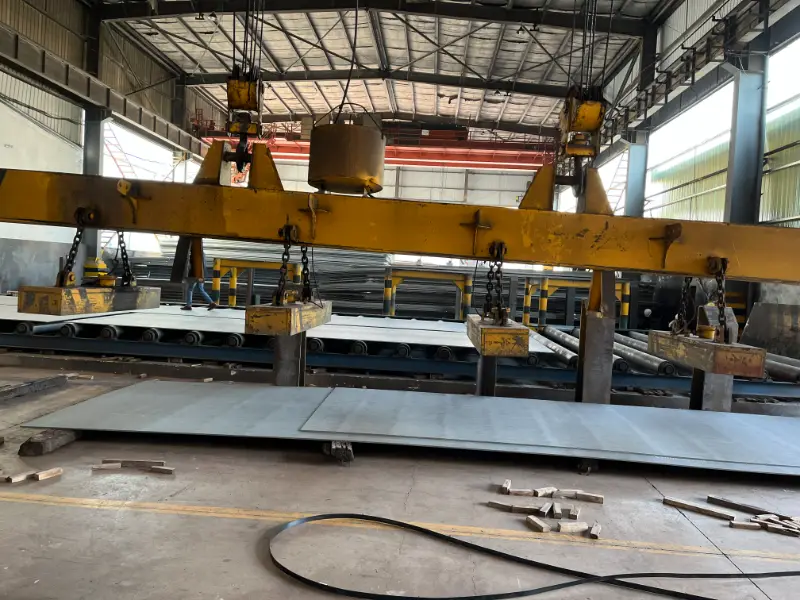
CCS Grade DQ56 Quenched & Tempered Shipbuilding Steel Plate
CCS Grade DQ56 Quenched & Tempered Shipbuilding Steel Plate: Data & Equivalents
Complete material analysis of CCS Grade DQ56 shipbuilding steel: chemistry, mechanical properties, thermal/physical data, equivalent grades, and application guidance for marine structures.
Flame cutting, plasma cutting, submerged arc welding, gas metal arc welding, shielded metal arc welding, cold and hot forming (with controlled heat input), post-weld heat treatment not typically required.
- Phone : +8618037372205
- Email : [email protected]
- WhatsApp: Contact via Whtsapp
- WeChat: +8618037372205
CCS Grade DQ56 Quenched & Tempered Shipbuilding Steel Plate Introduction
CCS Grade DQ56 is an extra-high-strength quenched and tempered (QT) shipbuilding steel governed by the China Classification Society (CCS) Rules, which align with IACS UR W28. It is designed for critical hull and offshore structural components requiring minimum yield strength of 560 MPa and good low-temperature toughness.
- Excellent weldability with low carbon equivalent
- High strength-to-weight ratio for weight reduction
- Guaranteed impact energy of 47 J at -20 °C
- Available in thicknesses up to 150 mm
- Controlled sulfur and phosphorus for enhanced cleanliness
This steel is widely used in large container ships, offshore platforms, and Arctic marine structures.
CCS Grade DQ56 Quenched & Tempered Shipbuilding Steel Plate Chemical Composition
Chemical requirements conform to IACS UR W28 Rev.8. All values are maxima unless a range or minimum is indicated. Carbon equivalent CEV is calculated according to the IIW formula: CEV = C + Mn/6 + (Cr+Mo+V)/5 + (Ni+Cu)/15. Fine-grain elements Nb, V, Ti are optional but total microalloy content is regulated.
| Element | Specified Value (max, wt%) | Remarks |
|---|---|---|
| C | 0.20 | |
| Si | 0.55 | |
| Mn | 1.60 | |
| P | 0.025 | |
| S | 0.025 | |
| Al (acid soluble) | ≥ 0.015 | Min value |
| Nb | 0.05 | Optional; if added, total Nb+V+Ti ≤ 0.12 |
| V | 0.10 | Optional |
| Ti | 0.02 | Optional |
| Cu | 0.35 | |
| Cr | 0.20 | |
| Ni | 0.40 | |
| Mo | 0.08 | |
| CEV | ≤ 0.57 (t ≤ 50 mm) ≤ 0.59 (50 < t ≤ 100 mm) ≤ 0.60 (100 < t ≤ 150 mm) | Carbon equivalent, calculated per IIW |
CCS Grade DQ56 Quenched & Tempered Shipbuilding Steel Plate Thermal and Electrical Physical Properties
These properties are not specified in the CCS or IACS standards for DQ56 steel. The values below are representative for quenched and tempered high-strength low-alloy steel at room temperature. For design purposes, conduct project-specific tests or consult the mill certificate.
| Property | Standard Value / Range | Unit | Test Condition |
|---|---|---|---|
| Density (ρ) | 7.85 | g/cm³ | 20 °C |
| Elastic Modulus (E) | 205 | GPa | 20 °C |
| Shear Modulus (G) | 80 | GPa | 20 °C |
| Poisson's Ratio (ν) | 0.3 | – | 20 °C |
| Thermal Expansion Coeff. (α) | 12.0 | ×10⁻⁶ /K | 20 – 100 °C |
| Thermal Conductivity (λ) | 50 | W/(m·K) | 20 °C |
| Specific Heat Capacity | 480 | J/(kg·K) | 20 °C |
| Electrical Resistivity (ρₑ) | 0.18 | µΩ·m | 20 °C |
CCS Grade DQ56 Quenched & Tempered Shipbuilding Steel Plate Mechanical Properties
Mechanical properties are determined on tensile specimens taken in the transverse direction and impact specimens in the longitudinal direction (unless transverse agreed). Bend test: 180° bend over a mandrel of diameter d, no cracks allowed. Impact test temperature for DQ56 is -20 °C. For thicknesses above 150 mm, properties shall be specially agreed.
| Property | Specified Value | Unit | Test Condition / Thickness Range |
|---|---|---|---|
| Yield Strength (ReH) | 560 (min) | MPa | t ≤ 150 mm |
| Tensile Strength (Rm) | 670 – 860 | MPa | t ≤ 100 mm |
| Tensile Strength (Rm) | 600 – 760 | MPa | 100 < t ≤ 150 mm |
| Elongation (A5) | 17 (min) | % | t ≤ 50 mm |
| Elongation (A5) | 16 (min) | % | 50 < t ≤ 100 mm |
| Elongation (A5) | 15 (min) | % | 100 < t ≤ 150 mm |
| Impact Energy KV (Long.) | 47 (min) | J | -20 °C, t ≤ 50 mm |
| Impact Energy KV (Long.) | 50 (min) | J | -20 °C, 50 < t ≤ 150 mm |
| Impact Energy KV (Trans.) | 31 (min) | J | -20 °C, t ≤ 50 mm |
| Impact Energy KV (Trans.) | 34 (min) | J | -20 °C, 50 < t ≤ 150 mm |
| Bend Test (d=mandrel diameter) | 3a (no cracks) | – | t ≤ 50 mm, 180° bend |
| Bend Test (d=mandrel diameter) | 4a (no cracks) | – | 50 < t ≤ 100 mm, 180° bend |
| Bend Test (d=mandrel diameter) | 5a (no cracks) | – | 100 < t ≤ 150 mm, 180° bend |
CCS Grade DQ56 Quenched & Tempered Shipbuilding Steel Plate Fully Equivalent Material Standards and Substitutable Grades
| Country / Society | Standard / Rule | Grade / Designation | Remarks |
|---|---|---|---|
| International | IACS UR W28 | DQ56 | Direct equivalent; CCS is IACS member |
| China | GB/T 712 | DH550 | Same chemical and mechanical requirements |
| DNV (Norway/Germany) | DNV Rules Pt.2 Ch.2 | D550 | Equivalent, -20 °C impact |
| Bureau Veritas (France) | BV Rules Pt.2 Ch.1 | D550 | Equivalent |
| American Bureau of Shipping | ABS Rules | DQ56 | Identical grade designation |
| Lloyd's Register (UK) | LR Rules | DQ56 | Identical grade designation |
| Nippon Kaiji Kyokai (Japan) | NK Rules | KD56 | Impact temp. -20 °C, min yield 560 MPa |
| RINA (Italy) | RINA Rules | D550 | Equivalent, thickness limits may vary |
| Korean Register | KR Rules | RD56 | Equivalent |
CCS Grade DQ56 Quenched & Tempered Shipbuilding Steel Plate Application Introduction
CCS Grade DQ56 is engineered for welded structures in the shipbuilding and offshore industry where high strength, excellent weldability, and reliable low-temperature toughness are required. It allows designers to reduce plate thickness (weight) without compromising safety. The steel is typically supplied in quenched and tempered condition and is capable of being formed into complex shapes by cold or hot working. Welding consumables must match the strength and toughness requirements, and drying of electrodes or flux is essential to avoid hydrogen cracking.
Product Applications: Hull shell plates and stiffeners, Strength and weather decks, Longitudinal and transverse bulkheads, Bottom and side shells of icebreakers, Offshore platform tubular joints and transition pieces, Jack-up rig leg rack and chord members
Processed into products: Main deck plating, Sheer strake, Bilge strake, Hatch coamings, Rudder horns and rudder plates, Crane pedestals, Mooring system brackets, Watertight doors and hatches (structural parts), Leg sections of self-elevating units
Application industries: Shipbuilding (commercial vessels, naval ships, ice-class ships), Offshore oil & gas (platforms, FPSO, jack-up rigs, subsea structures), Marine renewable energy (offshore wind turbine foundations, tidal energy structures), Heavy construction (bridges, crane structures, pressure vessels for low temperature)
CCS Grade DQ56 Quenched & Tempered Shipbuilding Steel Plate Materials with Similar Properties, Acceptable as Alternates
| Country / Society | Standard / Rule | Grade | Comparison / Remarks |
|---|---|---|---|
| China | GB/T 712 | AH550 | Same strength, but impact temp. 0 °C (instead of -20 °C) – not suitable for low-temperature service without verification. |
| China | GB/T 712 | EH550 | Higher toughness: impact temp. -40 °C; may be used where DQ56's -20 °C is insufficient. |
| IACS | IACS UR W28 | AQ56 / EQ56 / FQ56 | Same strength; impact test temperatures 0 °C, -40 °C, -60 °C respectively. Use depending on design service temperature. |
| Offshore standard | EN 10225 / NORSOK | S550QL / Ymp. 550 | European quenched and tempered structural steel for offshore; may require additional certifications for ship classification society approval. |
| API | API 2Y / 2W | Grade 60–70 | High-strength offshore structural steel; similar yield range; requires classification society approval for shipbuilding. |
Notes:
- Welding: Low hydrogen practices mandatory; preheat temperature typically 100–150 °C depending on thickness. Post-weld heat treatment not usually required but may be applied for stress relief if agreed.
- Inspection: Plates are normally ultrasonically tested per EN 10160 or equivalent. Surface defects may be repaired by grinding followed by NDT.
- Thickness tolerance: Per CCS Rules or EN 10029 Class B.
- Certification: Mill certificate 3.1 (EN 10204) or 3.2 with classification society stamp is standard.
- Share



