
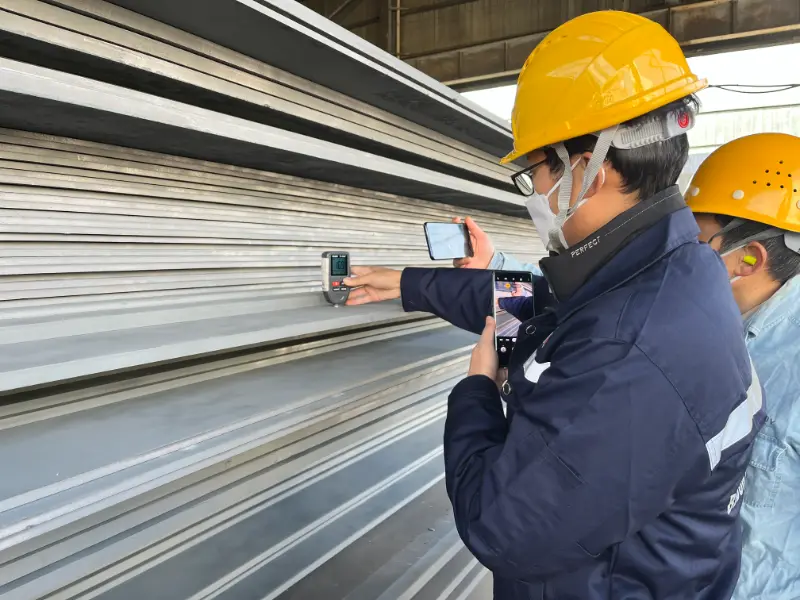
CCS Grade AQ56 Shipbuilding Steel Plate
CCS Grade AQ56 Shipbuilding Steel Plate - High-Strength Quenched and Tempered Steel for Marine Structures
Comprehensive technical data for CCS Grade AQ56 shipbuilding steel, including chemical composition, mechanical and thermal properties, equivalent grades, and application guidance for marine engineering.
Hot rolling, Quenching and Tempering (Q&T), Normalizing (if specified), Machining, Welding, Forming
- Phone : +8618037372205
- Email : [email protected]
- WhatsApp: Contact via Whtsapp
- WeChat: +8618037372205
CCS Grade AQ56 Shipbuilding Steel Plate Introduction
CCS Grade AQ56 is a high-strength structural steel plate certified by the China Classification Society (CCS) for shipbuilding and offshore applications. It belongs to the quenched and tempered (Q&T) category of hull steels and is characterized by a minimum yield strength of 560 MPa, ensuring excellent weight-to-strength ratios for large-scale marine constructions. The 'A' in the grade indicates a required impact test temperature of 0 °C, while 'Q56' denotes the ultra-high strength level.
The steel offers good weldability, low-temperature toughness, and resistance to brittle fracture, making it suitable for critical structural members in ships, offshore platforms, and other marine environments.
Typical delivery condition is quenched and tempered, and the product is usually supplied as plates.
CCS Grade AQ56 Shipbuilding Steel Plate Chemical Composition
The chemical composition of AQ56 steel is designed to achieve high strength and good toughness after quenching and tempering. Microalloying elements such as Nb, V, and Ti are added for grain refinement and precipitation hardening. Carbon equivalent (CEV) is typically controlled to ensure weldability.
- P and S are kept at low levels to improve impact properties and prevent hot shortness.
- Optional elements like Cr, Ni, Mo may be present depending on the thickness and mechanical requirements.
| Element | Specified Value (max unless noted) | Remarks |
|---|---|---|
| Carbon (C) | ≤ 0.20 | Quenched and tempered condition; limits may be reduced for thinner plates |
| Silicon (Si) | ≤ 0.55 | Deoxidizer; upper limit may be 0.50 in some specifications |
| Manganese (Mn) | 1.00 – 1.70 | For strength and toughness balance |
| Phosphorus (P) | ≤ 0.025 | Low P ensures ductility and avoids temper embrittlement |
| Sulfur (S) | ≤ 0.025 | Low S for improved through-thickness properties |
| Chromium (Cr) | ≤ 0.35 | Optional: small additions increase hardenability |
| Nickel (Ni) | ≤ 0.40 | Improves low-temperature toughness |
| Molybdenum (Mo) | ≤ 0.10 | Helps in tempering resistance |
| Copper (Cu) | ≤ 0.35 | Residual from scrap; may improve corrosion resistance |
| Niobium (Nb) | 0.02 – 0.05 | Important microalloy for grain refinement and precipitation |
| Vanadium (V) | 0.05 – 0.12 | Contributes to precipitation strengthening |
| Titanium (Ti) | 0.007 – 0.02 | Grain growth inhibitor in HAZ during welding |
| Aluminum (Al) | ≥ 0.020 total | Used for deoxidation and grain size control |
| Nitrogen (N) | ≤ 0.012 | May combine with V or Al; excess can deteriorate toughness |
CCS Grade AQ56 Shipbuilding Steel Plate Thermal and Electrical Physical Properties
The following physical properties are representative for quenched and tempered low-alloy steels like AQ56. Exact values depend on the specific heat treatment and testing conditions. These data are useful for design, distortion analysis, and welding simulations.
- Thermal expansion and conductivity influence welding requirements.
- Values are given at room temperature unless otherwise noted.
| Property | Typical Value | Unit | Test Condition / Remarks |
|---|---|---|---|
| Density (ρ) | 7850 | kg/m³ | Room temperature |
| Elastic modulus (E) | 205 – 210 | GPa | Room temperature, tension |
| Shear modulus (G) | 79 – 81 | GPa | Calculated from E and Poisson's ratio |
| Poisson's ratio (ν) | 0.28 – 0.30 | – | Elastic region |
| Thermal expansion coefficient (α) | 11.5 – 12.5 | 10⁻⁶/K | 20 °C – 200 °C, linear expansion |
| Thermal conductivity (λ) | 38 – 42 | W/(m·K) | At 20 °C |
| Specific heat capacity (cₚ) | 460 – 480 | J/(kg·K) | At 20 °C |
| Electrical resistivity (ρ_e) | 0.25 – 0.35 | µΩ·m | At 20 °C |
CCS Grade AQ56 Shipbuilding Steel Plate Mechanical Properties
The following table lists the guaranteed mechanical properties for AQ56 plates in the quenched and tempered condition. Testing is performed according to CCS rules, usually on longitudinal specimens.
- Yield strength is the minimum 0.2% offset yield strength (ReH).
- Impact test is Charpy V-notch; for A-grade the test temperature is 0 °C.
- Bend test diameter 3 × thickness (3a) for thicknesses up to 50 mm; different requirements may apply for thicker sections.
| Property | Specified Value | Unit | Condition / Remarks |
|---|---|---|---|
| Yield strength (ReH) | ≥ 560 | MPa | Room temperature, longitudinal, t ≤ 50 mm |
| Yield strength (ReH) | ≥ 550 | MPa | Room temperature, longitudinal, 50 < t ≤ 100 mm |
| Tensile strength (Rm) | 670 – 830 | MPa | Room temperature, longitudinal |
| Elongation (A) | ≥ 16 | % | Gauge length 5.65√So (5D), longitudinal, t ≤ 50 mm |
| Elongation (A) | ≥ 15 | % | 50 < t ≤ 100 mm |
| Bend test | d = 3a | – | 180° bend, no cracks; a = specimen thickness |
| Impact energy (KV₂) | ≥ 41 | J | Longitudinal, Charpy V-notch, 0 °C, average of 3 tests |
| Impact energy (KV₂) | ≥ 27 | J | Transverse, Charpy V-notch, 0 °C, average of 3 tests |
| Hardness | ≤ 300 | HBW | Informative, Brinell hardness, not mandatory |
CCS Grade AQ56 Shipbuilding Steel Plate Fully Equivalent Grades and Substitution Recommendations
| Country / Region | Standard | Grade | Remarks |
|---|---|---|---|
| China | GB/T 712 | Q560 (formerly AH56) | Ballistic equivalent within GB system; similar strength and impact class |
| European Union | EN 10025-6 | S690Q (1.8931) | Quenched & tempered steel with min. yield 690 MPa; slightly higher strength; comparable in many marine applications |
| International | ISO 4950-2 | E690 | High yield strength structural steel; similar chemical and mechanical properties |
| USA | ASTM A514 / A514M | Grade Q | Alloy steel plate, quenched and tempered; yield strength 690 MPa; close match for thicknesses up to 150 mm |
| Japan | JIS G 3128 | SHY685N / SHY685 | High-strength steel for welded structures; yield ≥ 685 MPa; equivalent in performance class |
CCS Grade AQ56 Shipbuilding Steel Plate Application Introduction
CCS Grade AQ56 steel is primarily used in heavy-load marine structures where high strength-to-weight ratio and reliable toughness are essential. It is delivered in quenched and tempered condition, enabling thinner sections to achieve the same load-bearing capacity as thicker conventional steels. Typical applications include
- Primary hull structural members
- Jack-up rig legs and spudcans
- Offshore topside modules
- Crane and lifting equipment
- High-pressure pipeline systems
The steel can be shaped by cold forming (with attention to minimum bend radii) and machined using standard methods. Pre-heating and post-weld heat treatment may be necessary depending on thickness and design requirements. It is widely used in new shipbuilding, offshore engineering, and repair projects.
Product Applications: Ship hull plates (container ships, bulk carriers, tankers), Offshore platform legs and decks, Lattice boom cranes, Icebreaker hulls, Large-diameter high-pressure pipes
Processed into products: Bottom and side shell plating, Stringers and web frames, Transverse bulkheads, Deck girders, Crane pedestals, Rudder horns, Heavy machinery foundations, Tow sockets and bollards
Application industries: Shipbuilding, Offshore Oil & Gas, Marine Engineering, Heavy Equipment Manufacturing, Port & Terminal Construction
CCS Grade AQ56 Shipbuilding Steel Plate Similar / Substitute Materials with Close Performance
| Country / Region | Standard | Grade | Remarks |
|---|---|---|---|
| China | CCS / GB/T 712 | AH36 | Lower strength (yield ≥355 MPa); suitable when high strength is not required; better weldability |
| China | CCS / GB/T 712 | DH36 | As AH36 but with -20 °C impact requirement; easier to fabricate than AQ56 |
| China | CCS / GB/T 712 | EQ56 | Offers -40 °C impact toughness; slightly more stringent low-temperature performance than AQ56 |
| Europe | EN 10025-4 | S460M | Thermomechanically rolled fine-grain steel; lower strength but still high strength; may be alternative for certain structural parts |
| USA | ASTM A572 | Grade 65 | HSLA steel yield ≥ 450 MPa; a lower strength alternative when not requiring quench and tempering |
Notes:
Welding: Use low-hydrogen processes and dry electrodes/consumables. Preheating to 100–200 °C is recommended for thicknesses above 25 mm. The carbon equivalent (CEV) shall be reported by the steel manufacturer to assist welding procedure design.
Heat treatment: The steel is supplied in quenched and tempered condition; subsequent heating above 600 °C may reduce strength. Stress relieving, if required, should be performed at a temperature below the original tempering temperature.
Certification: All plates must be stamped with the CCS mark and accompanied by a material certificate showing chemical analysis, mechanical test results, and heat treatment record. Optional through-thickness tensile testing (Z-quality) is available upon request.
Surface quality: Plates shall be free from harmful surface defects and trimmed to specified size; ultrasonic testing may be specified to ensure internal soundness.
- Share



