
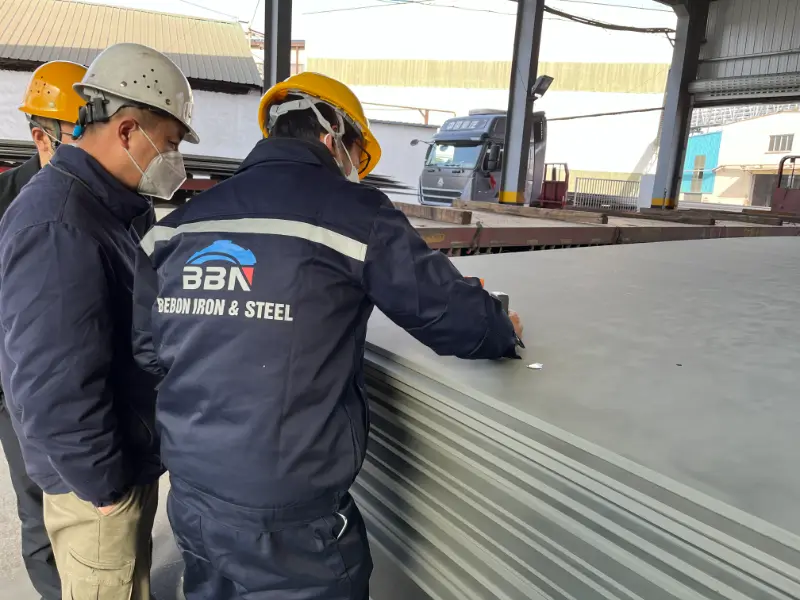
CCS Grade FQ51 Shipbuilding Steel Plate
CCS Grade FQ51 Shipbuilding Steel Plate - High-Strength Quenched & Tempered Material for Extreme Offshore Environments
Comprehensive technical data for CCS FQ51, an ultra-high-strength quenched & tempered shipbuilding steel with minimum 510 MPa yield strength, excellent low-temperature toughness (-60°C), and strict compliance with CCS Rules for offshore and marine applications.
Thermal cutting, cold forming, welding (SAW, SMAW, FCAW, GMAW), machining
- Phone : +8618037372205
- Email : [email protected]
- WhatsApp: Contact via Whtsapp
- WeChat: +8618037372205
CCS Grade FQ51 Shipbuilding Steel Plate Introduction
CCS Grade FQ51 is a premium quenched and tempered (Q&T) shipbuilding steel plate regulated by the China Classification Society (CCS). It offers a minimum yield strength of 510 MPa and outstanding toughness at -60°C, qualifying it for critical structural members in modern shipbuilding and offshore engineering. As a member of the CCS high-strength Q-series, FQ51 is designed for welded structures subjected to heavy dynamic loads and harsh cryogenic conditions.
- Ultra-high strength combined with excellent ductility and weldability
- Low-temperature impact toughness class F (down to -60°C)
- Strict cleanliness and controlled carbon equivalent (Ceq) for superior weldability
- Available as plates and wide flats for structural fabrication
CCS Grade FQ51 Shipbuilding Steel Plate Chemical Composition
Chemical elements are controlled according to CCS Rules for materials. Microalloying elements (Nb, V, Ti, Al) are used for grain refinement, and the carbon equivalent (Ceq) is restricted to ensure good weldability. Actual values depend on product thickness and manufacturer, but must fall within the specified ranges.
- Phosphorus and sulfur limits are set low for high cleanness.
- Optional additions of Cr, Ni, Mo, Cu may be applied upon agreement.
| Element | Requirement (Max %) | Remarks |
|---|---|---|
| C | 0.18 | Heat analysis; adjustable within ≤0.18% by agreement |
| Si | 0.10 – 0.55 | Typical range |
| Mn | 0.90 – 1.60 | May be adjusted to suit strength and toughness |
| P | 0.025 | Maximum for improved toughness |
| S | 0.025 | Maximum for cleaner steel |
| Cr | 0.20 | Maximum, unless agreed for higher |
| Ni | 0.40 | Maximum |
| Mo | 0.08 | Maximum |
| Cu | 0.35 | Maximum |
| Nb | 0.02 – 0.05 | Grain refining element |
| V | 0.05 – 0.10 | Precipitation strengthening |
| Ti | 0.007 – 0.05 | Grain refinement; typical max 0.02% |
| Al (total) | ≥0.015 | Minimum for fine grain practice |
| N | 0.012 | Maximum; Ti or Al is used to bind N |
| Ceq | ≤ 0.53 | IIW formula, typically 0.45-0.53 for 50mm thickness |
CCS Grade FQ51 Shipbuilding Steel Plate Thermal and Electrical Physical Properties
Physical properties are not specified by ship classification rules but are given from engineering handbooks and supplier datasheets for similar C-Mn microalloyed steels. These values are typical for FQ51 grade at ambient temperature unless otherwise noted. Properties may vary slightly with composition and heat treatment.
- Density used for weight calculation.
- Thermal expansion and conductivity are important for design of welded structures operating at varying temperatures.
| Property | Typical Value | Unit | Condition |
|---|---|---|---|
| Density (ρ) | 7.85×10³ | kg/m³ | 20°C |
| Modulus of elasticity (E) | 210×10³ | MPa | 20°C |
| Shear modulus (G) | 81×10³ | MPa | 20°C |
| Poisson's ratio (ν) | 0.3 | — | 20°C |
| Thermal expansion coefficient (α) | 12.0×10⁻⁶ | K⁻¹ | 20–300°C |
| Thermal conductivity (λ) | 42 | W/(m·K) | 20°C |
| Specific heat capacity (cp) | 460 | J/(kg·K) | 20°C |
| Electrical resistivity (ρe) | 0.25×10⁻⁶ | Ω·m | 20°C |
CCS Grade FQ51 Shipbuilding Steel Plate Mechanical Properties
Tensile and impact tests are conducted on material in quenched & tempered condition. Minimum strength and elongation values vary with plate thickness. Transverse specimens are generally taken from plates; longitudinal values may be specified by purchaser. Charpy V-notch impact test at -60°C confirms the F-class toughness.
- Test piece location and orientation according to CCS Rules.
- Bend test (180°) confirms soundness of the plate.
| Property | Requirement | Unit | Test Condition / Remarks |
|---|---|---|---|
| Yield Strength (ReH) | ≥ 510 | MPa | t ≤ 100 mm; thickness > 100 mm by agreement |
| Tensile Strength (Rm) | 610 – 770 | MPa | t ≤ 100 mm |
| Elongation (A) | ≥ 16 | % | t ≤ 50 mm; L0 = 5.65√S0, transverse |
| Elongation (A) | ≥ 14 | % | 50 < t ≤ 100 mm; L0 = 5.65√S0, transverse |
| Impact energy (KV) | ≥ 46 | J | Charpy V-notch, -60°C, transverse; min. single value 33 J |
| Bend test (bend diameter) | 3a | — | 180° bending; a = specimen thickness; no cracks or defects |
| Through-thickness reduction of area | ≥ 35 (Z35) | % | Optional Z-quality; Z25, Z35 upon agreement |
CCS Grade FQ51 Shipbuilding Steel Plate Identical Cross-Recognised Material Standards and Substitutable Grades
| Country/Region | Standard | Grade | Remarks |
|---|---|---|---|
| International | IACS Unified Requirement W11 | FQ51 | Mutual recognition among IACS members |
| USA | ABS Rules | FQ51 | American Bureau of Shipping – identical properties |
| Norway / Germany | DNV Rules | FQ51 | DNV GL – same designation and properties |
| UK | LR Rules | FQ51 | Lloyd's Register – equivalent grade |
| France | BV Rules | FQ51 | Bureau Veritas – equivalent grade |
| Japan | NK Rules | FQ51 | Nippon Kaiji Kyokai – identical |
| South Korea | KR Rules | FQ51 | Korean Register – identical |
| Italy | RINA Rules | FQ51 | RINA – equivalent grade |
CCS Grade FQ51 Shipbuilding Steel Plate Application Introduction
CCS FQ51 steel is specifically engineered for heavy welded structures requiring high strength and exceptional low-temperature toughness. It is widely employed in the marine, offshore, and shipbuilding sectors where weight savings, high payload capability, and reliability in Arctic or deep-water conditions are critical.
- Compliant with classification society rules, making it mandatory or recommended for critical structural parts of vessels and platforms.
- Excellent weldability with preheating and controlled heat input, enabling efficient fabrication.
Product Applications: Ship hull plates and stiffeners for ice-class vessels, Deck and bottom plates for container ships and bulk carriers, Jack-up rig leg rack plates and chord members, Offshore platform braces, nodes, and column sections, Mooring equipment and fairleads, Pressure hulls for submersibles
Processed into products: Main deck plating and longitudinal girders, Hatch coamings and hatch covers, Transverse bulkheads and frame brackets, Rig leg sections and jacking frames, Topside module structural beams, Heavy-duty crane pedestals and booms, Subsea manifold and wellhead structures
Application industries: Shipbuilding (commercial and naval vessels, ice-class ships, LNG carriers), Offshore oil & gas (fixed platforms, FPSOs, TLPs, subsea templates), Renewable energy (offshore wind turbine foundations, transition pieces), Heavy lifting equipment (crane booms, heavy-duty jibs), Cryogenic and Arctic engineering, Bridge construction (specialty high-strength applications)
CCS Grade FQ51 Shipbuilding Steel Plate Comparable Alternative Materials with Similar Performance
| Country/Region | Standard | Grade | Remarks |
|---|---|---|---|
| International | CCS Rules | FH51 | Same strength (510 MPa) and -60°C toughness; typically produced by TMCP or normalising – not quenched & tempered, may differ in welding procedures |
| International | CCS Rules | EH51 | Same strength but toughness class E (-40°C) – suitable for slightly less severe low-temperature applications |
| Europe | EN 10225 | S500G2+Q / S500G1+Q | Yield strength 500 MPa; quenched & tempered offshore structural steel; may require additional qualification for marine use |
| USA | API RP 2Z | Grade 65 (450 MPa yield) | Lower yield strength; often used in offshore structures but not direct replacement for 510 MPa design |
| Europe | EN 10025-6 | S690Q | Higher strength (690 MPa yield) – possible alternative where design can accommodate higher strength and lower ductility |
Notes:
- CCS FQ51 plates are normally supplied with classification society certificates (Certs 3.1 or 3.2 per EN 10204).
- Welding: Preheat and interpass temperature control (typically 100–175°C) and low-hydrogen consumables are essential to avoid cold cracking.
- Thicknesses greater than 100 mm may require special qualification and possibly modified mechanical properties.
- Z-direction properties (through-thickness tensile test) can be specified when the steel is subjected to high restraint and thickness-direction loading (e.g., nodal joints).
- Ultrasonic testing is mandatory to guarantee internal soundness for critical applications.
- Share



