
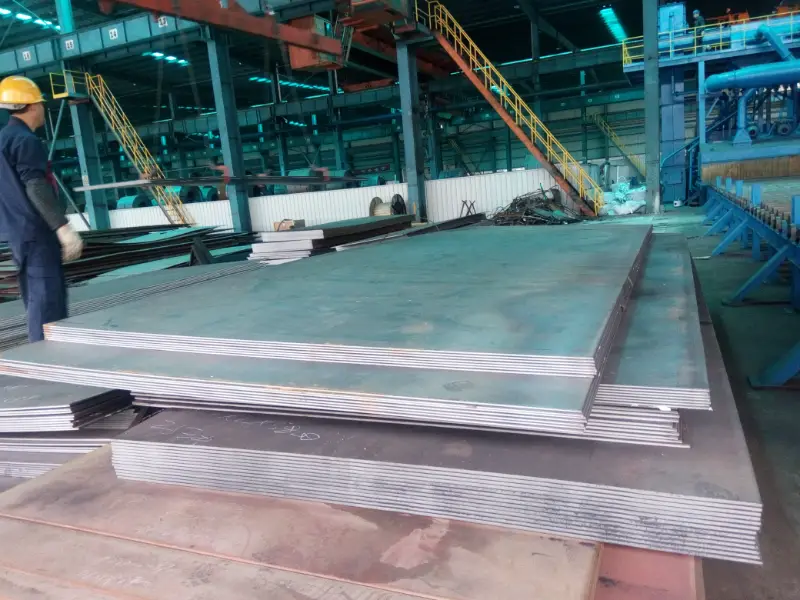
ABS Grade EH32 Shipbuilding Steel
ABS Grade EH32 Shipbuilding Steel: High Strength & -40°C Toughness
Detailed data sheet for ABS Grade EH32 shipbuilding steel: chemical composition, tensile and impact properties at -40°C, physical constants, and international equivalents for hull and offshore structures.
Hot rolling with normalizing or TMCP; optional tempering
- Phone : +8618037372205
- Email : [email protected]
- WhatsApp: Contact via Whtsapp
- WeChat: +8618037372205
ABS Grade EH32 Shipbuilding Steel Introduction
ABS Grade EH32 is a high-strength structural steel for shipbuilding, classified by the American Bureau of Shipping. It is designed for critical marine and offshore applications requiring reliable low-temperature toughness, exemplified by its minimum impact energy of 34 J at -40 °C (longitudinal). The steel is supplied in normalized or thermomechanically controlled processed (TMCP) condition, ensuring a fine-grained microstructure and excellent weldability. Typical yield strength exceeds 315 MPa, with tensile strength in the range of 440–590 MPa and elongation at least 22%, making EH32 suitable for hull plating, decks, longitudinals, and ice-strengthened structures.
Key features include:
- Consistent through-thickness properties (Z-test available)
- Fine-grain practice with Al, Nb, V or Ti additions
- Good formability, flatness and surface quality
- Fully killed and continuously cast steel
- CEV controlled for preheat-free welding
EH32 is directly equivalent to Grades EH32 of DNV, LR, BV, GL, CCS, NK, KR, RINA and other IACS classification societies.
ABS Grade EH32 Shipbuilding Steel Chemical Composition
Chemical requirements per ABS Rules Part 2, Table 1 for Grade EH32. The steel is fully killed and fine-grain treated. Micro-alloying elements (Nb, V, Ti) may be used singly or in combination to achieve grain refinement and strength. The carbon equivalent (CEV) is limited to ensure good weldability and avoid cold cracking.
| Chemical Element | Standard Value (wt%) | Remarks |
|---|---|---|
| C | ≤ 0.18 | Ladle analysis; CEV controlled |
| Si | 0.10 – 0.50 | |
| Mn | 0.90 – 1.60 | |
| P | ≤ 0.035 | |
| S | ≤ 0.035 | |
| Cr | ≤ 0.20 | Residual |
| Ni | ≤ 0.40 | Residual |
| Cu | ≤ 0.35 | Residual |
| Mo | ≤ 0.08 | Residual |
| Al (acid soluble) | ≥ 0.015 | Fine-grain practice |
| Nb | ≤ 0.05 | Optional grain refiner |
| V | ≤ 0.10 | Optional grain refiner |
| Ti | ≤ 0.02 | Optional grain refiner |
| N | ≤ 0.009 | If applicable |
| Nb + V + Ti | ≤ 0.12 | Combination limit |
| CEV | ≤ 0.38 | CEV = C + Mn/6 + (Cr+Mo+V)/5 + (Ni+Cu)/15 |
ABS Grade EH32 Shipbuilding Steel Thermal & Electrical Physical Properties
These physical constants are representative for carbon‑manganese structural steels such as EH32. Actual values may vary slightly with composition and heat treatment. Thermal expansion, conductivity, and specific heat are given for the room‑to‑moderate temperature range commonly used in design.
| Property Item | Typical Value | Unit | Test Condition |
|---|---|---|---|
| Density (ρ) | 7.85 | g/cm³ | 20 °C |
| Modulus of elasticity (E) | 206 | GPa | 20 °C, static |
| Shear modulus (G) | ≈ 80 | GPa | 20 °C |
| Poisson's ratio (ν) | 0.3 | — | 20 °C |
| Thermal expansion coefficient (α) | 11.7 × 10⁻⁶ | K⁻¹ | 20 – 100 °C |
| Thermal conductivity (λ) | ≈ 50 | W/(m·K) | 20 °C |
| Specific heat capacity (cp) | ≈ 460 | J/(kg·K) | 20 °C |
| Electrical resistivity (ρe) | ≈ 0.22 | µΩ·m | 20 °C |
ABS Grade EH32 Shipbuilding Steel Mechanical Properties
Tensile and impact properties according to ABS Rules Part 2. Tests are performed on standard specimens taken from normalised or TMCP plates, in the as-delivered condition. Impact values represent minimum average for three specimens; single value may not fall below 70 % of the specified minimum. Bending test is done at room temperature with the mandrel diameter depending on thickness.
| Property Item | Standard Value | Unit | Test Condition |
|---|---|---|---|
| Yield strength (ReH) | ≥ 315 | MPa | Ambient, tensile test, transverse |
| Tensile strength (Rm) | 440 – 590 | MPa | Ambient, tensile test, transverse |
| Elongation (A5) | ≥ 22 | % | Gauge length 5.65√S₀, transverse |
| Bend test (flat specimen) | No cracks, 180° | — | Mandrel diameter = 3t (t ≤ 50 mm) |
| Impact energy (KV, longitudinal) | ≥ 34 | J | -40 °C |
| Impact energy (KV, transverse) | ≥ 27 | J | -40 °C |
ABS Grade EH32 Shipbuilding Steel Fully Equivalent Material Standards & Grades
| Country/Region | Standard / Classification Society | Grade | Remarks |
|---|---|---|---|
| International | IACS Member Societies | EH32 | Identical requirements across IACS |
| Norway / Germany | DNV (Det Norske Veritas) | EH32 | Equivalent chemistry and -40 °C toughness |
| UK | LR (Lloyd's Register) | EH32 | |
| France | BV (Bureau Veritas) | EH32 | |
| Germany | GL (Germanischer Lloyd, now DNV GL) | EH32 | Pre-merger grade |
| China | CCS (China Classification Society) | EH32 | Same CH/mechanical requirements |
| Japan | NK (Nippon Kaiji Kyokai) | EH32 | |
| South Korea | KR (Korean Register) | EH32 | |
| Italy | RINA (Registro Italiano Navale) | EH32 | |
| USA | ABS / ASTM A131 | EH32 | ASTM A131 EH32 is almost identical |
ABS Grade EH32 Shipbuilding Steel Application Introduction
ABS EH32 is extensively used in the maritime and offshore sectors where a combination of strength, weldability and guaranteed toughness at sub‑zero temperatures is mandatory. Typical service temperatures down to -40 °C are accommodated without brittle failure. The steel is suitable for primary structural members, ice‑belt shell plating, and components exposed to dynamic loads. The grade's fine-grain practice allows for thermo‑mechanically controlled rolling (TMCP), which offers high strength while maintaining excellent weldability and reduced pre‑heat requirements.
Product Applications: Hull outer plating (side and bottom shell), Longitudinal and transverse framing systems, Watertight and oiltight bulkheads, Ice-strengthened vessel belts, Offshore module support structures
Processed into products: Deck stringers and sheer strakes, Keel plates and bilge strakes, Web frames and stiffeners, Attachments and lifting lugs (when notch toughness is required), Fatigue-sensitive details where high impact energy is essential
Application industries: Shipbuilding (merchant, naval, arctic), Offshore oil & gas platforms, Renewable marine energy (wind turbine foundations), Heavy engineering and crane structures
ABS Grade EH32 Shipbuilding Steel Similar & Alternative Steel Grades
| Country/Region | Standard / Classification Society | Grade | Remarks |
|---|---|---|---|
| International | IACS | EH36 | Higher strength (yield ≥ 355 MPa); same -40 °C toughness |
| International | IACS | DH32 | Similar strength but impact at -20 °C instead of -40 °C |
| International | IACS | FH32 | Even lower temperature toughness (-60 °C) |
| Europe | EN 10025-4 | S355MLO / S355G10+N | Offshore structural steel, some with -40 °C option |
| USA | ASTM A131 | DH32 / EH36 | Adjacent grades in the shipbuilding specification |
| USA | API 2H Gr.50 | Gr.50 | For offshore structures, similar strength, Z-quality |
Notes:
Additional requirements may be agreed:
- Through‑thickness tensile testing (Z‑quality to Z25 or Z35)
- Ultrasonic testing to EN 10160 or ASTM A578
- CTOD (crack tip opening displacement) testing for fracture‑critical applications
- Special flatness tolerances and shot‑blasting/primer treatment
The steel can be delivered as‑rolled, normalised, or TMCP. When TMCP is used, the specified mechanical properties must be verified after stress‑relieving heat treatment if required. Maximum thickness for guaranteed properties is typically 50 mm; thicker plates may need separate qualification.
- Share



