
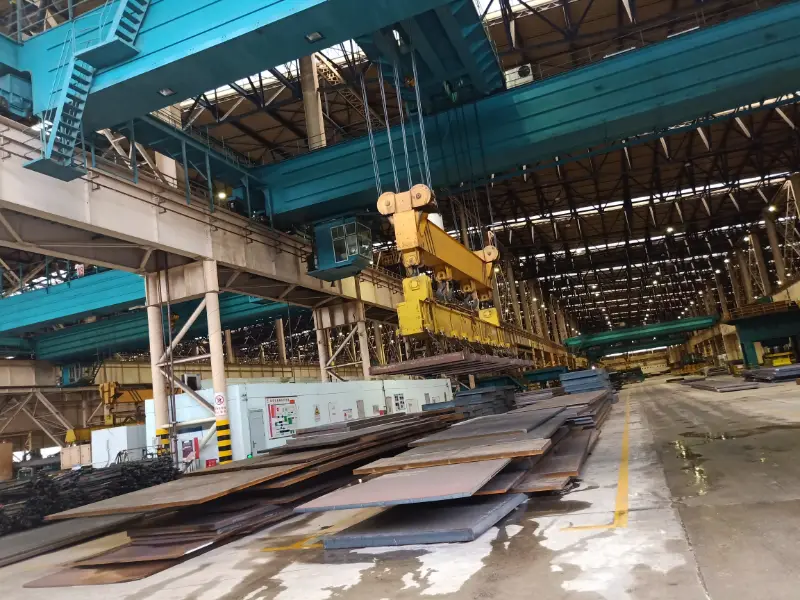
ABS Grade DH32 Shipbuilding Steel Plate
ABS Grade DH32 Shipbuilding Steel Plate - High Strength Hull Structural Steel with Low-Temperature Toughness
ABS Grade DH32 is a normalised high-strength shipbuilding steel plate designed for hull structures operating at temperatures down to -20°C. It meets ABS Rules and IACS UR W11, offering minimum yield strength of 315 MPa and guaranteed impact toughness at -20°C.
Welding, bending, cutting, forming, machining, normalising heat treatment (delivery condition)
- Phone : +8618037372205
- Email : [email protected]
- WhatsApp: Contact via Whtsapp
- WeChat: +8618037372205
ABS Grade DH32 Shipbuilding Steel Plate Introduction
ABS Grade DH32 is a high-strength structural steel plate for shipbuilding, certified by the American Bureau of Shipping (ABS). It belongs to the 32 kg/mm² (315 MPa) minimum yield strength category and is intended for hull and offshore construction. Key characteristics:
- Normalised delivery condition and fine grain practice ensure uniform properties and good weldability.
- Low-temperature impact toughness guaranteed at -20°C (longitudinal: 27 J, transverse: 20 J), making it suitable for cold environments.
- Excellent bend formability and weldability with common shipyard fabrication processes.
- Strictly controlled chemical composition with micro-alloying elements (Nb, V, Ti) to refine grain size and enhance strength-toughness balance.
The steel is widely used in hull structures, decks, bulkheads and offshore modules requiring a combination of strength and ductility.
ABS Grade DH32 Shipbuilding Steel Plate Chemical Composition
The chemical composition of ABS Grade DH32 meets the requirements of ABS Rules Part 2, Chapter 1. Main elements are strictly controlled: Carbon equivalent (Ceq) is typically limited to improve weldability.
- Grain refining elements such as aluminium (acid soluble) are mandatory.
- Micro-alloying elements (Nb, V, Ti) may be added singly or in combination, with total content not exceeding 0.12%.
- Residual elements (Cu, Cr, Ni, Mo) are limited, but if added intentionally, they must be reported and the sum of Cu+Cr+Ni+Mo shall not exceed 0.80%.
| Element | Standard Value (%) | Remarks |
|---|---|---|
| Carbon (C) | ≤ 0.18 | Ladle analysis |
| Manganese (Mn) | 0.90 - 1.60 | High Mn improves strength and toughness |
| Silicon (Si) | 0.10 - 0.50 | Deoxidiser |
| Phosphorus (P) | ≤ 0.035 | Maximum for product analysis 0.040% |
| Sulfur (S) | ≤ 0.035 | Low sulfur for better weldability |
| Aluminium (Alsol) | ≥ 0.015 | Acid soluble, grain refinement |
| Niobium (Nb) | 0.02 - 0.05 | Optional micro-alloy, max 0.05% if added |
| Vanadium (V) | 0.05 - 0.10 | Optional micro-alloy, max 0.10% if added |
| Titanium (Ti) | ≤ 0.02 | Optional micro-alloy, max 0.02% if added |
| Copper (Cu) | ≤ 0.35 | Residual element |
| Chromium (Cr) | ≤ 0.20 | Residual element |
| Nickel (Ni) | ≤ 0.40 | Residual element |
| Molybdenum (Mo) | ≤ 0.08 | Residual element |
| Total Nb+V+Ti | ≤ 0.12 | Any combination, if added |
ABS Grade DH32 Shipbuilding Steel Plate Physical Properties
The physical properties are typical for low‑carbon manganese structural steel and serve as approximate values. They can vary slightly depending on exact composition and heat treatment.
- Density, elastic moduli, and thermal expansion are commonly used for engineering calculations.
- Thermal conductivity and electrical resistivity are given at room temperature unless otherwise noted.
| Property | Typical Value | Unit | Test Condition |
|---|---|---|---|
| Density (ρ) | 7.85 | g/cm³ | 20°C |
| Elastic Modulus (E) | 205 | GPa | 20°C |
| Shear Modulus (G) | 80 | GPa | 20°C |
| Poisson's Ratio (ν) | 0.3 | — | 20°C |
| Thermal Expansion Coefficient (α) | 11.7 × 10⁻⁶ | /K | 20–100°C |
| Thermal Expansion Coefficient (α) | 12.5 × 10⁻⁶ | /K | 20–200°C |
| Thermal Expansion Coefficient (α) | 13.5 × 10⁻⁶ | /K | 20–400°C |
| Thermal Conductivity (λ) | 51.9 | W/(m·K) | 20°C |
| Thermal Conductivity (λ) | 49.0 | W/(m·K) | 100°C |
| Specific Heat Capacity (c) | 486 | J/(kg·K) | 20°C |
| Electrical Resistivity (ρₑ) | 0.142 – 0.196 | μΩ·m | 20°C |
ABS Grade DH32 Shipbuilding Steel Plate Mechanical Properties
Mechanical properties are determined on test samples taken in accordance with ABS Rules. Tensile testing is performed on transverse specimens; impact testing on longitudinal (sometimes transverse) Charpy V-notch specimens at -20°C.
- Yield strength and tensile strength values apply to plate thicknesses up to 100 mm. For thickness > 50 mm, elongation may be slightly reduced (specified in standard).
- Bend test is carried out over a former diameter of 3t to 180° without cracking.
| Property | Standard Requirement | Unit | Test Condition |
|---|---|---|---|
| Yield Strength (ReH) | ≥ 315 | MPa | Transverse, t ≤ 50 mm |
| Yield Strength (ReH) | ≥ 295 (t > 50–100 mm) | MPa | Transverse |
| Tensile Strength (Rm) | 440 – 590 | MPa | Transverse, all thicknesses |
| Elongation (A) | ≥ 22 | % | Transverse, gauge length 5.65√S₀; t ≤ 50 mm |
| Elongation (A) | ≥ 21 (t > 50–100 mm) | % | Transverse |
| Charpy Impact (KV) | ≥ 27 (average) | J | Longitudinal, -20°C (DH32) |
| Charpy Impact (KV) | ≥ 20 (average) | J | Transverse, -20°C (DH32) |
| Bend Test (D = 3t) | 180° without cracks | — | t = specimen thickness; bend angle 180° |
ABS Grade DH32 Shipbuilding Steel Plate Fully Equivalent International Standards and Substitute Grades
| Country/Region | Standard | Grade | Remarks |
|---|---|---|---|
| International | IACS UR W11 | DH32 | Direct equivalent, all IACS members |
| USA | ASTM A131 | Grade DH32 | Equivalent to ABS DH32 |
| UK | Lloyd's Register | LR DH32 | Same technical requirements |
| Norway | DNV Rules | DNV DH32 | Same yield strength and impact at -20°C |
| France | Bureau Veritas | BV DH32 | Identical grade |
| China | CCS Rules | CCS DH32 | Fully equivalent |
| Italy | RINA Rules | RINA DH32 | Fully equivalent |
| Japan | ClassNK | NK DH32 | Fully equivalent |
| Korea | Korean Register | KR DH32 | Fully equivalent |
| Europe | EN 10025-4 | S355ML (thickness ≤ 50 mm) | Comparable mechanical properties; impact test at -50°C (ML), not identical but often accepted with additional agreement |
ABS Grade DH32 Shipbuilding Steel Plate Application Introduction
ABS Grade DH32 is a versatile high-strength hull structural steel suitable for primary and secondary ship structures, coastal and offshore engineering projects. Its guaranteed toughness at -20°C permits use in most marine environments except extreme arctic conditions.
- Normalised delivery provides homogeneous microstructure, facilitating cold forming and welding without preheating in moderate thicknesses.
- Used extensively in shipyards for constructing hulls, decks, bulkheads, and structural members of oil tankers, bulk carriers, container vessels, and offshore platforms.
- Fabrication requires compliance with ABS welding and workmanship standards.
Product Applications: Hull shell plating, Main deck and strength decks, Bottom shell and bilge plates, Bulkheads and transverse webs, Longitudinal stiffeners and girders, Offshore module structural steelwork, Ship and barge structural elements
Processed into products: Keel plates, Deck stringer plates, Bilge strakes, Cofferdam bulkhead panels, Hatch coamings, Main frame brackets, Stiffener profiles (angles, bulb flats), Pillar and stanchion plates
Application industries: Commercial shipbuilding (tankers, bulk carriers, container ships, ferries), Naval shipbuilding (auxiliary vessels, patrol boats), Offshore oil and gas (topsides, jackets, living quarters modules), Marine ports and harbor structures (fender systems, sheet piles), Renewable energy (offshore wind foundation substructures)
ABS Grade DH32 Shipbuilding Steel Plate Near/Similar Substitute Materials and Sister Grades
| Country/Region | Standard | Grade | Remarks |
|---|---|---|---|
| International | ABS Rules | ABS AH32 | Same strength, impact only at 0°C; cheaper alternative if low temperature toughness not critical |
| International | ABS Rules | ABS EH32 | Same strength, impact at -40°C; for colder service |
| International | ABS Rules | ABS FH32 | Same strength, impact at -60°C |
| International | ABS Rules | ABS DH36 | Higher strength (≥355 MPa yield); similar impact temperature -20°C, used for weight reduction |
| International | ABS Rules | ABS DH40 | Higher strength (≥390 MPa yield); same impact temperature, structural parts with higher loading |
| USA | ASTM A131 | Grade DH36 | Similar with higher yield strength |
| Europe | EN 10025-4 | S355ML | Near equivalent, TMCP delivery; impact -50°C, often used in offshore as DH32 substitute |
Notes:
Welding: DH32 is weldable by all common arc welding processes. Low hydrogen electrodes and proper heat input control are recommended to avoid cold cracking. Preheat may be required for thick sections (>50 mm) or low ambient temperatures.
Certification: ABS survey and marking are mandatory. Test certificates (material and impact) are issued per ABS Rules. Ultrasonic testing or other NDE may be specified for critical applications.
Surface condition: Plates are usually supplied descaled and shop-primed for corrosion protection during construction.
- Share



