
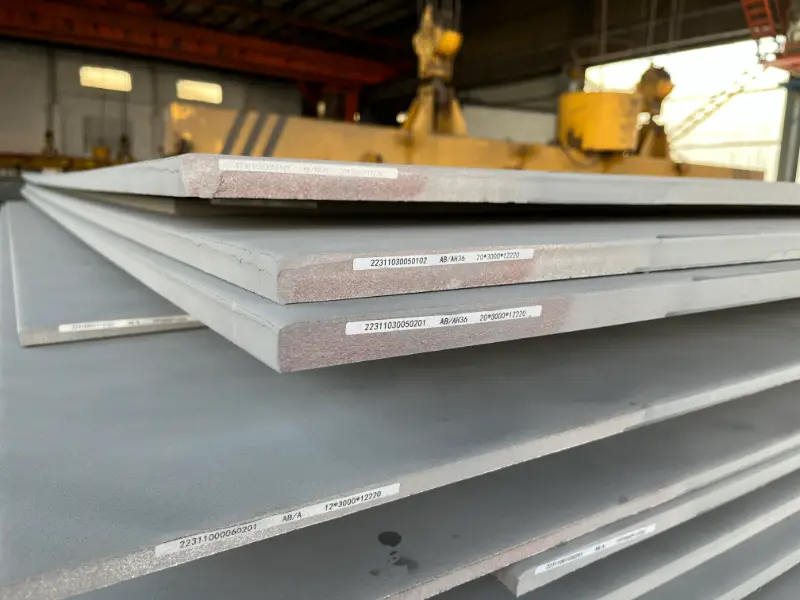
ABS Grade EH36 Shipbuilding Steel
ABS Grade EH36 Shipbuilding Steel - High-Strength Plate for Arctic-Class Structures
ABS EH36 is a high-strength hull structural steel with a minimum yield strength of 355 MPa and guaranteed Charpy impact toughness at -40°C. Ideal for shipbuilding and offshore platforms operating in cold climates.
Hot rolling, normalising, TMCP, cutting, cold forming, welding, machining
- Phone : +8618037372205
- Email : [email protected]
- WhatsApp: Contact via Whtsapp
- WeChat: +8618037372205
ABS Grade EH36 Shipbuilding Steel Introduction
ABS Grade EH36 is a high strength, normalised or thermo-mechanically controlled processed (TMCP) shipbuilding steel plate certified by the American Bureau of Shipping. It belongs to the high-strength hull structural group with a specified minimum yield strength of 355 MPa and tensile strength between 490 and 620 MPa. The letter 'E' indicates it delivers reliable impact toughness at -40°C, making it suitable for ships and offshore structures operating in cold and ice-prone waters. Its chemical composition is carefully controlled with microalloying elements (Nb, V, Al) to ensure fine grain size and consistent mechanical properties through thickness. EH36 is widely used for the construction of decks, hulls, bulkheads and critical structural components in tankers, bulk carriers and ice-class vessels. It is available in thicknesses up to 150 mm and can be supplied in as-rolled, normalised or TMCP condition, with improved weldability and good ductility.
ABS Grade EH36 Shipbuilding Steel Chemical Composition
The chemical composition of ABS EH36 is designed for high strength, fine grain structure and excellent low-temperature toughness. Carbon is restricted to ≤0.18% to ensure good weldability. Manganese, silicon and aluminium are used for deoxidation and grain refinement. Microalloying elements niobium and vanadium provide precipitation strengthening without sacrificing toughness. Residual elements such as P and S are limited to ≤0.035% each. Whenever the carbon equivalent (CEV) is required for weldability assessment, a typical value is around 0.38–0.43 depending on thickness and processing route.
| Element | Standard Value (%) | Remarks |
|---|---|---|
| Carbon (C) | ≤ 0.18 | Lower C improves weldability and toughness |
| Manganese (Mn) | 0.90 – 1.60 | For strength and deoxidation |
| Silicon (Si) | 0.10 – 0.50 | Deoxidiser, contributes to strength |
| Phosphorus (P) | ≤ 0.035 | Strictly limited for toughness |
| Sulfur (S) | ≤ 0.035 | Low S reduces hot cracking risk |
| Aluminium (Al) acid soluble | ≥ 0.015 | Grain refinement |
| Niobium (Nb) | 0.02 – 0.05 | Microalloy for strength and fine grains |
| Vanadium (V) | 0.05 – 0.10 | Precipitation strengthening |
| Titanium (Ti) | ≤ 0.02 | Optional fixing of nitrogen |
| Copper (Cu) | ≤ 0.35 | Residual element |
| Chromium (Cr) | ≤ 0.20 | Residual, may be added for thickness |
| Nickel (Ni) | ≤ 0.40 | Residual |
| Molybdenum (Mo) | ≤ 0.08 | Residual |
ABS Grade EH36 Shipbuilding Steel Thermal and Electrical Physical Properties
The physical properties are based on typical data for low-carbon microalloyed steel and are not part of the ABS specification. They are provided as engineering reference for thermal analysis, heat treatment and structural design. Density is 7.85 g/cm³, elastic modulus about 205 GPa at room temperature. Thermal expansion coefficient averages 12 ×10⁻⁶/K in the range 20–100°C, and thermal conductivity is around 52 W/m·K. Electrical resistivity is about 0.22 ×10⁻⁶ Ω·m. These values may vary slightly with composition and heat treatment.
| Property | Standard / Typical Value | Unit | Test Condition |
|---|---|---|---|
| Density (ρ) | 7.85 | g/cm³ | At 20°C |
| Modulus of Elasticity (E) | 205 | GPa | At room temperature |
| Shear Modulus (G) | 80 | GPa | Calculated from E and ν |
| Poisson's Ratio (ν) | 0.3 | – | Elastic region |
| Thermal Expansion Coefficient (α) | 12.0 | 10⁻⁶/K | 20–100°C |
| Thermal Expansion Coefficient (α) | 12.5 | 10⁻⁶/K | 20–200°C |
| Thermal Expansion Coefficient (α) | 13.1 | 10⁻⁶/K | 20–400°C |
| Thermal Conductivity (λ) | 52 | W/(m·K) | At 20°C |
| Thermal Conductivity (λ) | 48 | W/(m·K) | At 200°C |
| Specific Heat Capacity | 460 | J/(kg·K) | At 20°C |
| Electrical Resistivity (ρ_e) | 0.22 | 10⁻⁶ Ω·m | At 20°C |
ABS Grade EH36 Shipbuilding Steel Mechanical Properties
The mechanical properties are determined on transverse test pieces in accordance with ABS requirements. The plate is normally supplied in normalised or TMCP condition. The specified yield strength ReH ≥355 MPa and tensile strength Rm 490–620 MPa apply for thicknesses up to 100 mm. Elongation A5 is minimum 21% for t ≤ 50 mm. Charpy V-notch impact energy is certified at -40°C with a minimum average of 34 J (24 J for single value) for transverse specimens. Bending tests are performed on a full-thickness specimen with a former diameter of 3t for the as-delivered condition (without strain ageing). The values below represent the base material before any forming or post-weld heat treatment.
| Property | Standard Requirement | Unit | Test Condition |
|---|---|---|---|
| Yield Strength (ReH) | ≥ 355 | MPa | Transverse, t ≤ 100 mm, room temperature |
| Tensile Strength (Rm) | 490 – 620 | MPa | Transverse, t ≤ 100 mm |
| Elongation (A5) | ≥ 21 | % | t ≤ 50 mm, transverse, gauge length 5.65√So |
| Elongation (A5) | ≥ 19 | % | 50 < t ≤ 70 mm |
| Elongation (A5) | ≥ 17 | % | 70 < t ≤ 100 mm |
| Charpy V-notch Impact Energy (KV2) | ≥ 34 (average) / ≥ 24 (single) | J | -40°C, transverse |
| Bend Test (Bend Diameter) | 3t (t = plate thickness) | – | 180° bend, no cracks, delivered condition |
ABS Grade EH36 Shipbuilding Steel Equivalent Standards and Grade Substitutions
| Country / Region | Standard | Grade | Remarks |
|---|---|---|---|
| International (ABS) | ABS Part 2 | EH36 | Certified by American Bureau of Shipping, -40°C impact |
| USA | ASTM A131/A131M | EH36 | Same chemical and mechanical properties |
| Europe (EN) | EN 10025-4 | S355ML | Thermo-mechanically rolled, -50°C impact (may exceed EH36 requirement) |
| Norway/Germany (DNV) | DNV GL Rules | NV E36 | Equivalent classification society grade |
| UK (LR) | Lloyd's Register Rules | LR EH36 | Identical hull structural steel |
| France (BV) | Bureau Veritas Rules | BV EH36 | Equivalent |
| Japan | JIS G 3106 (modified) | SM490YA | Closely equivalent if impact tested at -40°C (usual grade tested at 0°C); needs specification adjustment |
ABS Grade EH36 Shipbuilding Steel Application Introduction
ABS EH36 is the workhorse grade for cold-region shipbuilding and offshore structures. It is chosen where high strength, good weldability and reliable low-temperature toughness are required simultaneously. The grade can be fabricated by most conventional methods: welding (low hydrogen processes recommended), bending, cutting and machining. It is often delivered in normalised condition to homogenise properties and relieve residual stresses. For large structural components, preheating may be required depending on thickness and carbon equivalent. The following lists cover typical industries, products and specific fabricated parts.
Product Applications: Hull shell plating, Deck plates and stringer plates, Transverse and longitudinal bulkheads, Bottom and side longitudinal stiffeners, Keel plates, Ice belt plates, Leg components for jack-up rigs, Cargo tank plating for LPG/LNG carriers (subject to additional testing)
Processed into products: Hull plates up to 100 mm thick, Stiffeners and girders (fabricated from plate), Bracket plates and web frames, Rudder and stern frame components, Mast and crane pedestal base plates, Hatch coaming and coaming stays, Sea chest inserts, Dry dock gate structures
Application industries: Commercial shipbuilding (tankers, bulk carriers, container ships, ferries), Naval and defence vessels, Icebreakers and ice-strengthened vessels, Offshore oil & gas platforms (jack-up rigs, semi-submersibles), Renewable energy: offshore wind turbine substructures, Port and harbour equipment
ABS Grade EH36 Shipbuilding Steel Similar or Closely Related Alternative Materials
| Country / Region | Standard | Grade | Remarks |
|---|---|---|---|
| Europe | EN 10025-3 | S355NL | Normalised, -50°C impact; similar yield strength, slightly better low-temperature toughness |
| Europe | EN 10025-4 | S355ML | TMCP, -50°C impact; very close alternative |
| Europe | EN 10025-2 | S355J2 | Only -20°C impact; not suitable for low temperature but similar strength level |
| Japan | JIS G 3106 | SM490B/C/YA | Yield 365–490 MPa, impact temperature varies; need to specify -40°C for equivalence |
| China | GB 712 | EH36 | Identical grade and impact temperature under CCS rules |
| Russia | GOST 5521 | E36 | For shipbuilding, -40°C impact |
Notes:
- When EH36 is to be used for welded structures in cold service, supplementary notch toughness testing is often performed at -40°C or lower per ABS rules.
- For thickness >100 mm or for hot-rolled as-rolled delivery, special agreement with the classification society is required, and mechanical properties shall be verified by specific testing.
- The Carbon Equivalent (CEV) formula typically used is CEV = C + Mn/6 + (Cr+Mo+V)/5 + (Ni+Cu)/15. A common limit for EH36 is ≤ 0.40 for thickness ≤ 50 mm and ≤ 0.43 for 50–100 mm.
- All data in the tables comply with the ABS Rules for Materials and Welding 2024 edition and ASTM A131/A131M-19. Physical properties are typical reference values and not normative.
- Share



