
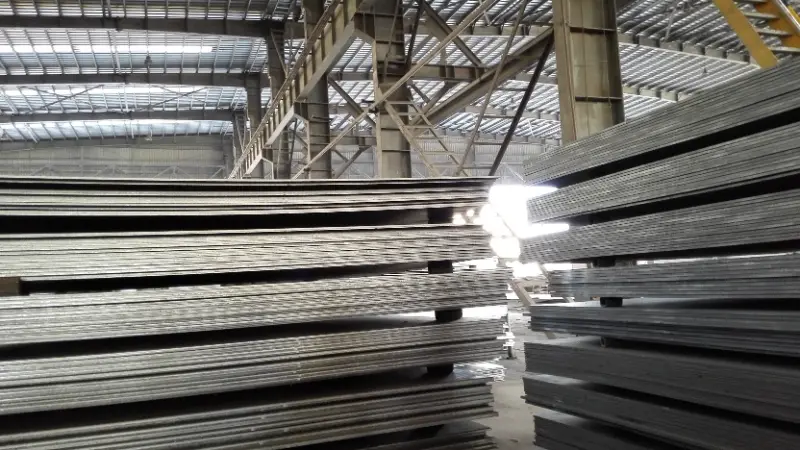
ABS Grade AH40 Shipbuilding Steel Plate
ABS Grade AH40 Shipbuilding Steel Plate: High-Strength Hull Structural Steel
ABS Grade AH40 is a high-strength shipbuilding steel plate with minimum yield strength of 390 MPa, superior toughness at 0°C, and excellent weldability, widely used in marine and offshore structures.
Welding, Bending, Cutting, Machining
- Phone : +8618037372205
- Email : [email protected]
- WhatsApp: Contact via Whtsapp
- WeChat: +8618037372205
ABS Grade AH40 Shipbuilding Steel Plate Introduction
ABS Grade AH40 is a high-strength structural steel plate used in shipbuilding and offshore engineering. It is characterized by a minimum yield strength of 390 MPa, excellent toughness at 0°C, and good weldability. The steel is typically supplied in normalized or thermo-mechanically controlled processed condition (TMCP). Its chemical composition is carefully balanced to ensure superior mechanical properties and resistance to brittle fracture. The material also exhibits good formability and can be readily joined using conventional welding methods. This grade conforms to the ABS Rules for Materials and Welding and is recognized by other major classification societies. AH40 is suitable for critical hull structures, decks, bulkheads, and offshore platform components.
ABS Grade AH40 Shipbuilding Steel Plate Chemical Composition
The chemical composition of ABS Grade AH40 steel is controlled to ensure high strength, good toughness, and excellent weldability. The following table shows the ladle analysis limits according to ABS Rules.
| Element | Standard Value (%) | Remarks |
|---|---|---|
| C | ≤0.18 | For strength and weldability |
| Mn | 0.90 - 1.60 | Deoxidation and strength |
| Si | 0.10 - 0.50 | Deoxidizer |
| P | ≤0.035 | Impurity |
| S | ≤0.035 | Impurity |
| Als (total Al) | ≥0.015 | Grain refinement (when grain-refined) |
| Nb | ≤0.05 | Microalloy for grain refinement |
| V | ≤0.10 | Microalloy |
| Ti | ≤0.02 | Grain refinement |
| Cu | ≤0.35 | Residual element |
| Cr | ≤0.20 | Residual element |
| Ni | ≤0.40 | Residual element |
| Mo | ≤0.08 | Residual element |
| N | ≤0.009 | Grain refinement combined with Al |
ABS Grade AH40 Shipbuilding Steel Plate Thermal and Electrical Physical Properties
Typical physical properties of AH40 steel at room temperature and elevated temperatures. These values are for reference only and not specified by ABS.
| Property | Value | Unit | Test Condition |
|---|---|---|---|
| Density (ρ) | 7.85 | g/cm³ | At 20°C |
| Modulus of Elasticity (E) | 205 | GPa | At 20°C |
| Shear Modulus (G) | 80 | GPa | At 20°C |
| Poisson's Ratio (ν) | 0.3 | - | At 20°C |
| Thermal Expansion (α) | 11.7 | 10⁻⁶/K | 20-100°C |
| Thermal Expansion (α) | 12.2 | 10⁻⁶/K | 20-200°C |
| Thermal Expansion (α) | 12.8 | 10⁻⁶/K | 20-300°C |
| Thermal Conductivity (λ) | 52 | W/m·K | At 20°C |
| Thermal Conductivity (λ) | 51 | W/m·K | At 100°C |
| Specific Heat Capacity (cp) | 460 | J/kg·K | At 20-100°C |
| Electrical Resistivity (ρe) | 0.20 | 10⁻⁶ Ω·m | At 20°C |
ABS Grade AH40 Shipbuilding Steel Plate Mechanical Properties
Mechanical properties are dependent on plate thickness and test direction. The following values are based on ABS requirements for AH40 steel. Transverse and longitudinal properties may vary.
| Property | Specified Value | Unit | Test Condition |
|---|---|---|---|
| Yield Strength (ReH) | ≥390 | MPa | Thickness ≤ 50 mm, transverse |
| Yield Strength (ReH) | ≥390 | MPa | Thickness > 50-70 mm, transverse |
| Yield Strength (ReH) | ≥390 | MPa | Thickness > 70-100 mm, transverse |
| Tensile Strength (Rm) | 510 - 650 | MPa | Thickness ≤ 100 mm, transverse |
| Elongation (A) | ≥20 | % | Thickness ≤ 50 mm, gauge length 5.65√S0 |
| Elongation (A) | ≥19 | % | Thickness > 50-70 mm |
| Elongation (A) | ≥18 | % | Thickness > 70-100 mm |
| Impact Energy (KV2) | ≥34 (average), ≥27 (single) | J | 0°C, longitudinal, thickness ≤ 50 mm |
| Impact Energy (KV2) | ≥24 (average), ≥17 (single) | J | 0°C, transverse, thickness ≤ 50 mm |
| Bend Test | No cracks after 180° bending, mandrel diameter 3t (t ≤ 25 mm) | - | Room temperature |
ABS Grade AH40 Shipbuilding Steel Plate Completely Equivalent Standards and Substitutable Grades
| Country/Region | Standard | Grade | Remarks |
|---|---|---|---|
| International | ABS | AH40 | Original grade |
| Norway/Germany | DNV GL | NV A40 | Equivalent |
| United Kingdom | LR | AH40 | Equivalent |
| France | BV | AH40 | Equivalent |
| China | CCS | AH40 | Equivalent |
| Japan | NK | KA40 | Equivalent |
| South Korea | KR | AH40 | Equivalent |
| Italy | RINA | AH40 | Equivalent |
| Russia | RS | A40 | Equivalent |
| International | IACS | A40 | Common IACS grade |
ABS Grade AH40 Shipbuilding Steel Plate Application Introduction
ABS AH40 steel is ideal for structural components requiring high strength, good weldability, and reliable toughness at low temperatures. It is extensively used in the shipbuilding and offshore industry. The steel can be cut, welded, bent, and machined using standard procedures, with attention to preheating and interpass temperature control to avoid cold cracking.
Product Applications: Ship hulls (shell plating, deck, bottom), Bulkheads and stiffeners, Offshore platform topside structures, Jack-up rig legs and spudcans, Marine cranes and heavy-lift equipment
Processed into products: Main deck plates, Bottom shell plates, Transverse web frames, Longitudinal stiffeners, Bulkhead plates, Hatch coaming plates, Offshore module support beams, Structural nodes and joints
Application industries: Shipbuilding, Offshore Engineering, Marine Construction, Port Machinery, Pressure Vessels (limited)
ABS Grade AH40 Shipbuilding Steel Plate Similar/Comparable Alternative Materials
| Country/Region | Standard | Grade | Remarks |
|---|---|---|---|
| International | ABS | DH40 | Higher toughness grade (-20°C impact) |
| International | ABS | EH40 | Higher toughness grade (-40°C impact) |
| International | API | 2H Grade 50 | Offshore structural steel with similar strength |
| Europe | EN 10025-4 | S420ML | Thermo-mechanical rolled steel, 420 MPa yield, for offshore |
Notes:
The above information is based on ABS Rules for Materials and Welding, Part 2. Actual material properties may vary with processing and certification condition. For specific projects, please consult the ABS material certificate and relevant standards.
- Share



