
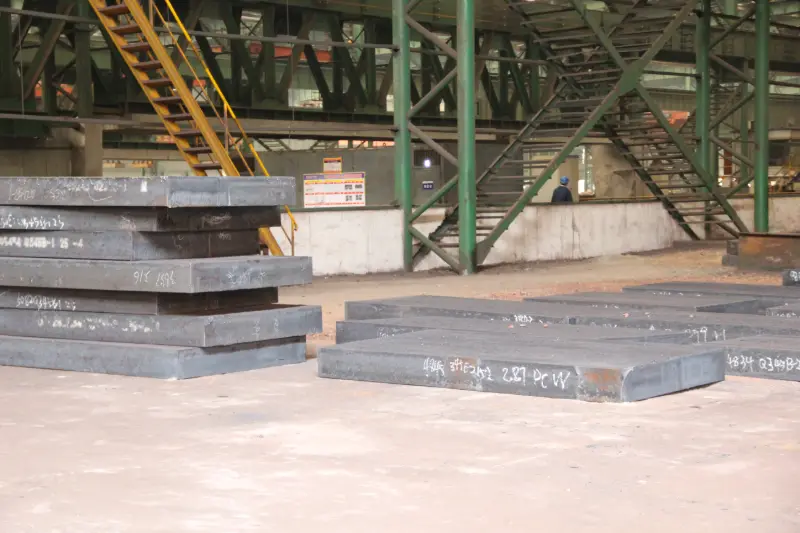
ABS Grade AQ51 Shipbuilding Steel Plate
ABS Grade AQ51 Shipbuilding Steel Plate - Technical Data, Properties & Equivalents
Complete material datasheet for ABS Grade AQ51 quenched and tempered shipbuilding steel plate: chemical composition, mechanical and thermal properties, equivalent grades, and application guidance.
Hot rolling followed by quenching and tempering; suitable for cold forming, welding, and machining
- Phone : +8618037372205
- Email : [email protected]
- WhatsApp: Contact via Whtsapp
- WeChat: +8618037372205
ABS Grade AQ51 Shipbuilding Steel Plate Introduction
ABS Grade AQ51 is a quenched and tempered high‑strength shipbuilding steel plate with a minimum yield strength of 355 MPa (51 ksi). It belongs to the category of higher‑strength hull structural steels according to the American Bureau of Shipping (ABS) Rules. This grade is designed for critical structural applications in ship and offshore construction where high strength, excellent weldability, and good low‑temperature impact toughness are required. The 'A' designation indicates impact testing at 0 °C, making it suitable for service at temperatures down to 0 °C. AQ51 offers improved strength‑to‑weight ratio compared to conventional shipbuilding grades, enabling lighter structures without compromising safety. It is typically supplied in normalized or quenched and tempered condition and meets the stringent requirements of IACS (International Association of Classification Societies) for marine materials.
ABS Grade AQ51 Shipbuilding Steel Plate Chemical Composition
The following chemical composition applies to product analysis according to ABS Rules for quenched and tempered shipbuilding steels. Grain‑refining elements are added to ensure fine austenitic grain size and achieve the required strength and toughness. Values are maximum unless a range is given.
| Element | Composition (wt.%) | Remarks |
|---|---|---|
| C | ≤ 0.18 | Max. for base metal strength and weldability |
| Si | 0.10 – 0.55 | Killing element; typical range |
| Mn | 0.90 – 1.60 | Ensures deep hardenability |
| P | ≤ 0.025 | Max. to avoid embrittlement |
| S | ≤ 0.025 | Max. for inclusion control |
| Cr | ≤ 0.20 | Residual limit for marine environments |
| Ni | ≤ 0.40 | Residual; beneficial for toughness |
| Mo | ≤ 0.08 | Residual; enhances hardenability |
| Cu | ≤ 0.35 | Residual; can affect hot shortness if too high |
| Al (total) | ≥ 0.015 | Min. for fine grain practice |
| Nb | 0.02 – 0.05 | Microalloying for grain refinement |
| V | 0.05 – 0.10 | Precipitation hardening contribution |
| Ti | ≤ 0.02 | Optional grain‑refiner |
| N | ≤ 0.009 | Max. to prevent strain ageing |
ABS Grade AQ51 Shipbuilding Steel Plate Thermal & Electrical Physical Properties
The following physical properties are representative for low‑alloy quenched and tempered steels of this strength class. They are not normative requirements but are useful for design calculations. Values may vary slightly depending on exact composition and heat treatment. Thermal conductivity and expansion are given for the temperature range 20–100 °C.
| Property | Typical Value | Unit | Test Condition / Remarks |
|---|---|---|---|
| Density (ρ) | 7.85 | g/cm³ | Room temperature |
| Elastic modulus (E) | 210 | GPa | Tension, room temperature |
| Shear modulus (G) | 80 | GPa | Calculated from E and ν |
| Poisson's ratio (ν) | 0.3 | — | Room temperature |
| Thermal expansion coefficient (α) | 11.7 × 10⁻⁶ | K⁻¹ | 20–100 °C |
| Thermal conductivity (λ) | ~ 50 | W/(m·K) | At 20 °C |
| Specific heat capacity (cp) | ~ 460 | J/(kg·K) | At 20 °C |
| Electrical resistivity (ρe) | ~ 0.15 | μΩ·m | At 20 °C |
ABS Grade AQ51 Shipbuilding Steel Plate Mechanical Properties
Mechanical properties are obtained from transverse test specimens taken from quenched and tempered plates. The values conform to ABS Rules for Grade AQ51. Actual test conditions and specimen orientation are as specified in the standard; longitudinal impact values are also shown where higher requirements exist. Bending test is carried out to a diameter of 3 × thickness, with no cracks or defects.
| Property | Minimum / Range | Unit | Test Condition / Remarks |
|---|---|---|---|
| Upper yield strength (ReH) | ≥ 355 | MPa | Room temperature; for t ≤ 50 mm |
| Tensile strength (Rm) | 490 – 620 | MPa | Room temperature |
| Elongation (A5) | ≥ 21 | % | Gauge length 5.65√So, for t ≤ 50 mm |
| Charpy impact energy (KV₂) | ≥ 50 (longitudinal) | J | At 0 °C, average of 3 specimens |
| Charpy impact energy (KV₂) | ≥ 34 (transverse) | J | At 0 °C, average of 3 specimens (if transverse specified) |
| 180° bend test | d = 3a, no cracks | t = thickness, a = bending angle |
ABS Grade AQ51 Shipbuilding Steel Plate Fully Equivalent Material Standards and Replaceable Grades
| Country / Region | Standard / Classification Society | Grade Designation | Remarks |
|---|---|---|---|
| International (ABS) | ABS Rules Part 2 | AQ51 | Base grade |
| International (BV) | BV Rules for Steel Ships | AQ51 | IACS member, identical requirements |
| International (CCS) | CCS Rules for Classification of Sea‑going Steel Ships | AQ51 | China Classification Society, equivalent |
| International (DNV) | DNV Rules for Ships | AQ51 | DNV GL (now DNV) equivalent |
| International (KR) | KR Rules for Classification of Steel Ships | AQ51 | Korean Register, equivalent |
| International (LR) | LR Rules for Ships | AQ51 | Lloyd's Register, equivalent |
| International (NK) | NK Rules for Ships | AQ51 | Nippon Kaiji Kyokai, equivalent |
| International (RINA) | RINA Rules for Construction of Ships | AQ51 | Registro Italiano Navale, equivalent |
ABS Grade AQ51 Shipbuilding Steel Plate Application Introduction
ABS AQ51 quenched and tempered steel is primarily used in the marine and offshore industry where a combination of high strength, low‑temperature toughness, and good weldability is essential. Its ability to achieve 355 MPa yield strength in quenched and tempered condition allows for weight‑saving designs without sacrificing structural integrity. Typical applications include highly stressed hull components, deck structures, and areas subject to fatigue loading. It can be formed, cut, and welded with appropriate procedures, and is often selected for large container ships, bulk carriers, and offshore installations.
Product Applications: Hull plates for longitudinal and transverse framing, Deck, bottom, and side shell plating, Stiffeners, girders, and brackets, Offshore platform topside structural members, Leg components of jack‑up rigs
Processed into products: Main deck plates, Bottom shell plates (flat bottom and bilge), Side shell strakes, Longitudinal bulkheads, Transverse web frames and floors, Hatch coaming and coaming stays, Stinger tails and J‑tube supports on offshore vessels, Crane pedestals and heavy‑duty foundations
Application industries: Shipbuilding (hull and superstructure), Offshore oil & gas (jack‑up rigs, semisubmersibles, FPSOs), Heavy civil engineering (bridges, hydraulic structures), Port and harbour equipment
ABS Grade AQ51 Shipbuilding Steel Plate Near‑Equivalent or Similar Performance Grades
| Country / Region | Standard / Classification Society | Grade Designation | Comparison / Remarks |
|---|---|---|---|
| International (ABS) | ABS Rules Part 2 | AH36 / DH36 / EH36 | Normalised or TMCP high‑strength grades; yield 355 MPa but impact temps differ (0, −20, −40 °C); not quenched & tempered |
| Europe | EN 10025‑6 | S460Q / S460QL | Quenched & tempered structural steel with min. yield 460 MPa; higher strength; similar Q+T processing |
| USA | ASTM A514 / A517 | Grade B or E | Quenched & tempered alloy steel plate; min. yield 690 MPa, much higher strength but comparable for some heavy plates |
| International (API) | API 2H | Grade 50 | Offshore structural steel plate; min. yield 345–483 MPa (50 ksi); used in offshore platforms, similar applications |
| International (IACS) | UR W11 | AQ47 | Lower yield strength (315 MPa) but same Q+T category; for less demanding structures |
Notes:
Delivery condition: Quenched and tempered. Normalising may be permitted for thicknesses ≤ 25 mm by agreement with the classification society.
Weldability: Good, provided proper preheat and low‑hydrogen procedures are followed; carbon equivalent (CEV) typically ≤ 0.42%.
Thickness range: Commonly supplied from 6 mm up to 150 mm, with the above properties guaranteed for t ≤ 50 mm; for thicker plates a slight reduction in minimum yield and impact values may apply per ABS rules.
Certification: Each plate is supplied with a Class Certificate and marked with ABS stamp and heat number.
Testing: Tensile, Charpy, bend, and drop‑weight tests are performed as required; ultrasonic testing may be specified for critical applications.
- Share



