
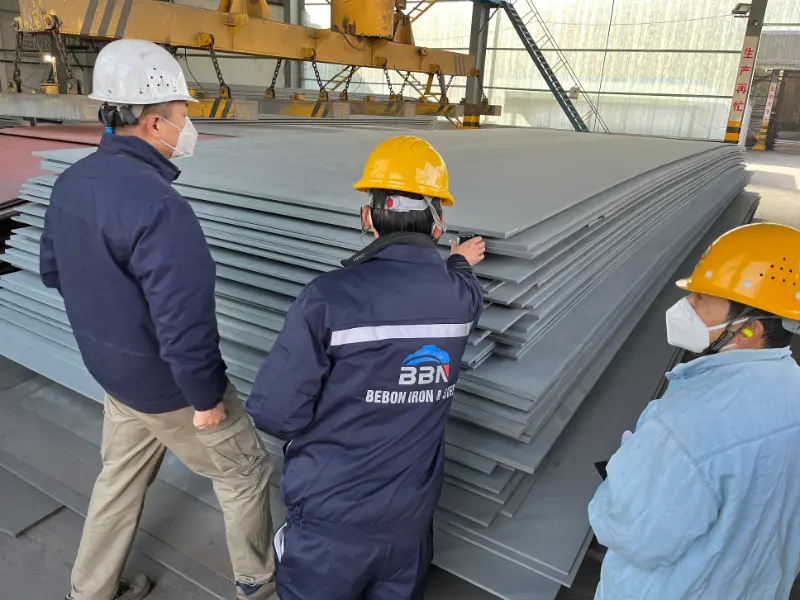
ASTM A131 Grade B Ship Steel
ASTM A131 Grade B Ship Steel: Superior Strength & Weldability for Marine Structures
Detailed data sheet for ASTM A131 Grade B shipbuilding steel including chemical composition, mechanical properties, thermal and electrical performance, international equivalents and application guide.
Hot rolling, normalizing, TMCP, cutting, welding, bending, forming
- Phone : +8618037372205
- Email : [email protected]
- WhatsApp: Contact via Whtsapp
- WeChat: +8618037372205
ASTM A131 Grade B Ship Steel Introduction
ASTM A131 Grade B is a normal-strength hull structural steel widely used in shipbuilding and offshore engineering. Manufactured in accordance with ASTM A131/A131M, it offers a balanced combination of strength, toughness and excellent weldability at moderate thicknesses. The steel is typically supplied in hot-rolled, normalized or thermomechanically controlled processed (TMCP) condition. With a minimum yield strength of 235 MPa and guaranteed Charpy V-notch impact energy of 27 J at 0°C (longitudinal), it meets stringent marine classification requirements. Its fine-grained microstructure, achieved through aluminum or microalloy additions, ensures reliable performance in cold-climate operations.
- Minimum yield strength 235 MPa (t≤50 mm)
- Tensile strength 400–520 MPa with good elongation
- Reliable low-temperature impact toughness at 0°C
- Excellent formability for bending and profiling
ASTM A131 Grade B Ship Steel Chemical Composition
The ladle analysis limits for ASTM A131 Grade B according to ASTM A131/A131M. The steel is characterized by controlled manganese content and low phosphorus and sulfur for good toughness. Fine-grain practice is evident from the required aluminum, vanadium, niobium or titanium additions. Residual elements like copper, nickel, chromium and molybdenum are restricted to maintain weldability.
| Element | Standard Value | Remarks |
|---|---|---|
| C | ≤0.21 | |
| Mn | 0.80–1.10 (t≤25 mm); 0.80–1.20 (t>25 mm) | Thickness-dependent |
| P | ≤0.035 | |
| S | ≤0.035 | |
| Si | 0.10–0.35 | |
| Cu | ≤0.35 | |
| Ni | ≤0.40 | |
| Cr | ≤0.25 | |
| Mo | ≤0.08 | |
| Al (acid soluble) | 0.015–0.06 | Required when Al is used as grain refiner |
| V | 0.02–0.05 | Optional grain refiner |
| Nb | 0.02–0.05 | Optional grain refiner |
| Ti | 0.007–0.02 | Optional grain refiner |
ASTM A131 Grade B Ship Steel Thermal & Electrical Physical Properties
The physical properties of ASTM A131 Grade B are representative of carbon-manganese structural steel. These values are not standardized but are useful for engineering calculations. They are derived from typical data for low-carbon steel with a density of about 7.85 g/cm³. The thermal expansion coefficient is an average for the 20–100°C range.
| Property | Approximate Value | Unit | Condition/Reference |
|---|---|---|---|
| Density (ρ) | 7.85 | g/cm³ | At room temperature |
| Modulus of Elasticity (E) | 200 | GPa | Typical for carbon steel |
| Shear Modulus (G) | 80 | GPa | Calculated from E and ν |
| Poisson's Ratio (ν) | 0.30 | - | Elastic range |
| Thermal Expansion Coeff. (α) | 11.5×10⁻⁶ | K⁻¹ | 20–100°C |
| Thermal Conductivity (λ) | ~50 | W/(m·K) | At 20°C, typical |
| Specific Heat Capacity | ~480 | J/(kg·K) | Near room temperature |
| Electrical Resistivity (ρ_e) | ~0.15 | μΩ·m | At 20°C |
ASTM A131 Grade B Ship Steel Mechanical Properties
Mechanical requirements for ASTM A131 Grade B as per ASTM A131/A131M. Minimum yield and tensile strengths apply for plate thicknesses ≤50 mm. Elongation is reported on both 200 mm and 50 mm gauge lengths. The bending test is mandatory and Charpy V-notch impacts are conducted at 0°C in the longitudinal direction. Values shown are the minimum required.
| Property | Standard Requirement | Unit | Test Condition |
|---|---|---|---|
| Yield Strength (ReH) | ≥235 | MPa | Thickness ≤50 mm, longitudinal/transverse |
| Tensile Strength (Rm) | 400–520 | MPa | |
| Elongation (A) | ≥22 | % | Gauge length 200 mm, thickness ≤50 mm |
| Elongation (A) | ≥24 | % | Gauge length 50 mm, thickness ≤50 mm |
| Bend Test | 180°, d=2a | t≤25 mm, no cracks | |
| Bend Test | 180°, d=3a | 25 | |
| Charpy V-Notch (KV2) | ≥27 (avg) / ≥20 (single) | J | 0°C, longitudinal specimen |
ASTM A131 Grade B Ship Steel Fully Equivalent Material Standards & Replaceable Grades
| Country/Region | Standard | Grade | Remarks |
|---|---|---|---|
| United States | ASTM A131/A131M | Grade B | Original specification |
| International (IACS) | UR W11 – ABS, DNV, LR, BV, CCS, NK, KR, RINA | Grade B | Recognized by major classification societies |
| European Union | EN 10025-2:2019 | S235J0 (modified chemistry) | Comparable strength and 0°C impact; may require additional agreement for marine application |
| China | GB/T 712-2022 | Grade B | Equivalent chemistry and mechanical properties |
| Japan | JIS G 3106:2008 | SM400B | Comparable tensile range and 0°C impact; verify marine certification |
| Russia / CIS | GOST 5521:2020 | Grade B | Very similar requirements for ship steel |
ASTM A131 Grade B Ship Steel Application Introduction
ASTM A131 Grade B is engineered for ship and offshore structures requiring dependable strength and ductility at ambient and low temperatures (0°C toughness guaranteed). It is extensively utilized in plates for hull construction, forming structural frameworks and stiffened panels. Due to its excellent weldability and formability, the grade is suitable for heavy fabrication with submerged arc, FCAW, and GMAW processes. Preheating is rarely needed for moderate thicknesses. It can be processed into a wide variety of components by cutting, bending, rolling, and machining.
Product Applications: Ship hull plates (shell, bottom, side), Decks and internal bulkheads, Stiffened panel assemblies, Offshore structural tubular members, braces and girders, Casings of winches and capstans
Processed into products: Longitudinal and transverse frames, Bulkhead stiffeners, Web frames and bracket plates, Rudder horn and hull brackets, Hatch coamings and deck openings, Mooring foundation plates
Application industries: Shipbuilding (commercial and naval vessels), Offshore & Marine Engineering (platforms, jack-up legs, FPSO modules), Port and Harbor Construction (sheet piles, fender systems), Bridge Construction (floating bridges, access platforms)
ASTM A131 Grade B Ship Steel Nearby/Similar Substitute Material Recommendations
| Country/Region | Standard | Grade | Analysis Note |
|---|---|---|---|
| United States | ASTM A36/A36M | A36 | Higher yield (250 MPa) but no guaranteed low-temperature impact; not intended for primary ship structure without endorsement |
| European Union | EN 10025-2 | S235JR | Yield 235 MPa, impact at +20°C only; not suitable for hulls below 0°C |
| China | GB/T 1591-2018 | Q235B | Similar yield but different P, S limits and impact at +20°C; not certified for marine use |
| Japan | JIS G3101 | SS400 | Tensile 400–510 MPa, but no impact requirement; shouldn't replace Grade B in dynamic loading |
| Brazil | NBR 5000 | SS 400 | General structural steel, lacks 0°C toughness guarantee |
Notes:
Certification: The material must be produced by a mill approved by a recognized classification society (e.g., ABS, DNV) when intended for classed vessels. Thickness restrictions: The specified mechanical property values apply to plate thicknesses ≤50 mm; for thicker plates, the buyer should consult the standard or request supplementary testing. Weldability: Grade B is delivered with a proven carbon equivalent (CE) typically below 0.38%, ensuring good cold-cracking resistance. Normalized or TMCP: Preferred delivery conditions for improved notch toughness in thicker sections.
- Share



