
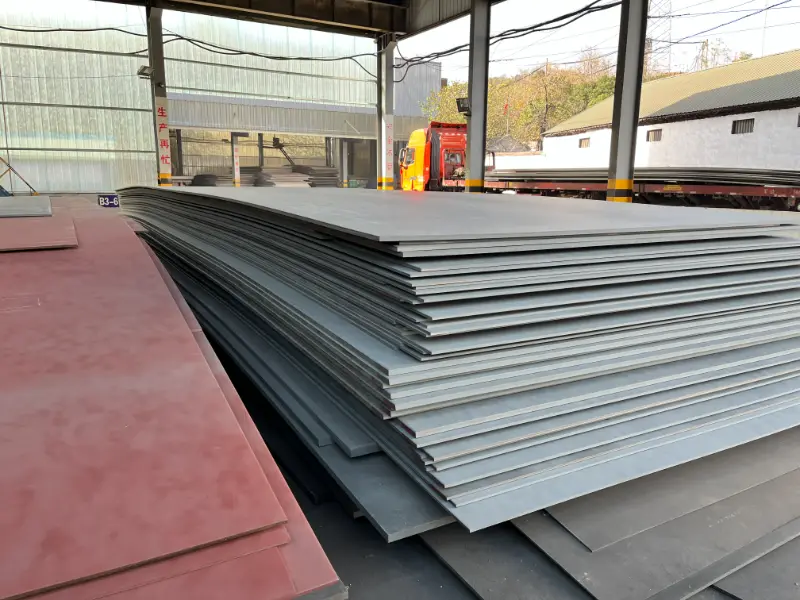
ASTM A131 Grade D Shipbuilding Steel Plate
ASTM A131 Grade D Shipbuilding Steel Plate: Full Material Data & Cross-References
Complete technical data sheet for ASTM A131 Grade D shipbuilding steel including chemical composition, mechanical properties, thermal & electrical properties, international equivalents, similar materials, and application guidance.
Hot rolling; can be supplied as-rolled, normalized, controlled rolled, or thermo-mechanically controlled processed (TMCP)
- Phone : +8618037372205
- Email : [email protected]
- WhatsApp: Contact via Whtsapp
- WeChat: +8618037372205
ASTM A131 Grade D Shipbuilding Steel Plate Introduction
ASTM A131 Grade D is a normal strength hot-rolled shipbuilding structural steel plate specified by the American Society for Testing and Materials (ASTM). It offers a minimum yield strength of 235 MPa (34 ksi) and tensile strength of 400–520 MPa (58–75 ksi), with guaranteed notch toughness at -20°C (-4°F).
Key characteristics:
- Good weldability and formability in shipyard conditions
- Reliable impact toughness at low ambient temperatures
- Moderate strength with excellent ductility for hull and structural applications
- Widely accepted by major classification societies (ABS, DNV, LR, etc.)
This grade is intended for main hull structures, decks, bulkheads, stiffeners, and other critical components in both commercial and naval vessels. It is supplied in normalized, controlled rolled, thermo-mechanically controlled process (TMCP), or as-rolled condition, depending on thickness and end-use requirements.
ASTM A131 Grade D Shipbuilding Steel Plate Chemical Composition
The chemical requirements for ASTM A131 Grade D are specified in the standard and are designed to ensure adequate strength, toughness, and weldability. Manganese content varies with plate thickness. Residual elements (Cu, Ni, Cr, Mo) are limited individually and in combination to avoid detrimental effects on weldability and toughness. Grain refining by aluminum is mandatory; silicon is present for deoxidation. If other deoxidizers are used, aluminum is still required.
| Element | Standard Value (wt. %) | Remarks |
|---|---|---|
| Carbon (C) | ≤ 0.21 | Max 0.21 % for all thicknesses. |
| Manganese (Mn) | 0.80 – 1.10 | For thickness ≤ 50 mm (2 in.). |
| Manganese (Mn) | 0.90 – 1.20 | For thickness >50 mm to 100 mm (2–4 in.). |
| Silicon (Si) | 0.10 – 0.35 | Deoxidizer. |
| Phosphorus (P) | ≤ 0.035 | |
| Sulfur (S) | ≤ 0.035 | |
| Aluminum (Al) | 0.015 – 0.060 (acid soluble) or ≥ 0.020 total Al | Grain refinement mandatory. |
| Copper (Cu) | ≤ 0.35 | Residual element. |
| Nickel (Ni) | ≤ 0.35 | Residual element. |
| Chromium (Cr) | ≤ 0.35 | Residual element. |
| Molybdenum (Mo) | ≤ 0.08 | Residual element. |
| Cu + Ni + Cr + Mo | ≤ 0.70 | Sum of residual elements. |
ASTM A131 Grade D Shipbuilding Steel Plate Thermal and Electrical Physical Properties
These physical properties are not mandated by ASTM A131 but are typical for carbon‑manganese structural steels similar to Grade D. They may vary slightly with exact chemistry and processing conditions. Values are given at room temperature unless otherwise noted. These data are provided for engineering calculations and general reference.
| Property | Typical Value | Unit | Condition / Remarks |
|---|---|---|---|
| Density (ρ) | 7850 | kg/m³ | At 20°C |
| Elastic Modulus (E) | 200 – 210 | GPa | Room temperature; decreases slightly at elevated temperatures |
| Shear Modulus (G) | 80 – 81 | GPa | Calculated from E and Poisson ratio |
| Poisson's Ratio (ν) | 0.27 – 0.30 | – | Typical for structural steel |
| Thermal Expansion Coefficient (α) | 11.5 – 12.0 × 10⁻⁶ | K⁻¹ | For 20–100°C range |
| Thermal Conductivity (λ) | 45 – 55 | W/(m·K) | At 20°C; varies with temperature |
| Specific Heat Capacity | 460 – 480 | J/(kg·K) | At 20°C; increases with temperature |
| Electrical Resistivity (ρₑ) | 0.14 – 0.20 × 10⁻⁶ | Ω·m | At 20°C; typical for mild steel |
ASTM A131 Grade D Shipbuilding Steel Plate Mechanical Properties
The mechanical properties listed below are the minimum requirements from ASTM A131/A131M. Values vary with plate thickness; both longitudinal and transverse tests are covered. The notch toughness (Charpy V‑notch) is guaranteed at –20°C for Grade D. Elongation values are for 200 mm (8 in.) gauge length. Transverse properties are typically 80% of longitudinal elongation. Actual test values from mills are often higher.
| Property | Standard Required Value | Unit | Test Condition / Thickness |
|---|---|---|---|
| Yield Strength (ReH), min | 235 | MPa | Thickness ≤ 40 mm |
| Yield Strength (ReH), min | 220 | MPa | 40 mm < thickness ≤ 50 mm |
| Yield Strength (ReH), min | 205 | MPa | 50 mm < thickness ≤ 100 mm |
| Tensile Strength (Rm) | 400 – 520 | MPa | All thicknesses |
| Elongation (A) in 200 mm, min, longitudinal | 21 | % | Thickness ≤ 40 mm |
| Elongation (A) in 200 mm, min, longitudinal | 24 | % | 40 mm < thickness ≤ 50 mm |
| Elongation (A) in 200 mm, min, longitudinal | 24 | % | 50 mm < thickness ≤ 100 mm |
| Charpy V‑notch Impact Toughness (KV), average min, longitudinal | 27 | J (20 ft·lbf) | At –20°C (–4°F), specimen size 10×10 mm; for subsize specimens consult standard |
ASTM A131 Grade D Shipbuilding Steel Plate Completely Equivalent Material Standards & Replaceable Grades
| Country / Region | Standard / Classification Society | Grade / Designation | Remarks |
|---|---|---|---|
| International (IACS) | American Bureau of Shipping (ABS) | ABS Grade D | Identical requirements; often dual certified with ASTM A131 D. |
| International (IACS) | DNV (Det Norske Veritas) | DNV NV D | Meets DNV rules for hull structural steel – normal strength. |
| International (IACS) | Bureau Veritas (BV) | BV Grade D | Equivalent toughness and strength level. |
| International (IACS) | Lloyd's Register (LR) | LR Grade D | Same application; can be used interchangeably. |
| International (IACS) | Nippon Kaiji Kyokai (ClassNK) | NK KD | Corresponds to Grade D in NK rules. |
| International (IACS) | China Classification Society (CCS) | CCS D | Widely used in Chinese shipyards. |
| International (IACS) | Registro Italiano Navale (RINA) | RINA Grade D | Italian shipbuilding equivalent. |
| International (IACS) | Korean Register (KR) | KR Grade D | South Korean equivalent. |
ASTM A131 Grade D Shipbuilding Steel Plate Application Introduction
ASTM A131 Grade D steel plate is the backbone of many marine and offshore constructions. Its balanced combination of strength, ductility, and notch toughness at sub‑zero temperatures makes it suitable for:
- Main hull plating (shell, inner bottom, decks)
- Bulkheads and web frames
- Stiffeners, girders, and brackets
- Superstructures and deckhouses (when toughness required)
- Helicopter decks and accommodation modules on offshore platforms
It can be formed, welded, and machined using conventional shipyard practices. Preheating is generally not required for thicknesses under 30 mm, but may be recommended for thicker sections or in cold climates. The steel is often coated or painted for corrosion protection in marine environments.
Product Applications: Ship hulls (bulk carriers, tankers, container vessels, passenger ships), Offshore platform decks and legs, Living quarters modules, Floating docks and pontoons, Heavy‑lift crane barges
Processed into products: Shell plates, bottom plates, side plates, Deck plates, bulkhead plates, Longitudinal and transverse frames, Stiffeners (flat bars, bulb flats, angles), Web frames, brackets, and gussets, Bilge keels, skegs, and rudder components, Pile sleeves and transition pieces for offshore wind
Application industries: Shipbuilding (commercial and naval vessels), Offshore oil & gas (fixed platforms, FPSOs, jack‑ups), Marine renewable energy (floating wind foundations, tidal structures), Barge and pontoon construction, Port and harbor infrastructure
ASTM A131 Grade D Shipbuilding Steel Plate Similar / Close Performance Substitute Materials
| Country / Region | Standard / Specification | Grade / Designation | Remarks / Analysis |
|---|---|---|---|
| Europe | EN 10025-2 | S235JR / S235J0 / S235J2 | S235JR has similar yield (235 MPa) and tensile range, but toughness levels differ: J0 guarantees 27J at 0°C, J2 at –20°C. Not directly equivalent for marine service; requires additional approval for ship use. |
| USA | ASTM A131 / A131M | Grade A | Same strength level but impact toughness is generally for ambient temperature (no defined low‑temperature notch toughness). Grade D is upgraded for lower service temperatures. |
| USA | ASTM A131 / A131M | Grade E | Higher toughness: Charpy at –40°C. Strength same as Grade D but intended for even colder environments. Grade D can be substituted if –20°C is sufficient. |
| USA | ASTM A36 / A36M | A36 | Structural carbon steel with min YS 250 MPa (36 ksi) and TS 400–550 MPa. No guaranteed low‑temperature toughness; not for marine classification unless specially agreed. |
| Japan | JIS G 3106 | SM400A / SM400B / SM400C | SM400B/C have controlled toughness; SM400B 27J at 0°C, SM400C 27J at –20°C. Strength similar. Acceptable for hull structures upon classification society approval. |
| Russia | GOST 5521-93 | D (Д) | Russian shipbuilding steel with YS ≥ 235 MPa and impact at –20°C. Chemically similar; can be interchanged after certification. |
Notes:
- Plates are usually supplied with mill test certificates (MTC) according to EN 10204 3.1 or 3.2.
- Ultrasonic testing (UT) is often mandatory for critical applications; ASTM A578/A578M or A435/A435M can be specified.
- Impact testing at –20°C is always performed for Grade D; when using normalized or TMCP delivery, the material exhibits fine‑grained microstructure.
- Weldability: carbon equivalent (CEV) is generally below 0.38%, making it easy to weld with low hydrogen processes (SMAW, SAW, FCAW, GMAW).
- For thicknesses above 50 mm, through‑thickness properties (Z‑direction) may be required for highly restrained joints; ASTM A770/A770M can be invoked.
- Share



