
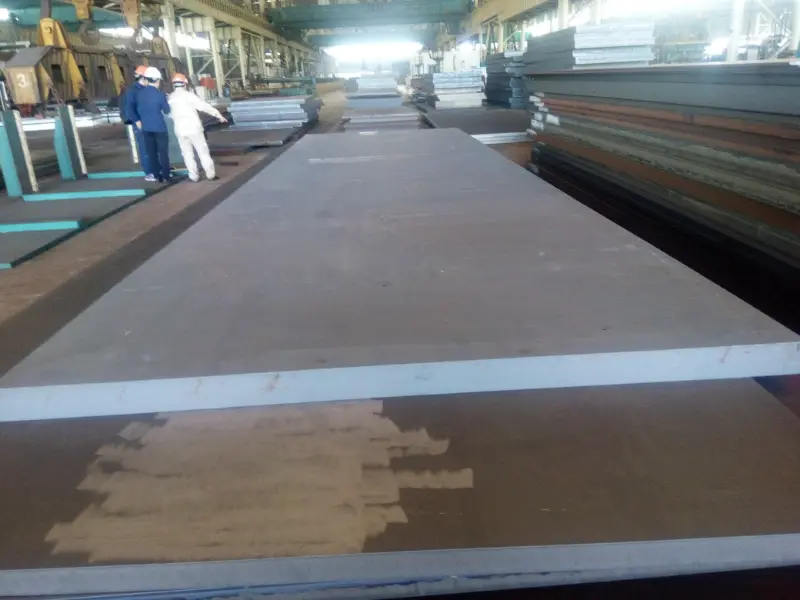
ASTM A131 Grade E Shipbuilding Steel Plate
ASTM A131 Grade E Shipbuilding Steel Plate: Complete Guide to Chemical, Mechanical & Thermal Properties
In-depth analysis of ASTM A131 Grade E marine steel plate including full chemical composition, tensile requirements, Charpy impacts at -40°C, physical properties, international equivalents from CCS, DNV, LR, ABS, and alternative grades.
Hot rolling, normalising, thermo-mechanical controlled rolling (TMCP), welding, cutting, forming, machining
- Phone : +8618037372205
- Email : [email protected]
- WhatsApp: Contact via Whtsapp
- WeChat: +8618037372205
ASTM A131 Grade E Shipbuilding Steel Plate Introduction
ASTM A131 Grade E is a normalised or thermo-mechanically rolled shipbuilding structural steel plate specifically designed for critical hull and marine structures operating at low temperatures. It offers a minimum yield strength of 235 MPa (34 ksi) and guarantees excellent notch toughness down to -40°C with Charpy V‑notch impact energy of 27 J longitudinal. The grade is fully killed, fine‑grain treated and often supplied with class society approvals from ABS, DNV, LR, BV, CCS and others. Key features:
- Excellent weldability with controlled carbon equivalent
- Reliable low‑temperature impact resistance for ice-class and Arctic operations
- Available in wide thickness ranges with guaranteed through‑thickness properties
- Supplied as normalised (N) or thermo‑mechanically controlled processed (TMCP)
ASTM A131 Grade E Shipbuilding Steel Plate Chemical Composition
The following heat analysis limits apply to ASTM A131 Grade E plates. The steel is fully killed, fine‑grain treated (generally with aluminium, or with niobium/vanadium as agreed). For thicknesses above 25.4 mm the manganese content is increased to maintain strength and toughness. Maximum carbon equivalent (CEV) is normally controlled to ensure excellent weldability, typically CEV ≤ 0.40% when specified. Notes:
- Aluminium is required as a grain refiner: acid‑soluble Al ≥ 0.015% or total Al ≥ 0.020%.
- Residual elements (Cu, Ni, Cr, Mo) are limited; their total content shall not exceed 0.70% unless otherwise agreed.
| Element | Standard Value (wt. %) | Remarks |
|---|---|---|
| Carbon (C) | ≤ 0.18 | All thicknesses |
| Manganese (Mn) | 0.70 – 1.35 | Thickness ≤ 25.4 mm |
| Manganese (Mn) | 0.85 – 1.35 | Thickness 25.4–50.8 mm |
| Manganese (Mn) | 1.00 – 1.35 | Thickness > 50.8 mm |
| Phosphorus (P) | ≤ 0.035 | |
| Sulfur (S) | ≤ 0.035 | |
| Silicon (Si) | 0.10 – 0.50 | |
| Copper (Cu) | ≤ 0.35 | If specified |
| Nickel (Ni) | ≤ 0.40 | Residual |
| Chromium (Cr) | ≤ 0.20 | Residual |
| Molybdenum (Mo) | ≤ 0.08 | Residual |
| Aluminium (Al) | ≥ 0.015 acid sol. / ≥ 0.020 total | Grain refining |
ASTM A131 Grade E Shipbuilding Steel Plate Thermal and Electrical Physical Properties
The physical property data provided here are representative for carbon‑manganese structural steel in the as‑rolled/normalised condition and are not part of the mandatory ASTM A131 specification. They are useful for design calculations, heat transfer modelling, and welding procedure development. Values may vary slightly with actual composition and manufacturing process.
- Density: 7850 kg/m³
- Thermal expansion coefficient evaluated between 20 °C and 100 °C.
- Thermal conductivity and electrical resistivity measured at room temperature (≈20 °C).
| Property | Typical Value | Unit | Test Condition |
|---|---|---|---|
| Density (ρ) | 7850 | kg/m³ | Room temperature |
| Modulus of elasticity (E) | 200 – 210 | GPa | Tensile, ambient |
| Shear modulus (G) | ≈ 80 | GPa | Calculated |
| Poisson's ratio (ν) | 0.29 – 0.30 | – | Elastic range |
| Thermal expansion coeff. (α) | 11.5 – 12.0 | 10⁻⁶ /K | 20–100 °C |
| Thermal conductivity (λ) | ≈ 51.9 | W/m·K | At 20 °C |
| Specific heat capacity (cp) | ≈ 477 | J/kg·K | At 20 °C |
| Electrical resistivity (ρe) | 0.14 – 0.17 | 10⁻⁶ Ω·m | At 20 °C |
ASTM A131 Grade E Shipbuilding Steel Plate Mechanical Properties
Tensile and impact properties are determined in accordance with ASTM A370. Plates are tested in the as‑delivered condition (normalised or TMCP). Longitudinal Charpy V‑notch tests at -40°C are mandatory to guarantee base metal toughness. For thicknesses exceeding 50.8 mm, the strength requirements are reduced as indicated. Bending tests are not mandatory in ASTM A131 but may be agreed as a supplementary requirement (typically 180° bend over a mandrel diameter of 2.0×thickness for t ≤ 25.4 mm and 2.5×thickness for t > 25.4 mm).
| Property | Standard Value | Unit | Test Condition / Remarks |
|---|---|---|---|
| Yield Strength (ReH) | ≥ 235 | MPa | Thickness ≤ 50.8 mm |
| Yield Strength (ReH) | ≥ 205 | MPa | Thickness 50.8–101.6 mm |
| Yield Strength (ReH) | ≥ 195 | MPa | Thickness > 101.6 mm |
| Tensile Strength (Rm) | 400 – 490 | MPa | All thicknesses |
| Elongation (A200) | ≥ 21 | % | Gauge length 200 mm |
| Elongation (A50) | ≥ 24 | % | Gauge length 50 mm |
| Charpy Impact (KV) | ≥ 27 (longitudinal) | J | At -40 °C, full‑size specimen |
| Charpy Impact (KV) | ≥ 20 (transverse) | J | At -40 °C, full‑size specimen |
| Bend Test (optional) | No cracks | – | 180° bend, mandrel diam. 2.0×t (t≤25.4mm) / 2.5×t (t>25.4mm) |
ASTM A131 Grade E Shipbuilding Steel Plate Completely Equivalent Standards and Substitutable Grades
| Country / Region | Standard / Class Society | Grade | Remarks |
|---|---|---|---|
| International | ASTM A131 / A131M | Grade E | Original standard; normalised or TMCP, -40°C impact |
| USA | ABS (American Bureau of Shipping) | Grade E | Identical requirements, recognised by USCG |
| Norway / Germany | DNV GL (now DNV) | E | DNV rules Pt.2 Ch.2, for ship structures |
| United Kingdom | LR (Lloyd's Register) | E | Equivalent to LR Rule Grade E |
| France | BV (Bureau Veritas) | E | BV Rules for Steel Ships, Grade E |
| China | CCS (China Classification Society) | E | CCS Rule Material Grade E |
| Japan | NK (Nippon Kaiji Kyokai) | KE | ClassNK rules, Grade KE |
| Italy | RINA (Registro Italiano Navale) | E | RINA Rules Part D, Grade E |
| Korea | KR (Korean Register) | RE | Equivalent Grade RE |
| Russia | RS (Russian Maritime Register) | E | RS rules, Grade E for hull structures |
ASTM A131 Grade E Shipbuilding Steel Plate Application Introduction
ASTM A131 Grade E steel is the backbone of modern shipbuilding for vessels operating in cold climates and ice‑infested waters. Its guaranteed toughness at -40°C makes it suitable for hull envelopes, ice belts, and structural members subject to dynamic loading. Typical applications include:
- Container ships, tankers, bulk carriers, and offshore supply vessels
- Ice‑class vessels (e.g., Polar Code Category A/B ships)
- Arctic offshore platforms and modules
- LNG/LPG carrier secondary barriers
- Port and harbour structures with maritime exposure
Product Applications: Hull plate and shell strakes, Deck plate and hatch coamings, Longitudinal stiffeners and bulb profiles, Transverse frames, floors and girders, Rudder plates and skegs, Ice‑strengthening belts and collision bulkheads, Helicopter decks (with additional non‑slip coating)
Processed into products: Welded T‑bars, L‑sections and built‑up girders, Bracket plates and tripping brackets, Bilge keel plates, Sea chest inserts and sea suction boxes, Rudders and rudder stocks (flame‑cut shapes), Mooring bollard base plates, Hatch cover bearing pads
Application industries: Shipbuilding and ship repair, Offshore oil and gas (FPSO, semi‑submersibles, jack‑up rigs), Marine engineering and heavy fabrication, Port infrastructure and floating docks, Renewable energy (offshore wind turbine substructures, tidal energy)
ASTM A131 Grade E Shipbuilding Steel Plate Similar or Alternative Material Grades
| Country / Region | Standard / Specification | Grade | Remarks |
|---|---|---|---|
| USA | ASTM A36 / A36M | A36 | Slightly higher min. yield 250 MPa; no mandatory low‑temp. impact; often used for non‑critical ship parts |
| USA | ASTM A572 / A572M | Grade 50 | Higher strength 345 MPa yield; impact test can be ordered (e.g. CVN at -20°C); used in offshore structures |
| EU | EN 10025‑2 | S235J2 | Similar 235 MPa yield; Charpy -20°C 27J; good weldability; not certified by all class societies |
| EU | EN 10025‑2 | S275J2 | Higher yield 275 MPa; Charpy -20°C 27J; possible alternative for load‑bearing components |
| Japan | JIS G3106 | SM400B / SM400C | SM400C: 245 MPa yield, 0°C impact; lower toughness than A131 Grade E; SM400B without impact guarantee |
| China | GB/T 712 | E | Chinese shipbuilding steel E grade, equivalent in chemical and impact requirements |
Notes:
Supplementary ordering options (ASTM A131/A131M):
- Ultrasonic examination in accordance with ASTM A578/A578M (acceptance level A, B or C).
- Through‑thickness tensile testing (Z‑quality) per ASTM A770.
- Restrictions on carbon equivalent (CEV) for improved weldability.
- Additional low‑temperature impact testing at -50°C or -60°C for special applications.
- Normalised delivery mandatory for thicknesses above 50.8 mm; TMCP delivery is also common up to 50.8 mm.
- Surface condition: descaled, shot blasted and shop‑primed available.
- Share



