
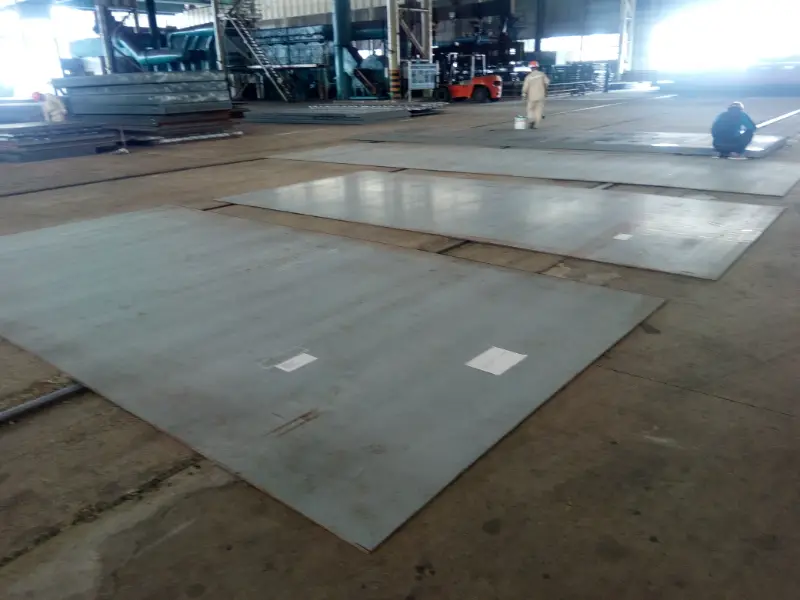
ASTM A131 AH32 Shipbuilding Steel
ASTM A131 AH32 Shipbuilding Steel - High Strength Marine Plate Grade
ASTM A131 Grade AH32 is a normalized high-strength hull structural steel plate with excellent toughness and weldability, widely used in ship and offshore structures.
Hot rolling, controlled rolling, normalizing, normalizing rolling, TMCP (thermo-mechanical controlled process)
- Phone : +8618037372205
- Email : [email protected]
- WhatsApp: Contact via Whtsapp
- WeChat: +8618037372205
ASTM A131 AH32 Shipbuilding Steel Introduction
ASTM A131 Grade AH32 is a high-strength shipbuilding steel defined in ASTM A131/A131M. It offers a minimum yield strength of 315 MPa and is designed for critical structural components in marine environments. The steel exhibits good low-temperature impact toughness (tested at 0°C), excellent weldability, and moderate corrosion resistance. It is usually supplied in normalized, controlled-rolled, or thermo-mechanically controlled processed (TMCP) condition to meet stringent classification society requirements. AH32 is widely accepted by all major ship classification societies and is used for hulls, decks, and offshore platforms, ensuring reliable performance under dynamic loads and harsh sea conditions.
ASTM A131 AH32 Shipbuilding Steel Chemical Composition
The typical chemical composition of ASTM A131 AH32 follows the standard requirements. Microalloying elements such as Nb, V, Ti may be added singly or in combination for grain refinement. Carbon equivalent (CE) is usually limited to ≤0.38% to ensure good weldability. Values shown are from ASTM A131/A131M-19 Table 1 and typical supplementary requirements.
| Element | Content (%) | Remarks |
|---|---|---|
| Carbon (C) | ≤0.18 | Standard requirement |
| Manganese (Mn) | 0.90 - 1.60 | For thickness ≤50 mm; ≥0.90 for >50 mm |
| Silicon (Si) | ≤0.50 | Commonly 0.10–0.50 |
| Phosphorus (P) | ≤0.035 | Standard requirement |
| Sulfur (S) | ≤0.035 | Standard requirement |
| Aluminum (Al, acid soluble) | ≥0.015 | Grain refining requirement |
| Niobium (Nb) | 0.02 – 0.05 | Optional, if added |
| Vanadium (V) | 0.05 – 0.10 | Optional, if added |
| Titanium (Ti) | ≤0.02 | Optional, if added |
| Copper (Cu) | ≤0.35 | Residual element, max |
| Chromium (Cr) | ≤0.20 | Residual element, max |
| Nickel (Ni) | ≤0.40 | Residual element, max |
| Molybdenum (Mo) | ≤0.08 | Residual element, max |
| Carbon Equivalent (CE) | ≤0.38 | CE = C+Mn/6+(Cr+Mo+V)/5+(Ni+Cu)/15 |
ASTM A131 AH32 Shipbuilding Steel Physical Properties
Physical properties are indicative for carbon-manganese steel and are not part of the ASTM A131 standard. These values may vary with production process and heat treatment. They are provided for engineering calculations.
| Property | Typical Value | Unit | Condition / Remarks |
|---|---|---|---|
| Density (ρ) | 7850 | kg/m³ | At room temperature |
| Elastic Modulus (E) | 205 | GPa | At 20°C |
| Shear Modulus (G) | 80 | GPa | At 20°C |
| Poisson's Ratio (ν) | 0.3 | - | Within elastic range |
| Thermal Expansion (α) | 11.5 × 10⁻⁶ | m/m·K | Range 20–100°C |
| Thermal Conductivity (λ) | 50 | W/m·K | At 20°C |
| Specific Heat Capacity | 460 | J/kg·K | At 20°C |
| Electrical Resistivity (ρₑ) | 0.22 × 10⁻⁶ | Ω·m | Approx. 0.22 Ω·mm²/m |
ASTM A131 AH32 Shipbuilding Steel Mechanical Properties
Mechanical properties for ASTM A131 AH32 are derived from tensile and impact tests. Yield and tensile requirements apply for all thicknesses. Elongation and Charpy impact values are thickness-dependent. Bend test requires 180° bending without cracks. Impact tests are usually longitudinal and at 0°C for AH grade.
| Property | Standard Value | Unit | Test Condition / Remarks |
|---|---|---|---|
| Yield Strength (ReH) | ≥315 | MPa | All thicknesses, tensile test transverse |
| Tensile Strength (Rm) | 440 – 590 | MPa | All thicknesses |
| Elongation (A) | ≥22 | % | Thickness ≤ 50 mm, gauge length 200 mm (or proportional) |
| Elongation (A) | ≥21 | % | Thickness >50 mm to 70 mm |
| Elongation (A) | ≥20 | % | Thickness >70 mm to 100 mm |
| Bend Test (180° bend) | 2a (mandrel diameter) | - | Thickness ≤ 25 mm, longitudinal |
| Bend Test (180° bend) | 3a (mandrel diameter) | - | Thickness >25 mm to 50 mm |
| Bend Test (180° bend) | 4a (mandrel diameter) | - | Thickness >50 mm to 100 mm |
| Charpy Impact Energy (KV, 0°C) | ≥34 | J | Longitudinal, thickness ≤ 50 mm, average of 3 specimens |
| Charpy Impact Energy (KV, 0°C) | ≥41 | J | Longitudinal, thickness >50 mm to 70 mm |
| Charpy Impact Energy (KV, 0°C) | ≥50 | J | Longitudinal, thickness >70 mm to 100 mm |
ASTM A131 AH32 Shipbuilding Steel Fully Equivalent Material Standards and Substitutable Grades
| Country / Region | Standard / Specification | Grade | Remarks |
|---|---|---|---|
| International | ASTM A131/A131M | AH32 | Original standard |
| USA | ABS Rules | AH32 | American Bureau of Shipping |
| Norway/Germany | DNV Rules | AH32 | Det Norske Veritas (now DNV GL) |
| UK | LR Rules | AH32 | Lloyd's Register |
| France | BV Rules | AH32 | Bureau Veritas |
| China | CCS Rules | AH32 | China Classification Society |
| Japan | NK Rules (ClassNK) | AH32 | Nippon Kaiji Kyokai |
| Korea | KR Rules | AH32 | Korean Register |
| Italy | RINA Rules | AH32 | Registro Italiano Navale |
| Russia | RS Rules | AH32 | Russian Maritime Register of Shipping |
ASTM A131 AH32 Shipbuilding Steel Application Introduction
ASTM A131 AH32 is ideally suited for critical structural parts of ships and marine constructions where high strength, excellent weldability, and guaranteed toughness at 0°C are required. It is often used in conjunction with classification society approvals.
Product Applications: Hull plates (shell, bottom, side plating), Deck plates and stringers, Bulkhead and tank top plates, Superstructures and hatch covers, Stiffeners, web frames, and girders, Offshore platform jackets and topside modules
Processed into products: Main deck panels, Transverse web frames, Longitudinal stiffeners (T-bars, flat bars), Rudder horn plates, Engine foundation plates, Mooring equipment attachments, Helicopter decks (offshore), Caisson and pile guides
Application industries: Shipbuilding (commercial vessels, naval ships), Offshore engineering (platforms, rigs, FPSO modules), Marine equipment and port machinery, Pressure vessels for marine service, Bridge construction (occasionally used for floating bridges)
ASTM A131 AH32 Shipbuilding Steel Similar or Alternative Material Recommendations
| Country / Region | Standard / Specification | Grade | Remarks |
|---|---|---|---|
| International | ASTM A131/A131M | AH36 | Higher strength (min 355 MPa yield), same impact temperature |
| International | ASTM A131/A131M | DH32 | Similar strength but lower impact test temperature (-20°C) |
| Europe | EN 10025-2 | S355J2+N | Structural steel with comparable strength but not marine-certified; requires additional testing for shipbuilding |
| USA | ASTM A572/A572M | Grade 50 [345] | High-strength low-alloy structural steel; not specifically for shipbuilding, weldability and toughness may differ |
| International | API 2H | Grade 42 | Offshore structural steel plate; comparable strength but different certification |
Notes:
ASTM A131 AH32 plates are often subject to additional classification society inspections (e.g., ABS, DNV, LR) which may impose stricter tests (e.g., ultrasonic testing, lamell tearing resistant Z-grade). Carbon equivalent (CE) is typically limited to ≤0.38% to ensure good weldability without preheating. When microalloyed with Nb/V/Ti, the steel can be produced via TMCP, providing improved strength and toughness balance. Always confirm the latest ASTM A131 edition and the specific class society rules for project requirements.
- Share



