
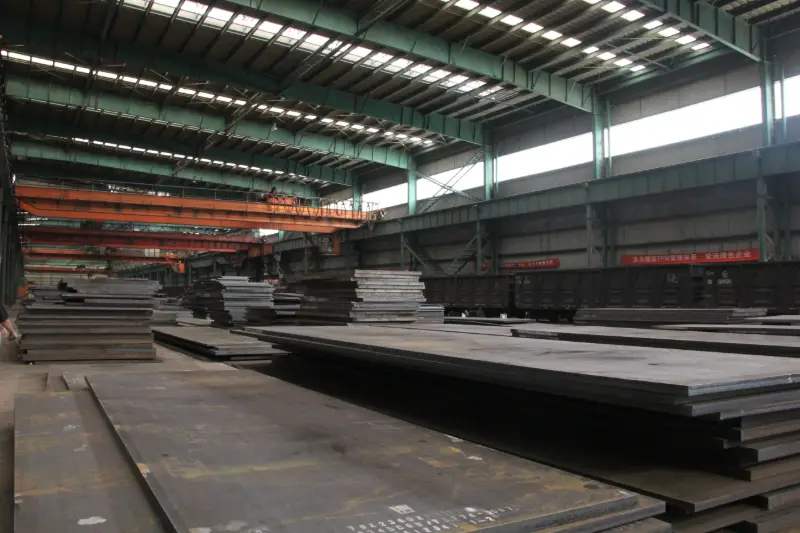
CCS Grade AQ70 Shipbuilding Steel Plate
CCS Grade AQ70 Shipbuilding Steel Plate: High-Strength Quenched & Tempered Steel for Offshore and Marine Engineering
Comprehensive data sheet for CCS Grade AQ70 shipbuilding steel plate, including chemical composition, mechanical and physical properties, equivalent grades, and application guidelines.
Cutting, welding (preheating required for thick sections), bending, forming, machining
- Phone : +8618037372205
- Email : [email protected]
- WhatsApp: Contact via Whtsapp
- WeChat: +8618037372205
CCS Grade AQ70 Shipbuilding Steel Plate Introduction
CCS Grade AQ70 is a high-strength, quenched and tempered steel plate specifically designed for shipbuilding and offshore structures under the China Classification Society (CCS) rules. It offers a minimum yield strength of 690 MPa, excellent toughness at low temperatures (impact tested at -20°C), and good weldability. The steel is primarily used in critical structural components that demand high load-bearing capacity and resistance to brittle fracture. It is supplied in the normalized or quenched and tempered condition, ensuring uniform mechanical properties and grain refinement. This grade belongs to the high-strength hull structural steel family, with the "A" designation indicating an impact test temperature of -20°C. Typical applications include ship hulls, offshore platforms, and marine equipment exposed to severe service conditions.
CCS Grade AQ70 Shipbuilding Steel Plate Chemical Composition
The chemical composition is in accordance with CCS Rules for Materials and Welding for Grade AQ70. All values are maximum unless a range is specified. The steel is low-carbon, microalloyed with niobium, vanadium, and titanium to achieve high strength and fine grain size. Aluminium is added as a grain refiner, and nitrogen is controlled to avoid strain aging. Combined Cu, Ni, Cr, Mo additions provide deep hardenability and corrosion resistance.
| Element | Standard Value | Remarks |
|---|---|---|
| C | ≤0.20 | Max. |
| Si | ≤0.55 | Max. |
| Mn | ≤1.60 | Max. |
| P | ≤0.025 | Max. |
| S | ≤0.025 | Max. |
| Cr | ≤1.50 | Max. |
| Ni | ≤2.0 | Max. |
| Mo | ≤0.70 | Max. |
| Cu | ≤0.50 | Max. |
| V | ≤0.10 | Max. |
| Nb | ≤0.06 | Max. |
| Ti | ≤0.02 | Max. |
| Al (total) | ≥0.015 | Min. |
| N | ≤0.012 | Max. |
| B | ≤0.005 | Optional for hardenability |
| Ceq (IIW) | Typically ≤0.50 | For plate thickness >50 mm |
CCS Grade AQ70 Shipbuilding Steel Plate Physical Properties
The physical properties provided are typical for quenched and tempered high-strength low-alloy steel similar to CCS AQ70. These values are representative for room temperature unless otherwise noted and are derived from published data for comparable grades (e.g., S690Q). They can be used for design calculations but are not specified in the CCS rules.
| Property | Typical Value | Unit | Test Condition |
|---|---|---|---|
| Density (ρ) | 7.85 | g/cm³ | 20°C |
| Elastic Modulus (E) | 210 | GPa | 20°C |
| Shear Modulus (G) | 81 | GPa | 20°C (calculated from E and Poisson) |
| Poisson's Ratio (ν) | 0.3 | - | 20°C |
| Thermal Expansion Coefficient (α) | 12.0 | 10⁻⁶/K | 20 - 100°C |
| Thermal Expansion Coefficient (α) | 13.0 | 10⁻⁶/K | 20 - 200°C |
| Thermal Expansion Coefficient (α) | 14.0 | 10⁻⁶/K | 20 - 400°C |
| Thermal Conductivity (λ) | 45 | W/(m·K) | 20°C |
| Thermal Conductivity (λ) | 40 | W/(m·K) | 200°C |
| Specific Heat Capacity (c) | 480 | J/(kg·K) | 20°C |
| Electrical Resistivity (ρₑ) | 0.25 - 0.30 | μΩ·m | 20°C |
CCS Grade AQ70 Shipbuilding Steel Plate Mechanical Properties
Tensile and impact properties are according to CCS Rules, applicable to quenched and tempered plates. Impact tests are performed on Charpy V-notch specimens at -20°C (Grade AQ70). Properties may vary with plate thickness; typical ranges are shown. For thicknesses above 100 mm, properties may be subject to additional agreement.
| Property | Standard Requirement | Unit | Test Condition / Thickness Range |
|---|---|---|---|
| Yield Strength (ReH) | ≥690 | MPa | t ≤ 100 mm, transverse |
| Yield Strength (ReH) | ≥670 | MPa | t > 100 mm, transverse |
| Tensile Strength (Rm) | 770 - 940 | MPa | t ≤ 100 mm |
| Tensile Strength (Rm) | 760 - 930 | MPa | t > 100 mm |
| Elongation (A, 5.65√S₀) | ≥14 | % | Transverse, gauge length proportional |
| Impact Energy (KV₂) at -20°C | ≥34 (individual) | J | Transverse, Charpy V-notch, -20°C, average of 3 |
| Impact Energy (KV₂) at -20°C | ≥24 (single minimum) | J | Transverse, Charpy V-notch, -20°C, individual value |
| Bend Test (180°) | D = 4a (t ≤ 25 mm), D = 5a (t > 25 mm) | - | Bend radius (D) as multiples of thickness (a), transverse |
CCS Grade AQ70 Shipbuilding Steel Plate Direct Equivalent Grades and Substitutional Recommendations
| Country/Region | Standard | Grade | Remarks |
|---|---|---|---|
| International | ABS (American Bureau of Shipping) | EQ70 | Identical yield and impact requirements (-20°C for AQ70) |
| International | DNV (Det Norske Veritas) | S690Q (or VL E690) | Direct equivalent for Q&T steel, 690 MPa YS |
| International | BV (Bureau Veritas) | E690 | Equivalent for shipbuilding, -20°C impact |
| International | Lloyd's Register (LR) | AH70 | AH70 corresponds to AQ70 with respect to strength and -20°C impact |
| International | Korean Register (KR) | RE70 | RE70 grade with -20°C impact, 690 MPa YS |
| International | Class NK (Japan) | KE70 | KE70 grade; verify impact temperature (often -20°C) |
| International | RINA (Italy) | E690 | Similar to CCS AQ70, yield strength 690 MPa |
| International | IACS (approximate) | EH690, EQ70 | IACS unified requirements define grades like EH690, but CCS uses AQ70 |
CCS Grade AQ70 Shipbuilding Steel Plate Application Introduction
CCS AQ70 steel plates are engineered for the most demanding marine and offshore applications where weight savings and high static/dynamic strength are crucial. They can be cold-formed with adequate radius and welded using low-hydrogen processes with controlled heat input. Preheating and interpass temperature control are essential for thicker sections. These plates are often delivered with ultrasonic testing (UT) to guarantee internal soundness.
Product Applications: Ship hulls (especially longitudinal strength members, sheer strakes, bilge strakes), Legs, spudcans, and jack-up components for jack-up rigs, Offshore platform nodes, braces, and jacking frames, Crane booms, crawler cranes, and heavy lift attachments, Subsea structural frames and protection structures, High-pressure storage spheres and tanks
Processed into products: Shell plates, deck plates, bottom plates exceeding 50 mm thickness, Transverse and longitudinal frames, girders, stringers, Heavy-duty pinions, racks, and jacking gear racks, Fabricated beams and columns for module support, Transition pieces and main flanges in wind turbine monopiles, Welded T-joints, K-joints, and tubular nodes
Application industries: Shipbuilding (commercial and naval vessels), Offshore oil and gas (platforms, rigs, FPSOs), Marine heavy lifting and cranage, Renewable energy (offshore wind turbine foundations), Pressure vessels and boilers for marine service, Bridge construction (special applications)
CCS Grade AQ70 Shipbuilding Steel Plate Similar/Alternative Structural Steels
| Country/Region | Standard | Grade | Remarks |
|---|---|---|---|
| Europe | EN 10025-6 | S690Q / S690QL / S690QL1 | Hot-rolled structural steel, Q&T, 690 MPa YS. Higher impact energy (27J at -20°C or -40°C). |
| Europe | EN 10225 | S690G1+M / S690G2+Q | Structural steel for fixed offshore structures, weldable, Q&T. |
| USA | ASTM A514 / A517 | Grade Q or Grade B | Quenched & tempered alloy steel plate, 690 MPa YS class. A514 is for structural applications. |
| USA | ASTM A709 | Grade HPS 100W (690 MPa YS class) | High-performance structural steel, but specific chemical and weldability differences. |
| Japan | JIS G 3128 | SHY 685 / SHY 685N | High yield strength steel plates for bridges and others, 685 MPa minimum YS. |
| China | GB/T 16270 | Q690D, Q690E | High-strength structural steel plates, Q&T, 690 MPa YS, with -20°C or -40°C impact. |
Notes:
- CCS AQ70 can also be supplied with enhanced properties: Z-quality (through-thickness) to avoid lamellar tearing, and with additional testing such as ultrasonic examination (UT), magnetic particle inspection (MPI), or CTOD toughness testing.
- Welding consumables should match the base metal strength and low-temperature impact properties. Typical preheat temperature for thick plates (>30 mm) is 100–150°C.
- For thicknesses above 80 mm, a creep-aged or strain-aged impact test may be required per CCS rules.
- The steel should not be used at service temperatures below -20°C without reevaluation of impact energy requirements (consider DQ70 or EQ70 grades for lower temperatures).
- Data provided is for general reference; always refer to the latest CCS Rules and the specific material certificate for guaranteed properties.
- Share



