
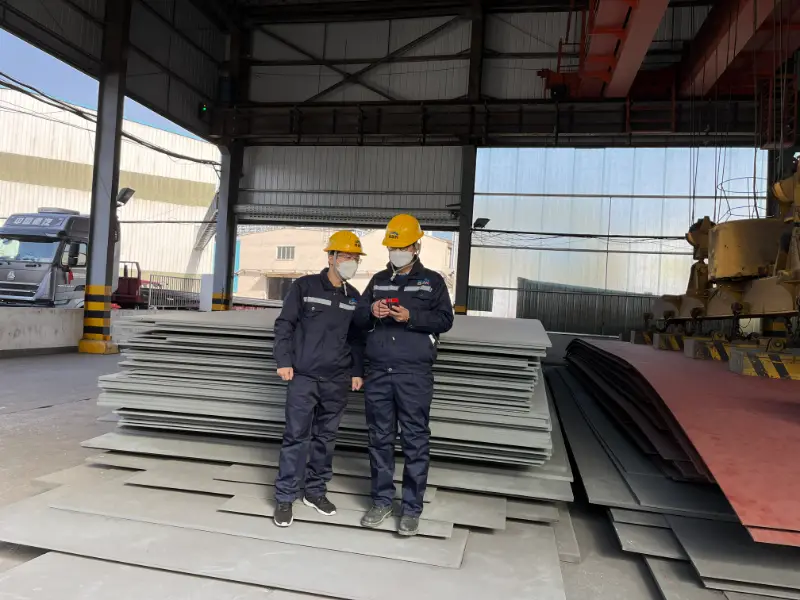
DNV Grade D40 Shipbuilding Steel Plate
DNV Grade D40 Shipbuilding Steel Plate: High-Strength Marine Structural Steel
Comprehensive technical data for DNV Grade D40 shipbuilding steel plate, including chemical composition, mechanical and thermal properties, international equivalents, and application guidance for marine and offshore structures.
Hot rolling, normalizing, thermomechanical rolling (TMCP), quenching and tempering (if applicable)
- Phone : +8618037372205
- Email : [email protected]
- WhatsApp: Contact via Whtsapp
- WeChat: +8618037372205
DNV Grade D40 Shipbuilding Steel Plate Introduction
DNV Grade D40 is a high-strength structural steel plate for shipbuilding and offshore applications, certified by Det Norske Veritas (DNV). It offers a minimum yield strength of 390 MPa in thicknesses up to 50 mm, combining excellent strength with good low-temperature toughness (tested at −20°C). The steel is supplied in normalized or thermomechanically controlled processed (TMCP) condition, ensuring fine grain structure and reliable weldability.
- Excellent notch toughness at −20°C (minimum 31 J longitudinal)
- Good weldability with standard shipyard practices
- Available in a wide range of plate thicknesses, wide flats and sections
It is widely used for hull structures, decks, bulkheads, and critical structural components in ice-class vessels and harsh environments.
DNV Grade D40 Shipbuilding Steel Plate Chemical Composition
Chemical composition according to DNV rules for high-strength hull structural steel grade D40. Values are maximum unless a range is indicated. The steel shall contain fine grain elements such as Al, Nb, V or Ti.
- Aluminum is required as grain refiner (acid-soluble min 0.015%).
- The sum of Nb+V+Ti may be ≤ 0.12%.
- For thicknesses > 50 mm, some elements may have adjusted limits.
| Element | Standard Value | Remarks |
|---|---|---|
| C | ≤ 0.18 % | Maximum carbon content |
| Si | 0.10 – 0.50 % | Silicon range |
| Mn | 0.90 – 1.60 % | Manganese range |
| P | ≤ 0.025 % | Maximum phosphorus |
| S | ≤ 0.025 % | Maximum sulfur |
| Als (acid soluble Al) | ≥ 0.015 % | Minimum total aluminum |
| Nb | ≤ 0.05 % | Optional microalloying; may be lower |
| V | ≤ 0.10 % | Optional microalloying |
| Ti | ≤ 0.02 % | Optional microalloying |
| Cu | ≤ 0.35 % | If added, residual or intentional |
| Cr | ≤ 0.20 % | Residual element, unless otherwise agreed |
| Ni | ≤ 0.40 % | Residual element |
| Mo | ≤ 0.08 % | Residual element |
| N | ≤ 0.009 % (if not killed with Nb, V, Ti) | Nitrogen limit if no strong nitride formers |
DNV Grade D40 Shipbuilding Steel Plate Thermal and Electrical Physical Properties
Representative physical properties for high-strength carbon-manganese shipbuilding steel at room temperature. These values are not mandated by the standard but are commonly used for design calculations.
- Density varies slightly with alloying content.
- Thermal expansion and conductivity are typical for structural steels.
- Electrical resistivity is for general estimation.
| Property | Standard Reference Value | Unit | Test Condition |
|---|---|---|---|
| Density (ρ) | 7.85 (7850) | g/cm³ (kg/m³) | At 20 °C |
| Modulus of Elasticity (E) | 205 (approx.) | GPa | Ambient temperature |
| Shear Modulus (G) | 80 (approx.) | GPa | Ambient temperature |
| Poisson's Ratio (ν) | 0.3 | — | Ambient temperature |
| Thermal Expansion Coefficient (α) | 11.1 (20–100 °C); 11.9 (20–200 °C); 12.5 (20–300 °C); 12.9 (20–400 °C); 13.5 (20–500 °C) | 10⁻⁶/K | Between 20 °C and indicated temperature |
| Thermal Conductivity (λ) | 45 (at 20 °C); 43 (at 250 °C); 40 (at 500 °C) | W/(m·K) | Typical values |
| Specific Heat Capacity | 460 | J/(kg·K) | At 20 °C |
| Electrical Resistivity (ρ_e) | ≈ 0.15 | μΩ·m | At 20 °C |
DNV Grade D40 Shipbuilding Steel Plate Mechanical Properties
Minimum mechanical properties required by DNV Rules at ambient temperature. For thicknesses > 50 mm, yield strength requirement reduces slightly (370 MPa for 50–70 mm, 360 MPa for 70–100 mm). Tensile strength range and elongation remain consistent.
- Tensile test specimens: flat, gauge length 5.65√So (proportional).
- Bend test: 180° over a former of diameter 3a (a = specimen thickness).
- Impact test: Charpy V-notch, average of three tests. Longitudinal specimens.
| Property | Standard Required Value | Unit | Test Condition |
|---|---|---|---|
| Yield Strength (ReH) | ≥ 390 | MPa | Ambient, longitudinal, thickness ≤ 50 mm |
| Tensile Strength (Rm) | 510 – 660 | MPa | Ambient, longitudinal |
| Elongation after fracture (A) | ≥ 20 | % | Gauge length 5.65√So, longitudinal |
| Bend Test | No cracks (180°) | — | Bend diameter = 3 × thickness |
| Impact Energy (KV) at −20 °C | ≥ 31 (average) / ≥ 24 (single) | J | Charpy V-notch, longitudinal |
DNV Grade D40 Shipbuilding Steel Plate Fully Equivalent Material Standards and Replaceable Grades
| Country/Region | Standard/Classification Society | Grade | Remarks |
|---|---|---|---|
| Norway / International | DNV (Det Norske Veritas) | NV D40 (D40) | Reference grade |
| USA / International | ABS (American Bureau of Shipping) | DH40 | Direct equivalent, same toughness class (−20 °C) |
| UK / International | LR (Lloyd's Register) | DH40 | Direct equivalent |
| France / International | BV (Bureau Veritas) | DH40 | Direct equivalent |
| China / International | CCS (China Classification Society) | DH40 | Direct equivalent |
| Italy / International | RINA (Registro Italiano Navale) | DH40 | Direct equivalent |
| Japan / International | NK (Nippon Kaiji Kyokai) | KDH40 | Equivalent grade |
| South Korea / International | KR (Korean Register) | DH40 | Equivalent grade |
| Russia / International | RS (Russian Maritime Register of Shipping) | DH40 | Equivalent grade |
| India / International | IR (Indian Register of Shipping) | DH40 | Equivalent grade |
DNV Grade D40 Shipbuilding Steel Plate Application Introduction
DNV D40 steel is primarily used in shipbuilding and offshore engineering where high strength, good weldability and reliable low-temperature toughness are essential. It is suitable for fabrication by cutting, cold forming, welding and machining. Preheating may be required based on thickness and carbon equivalent.
- Typical carbon equivalent (CEV) is kept below 0.40% to ensure good weldability.
- Post-weld heat treatment is not normally required if proper procedures are followed.
- Can be delivered with through-thickness properties (Z-quality) if specified.
Product Applications: Hull plates and stiffened panels, Decks and bottom shell plates, Transverse and longitudinal bulkheads, Web frames and girders, Offshore platform topside modules, Brackets and structural seats, Ice belt plating for ice-class vessels
Processed into products: Longitudinal stiffeners and stringers, Transverse frames and floors, Brackets and tripping brackets, Rudder horns and stern frames (when approved), Hatch coamings and corner reinforcements, Bitts, chocks, and fairleads (as per design), Transition pieces in monopile foundations
Application industries: Shipbuilding (commercial, naval, ice-class vessels), Offshore oil & gas (platforms, FPSOs, jackets), Marine engineering (port equipment, lock gates, caissons), Renewable energy (offshore wind turbine foundations, transition pieces), Heavy structural engineering (bridges, cranes with marine exposure)
DNV Grade D40 Shipbuilding Steel Plate Similar/Alternative Material Recommendations
| Country/Region | Standard | Grade | Remarks |
|---|---|---|---|
| International | DNV/ABS/LR/etc. | AH40 | Same strength level but impact test at 0 °C; suitable for less severe low-temperature service |
| International | DNV/ABS/LR/etc. | EH40 | Higher toughness class; impact test at −40 °C for arctic applications |
| International | DNV/ABS/LR/etc. | FH40 | Highest toughness; impact test at −60 °C for extreme cold environments |
| International | DNV/ABS/LR/etc. | DH36 | Lower strength (yield 355 MPa) but similar toughness; cost-effective substitute if design allows |
| International | API 2W Grade 50 / 2H Grade 50 | Offshore structural steel plate with similar strength; may require additional qualification for marine service | |
| Europe | EN 10225:2009 | S460G2+M (normalized) or S460G2+QT | Fixed offshore structure steel; higher strength but different toughness regime; not a direct substitute without agreement |
Notes:
For thicknesses above 50 mm, the minimum yield strength reduces to 370 MPa (50–70 mm) and 360 MPa (70–100 mm); consult the DNV rules for full details.
- Welding: Low hydrogen processes are recommended; preheat and interpass temperature shall be controlled based on the carbon equivalent and plate thickness.
- Z-direction properties: If resistance to lamellar tearing is required, order with supplementary requirement Z25 or Z35 according to EN 10164.
- Surface condition: Plates are normally supplied as-rolled, blast-cleaned and shop-primed if agreed.
- Share



