
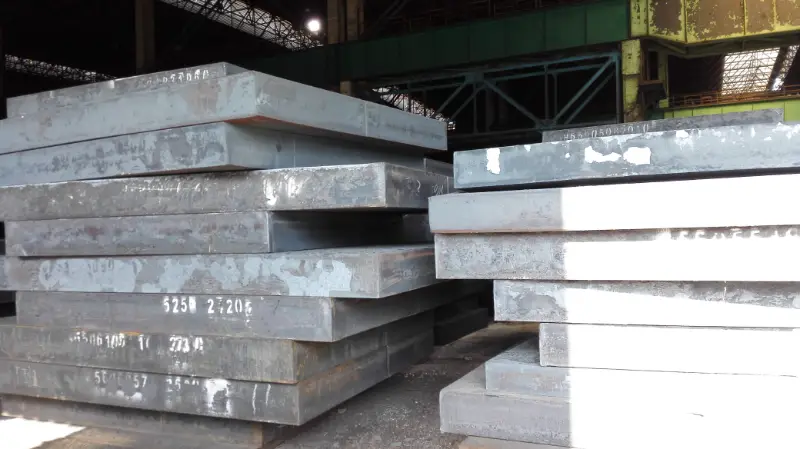
DNV Grade A36 Shipbuilding Steel Plate
DNV Grade A36 Shipbuilding Steel Plate - ASTM A36 with DNV Certification for Marine Structures
Explore the chemical, mechanical, and physical properties of DNV Grade A36 shipbuilding steel plate, fully compliant with ASTM A36 and DNV rules. Ideal for hulls, decks, and offshore construction.
Hot rolling, controlled rolling, normalising; suitable for welding, cutting (flame, plasma, laser), cold and hot forming, machining, drilling, and coating.
- Phone : +8618037372205
- Email : [email protected]
- WhatsApp: Contact via Whtsapp
- WeChat: +8618037372205
DNV Grade A36 Shipbuilding Steel Plate Introduction
DNV Grade A36 is a normal-strength carbon structural steel plate certified by Det Norske Veritas (DNV) for use in shipbuilding and marine applications. It fully complies with the chemical and mechanical requirements of ASTM A36/A36M and is additionally subjected to the stringent quality and testing protocols of DNV classification rules. This grade offers an excellent combination of weldability, ductility, and moderate strength, with a minimum yield strength of 250 MPa (36 ksi) and tensile strength of 400–550 MPa. The steel is typically supplied in the as‑rolled or normalized condition, ensuring reliable performance in hull structures, decks, bulkheads, and offshore platforms. Its widespread availability and cost‑effectiveness make it a staple choice for both newbuilding and repair projects where classification society approval is mandatory.
DNV Grade A36 Shipbuilding Steel Plate Chemical Composition
The chemical composition of DNV Grade A36 follows ASTM A36 requirements. Values shown are typical for plates ≤20 mm thickness. Under DNV rules, additional restrictions may apply to elements like C and Mn to ensure good weldability and toughness in shipbuilding.
- Microalloying elements (e.g., Al, Nb, V) may be added for grain refinement.
- Cu may be specified for improved corrosion resistance (≥0.20%).
| Element | Standard Value (≤20 mm) | Remarks |
|---|---|---|
| Carbon, C | ≤ 0.25 | Max 0.25% for plates ≤20 mm (ASTM A36) |
| Manganese, Mn | 0.80 – 1.20 | Typical range; may be adjusted for thickness |
| Phosphorus, P | ≤ 0.040 | Max |
| Sulfur, S | ≤ 0.050 | Max |
| Silicon, Si | ≤ 0.40 | Typical; optional element |
| Copper, Cu | ≥ 0.20 (if specified) | When improved atmospheric corrosion resistance is required |
| Residuals (Cr, Ni, Mo) | ≤ 0.30 each | Not explicitly limited by ASTM A36, but generally kept low |
DNV Grade A36 Shipbuilding Steel Plate Physical Properties
The following physical properties are representative for ASTM A36 type carbon steel at room temperature and elevated temperatures.
- These values are for general guidance; actual properties may vary slightly with composition and heat treatment.
- Thermal expansion and conductivity data cover a temperature range commonly encountered in design.
| Property | Value | Unit | Test Condition |
|---|---|---|---|
| Density, ρ | 7850 | kg/m³ | At 20 °C |
| Elastic Modulus, E | 200 | GPa | At 20 °C |
| Shear Modulus, G | 77 | GPa | At 20 °C (calculated) |
| Poisson's Ratio, ν | 0.30 | – | At 20 °C (typical) |
| Thermal Expansion, α | 12.1 × 10⁻⁶ | K⁻¹ | 20–100 °C |
| Thermal Expansion, α | 12.6 × 10⁻⁶ | K⁻¹ | 20–200 °C |
| Thermal Expansion, α | 13.2 × 10⁻⁶ | K⁻¹ | 20–300 °C |
| Thermal Conductivity, λ | 51.9 | W/(m·K) | At 100 °C |
| Thermal Conductivity, λ | 48.5 | W/(m·K) | At 200 °C |
| Thermal Conductivity, λ | 44.8 | W/(m·K) | At 300 °C |
| Specific Heat Capacity, cp | 486 | J/(kg·K) | 0–100 °C |
| Electrical Resistivity, ρe | 0.142 | µΩ·m | At 20 °C |
DNV Grade A36 Shipbuilding Steel Plate Mechanical Properties
Mechanical properties determined on test pieces taken transverse to rolling direction. Values depend on plate thickness according to ASTM A36 and DNV requirements.
- For shipbuilding plates, Charpy V‑notch impact tests are often required by DNV (not specified in ASTM A36 base standard); typical toughness values (if tested) are KV ≥ 34 J at 0 °C for Grade A equivalent.
- Bending test is according to ASTM A6/A6M: 180° bend with diameter as specified.
| Property | Requirement | Unit | Test Condition |
|---|---|---|---|
| Yield Strength, ReH | ≥ 250 | MPa | Plate thickness t ≤ 20 mm |
| Yield Strength, ReH | ≥ 230 | MPa | 20 < t ≤ 40 mm |
| Yield Strength, ReH | ≥ 220 | MPa | 40 < t ≤ 65 mm |
| Yield Strength, ReH | ≥ 205 | MPa | t > 65 mm |
| Tensile Strength, Rm | 400 – 550 | MPa | All thicknesses |
| Elongation, A | ≥ 20 | % | Gauge length 200 mm (8 in), t ≤ 20 mm |
| Elongation, A | ≥ 19 | % | Gauge length 200 mm (8 in), 20 < t ≤ 40 mm |
| Elongation, A | ≥ 18 | % | Gauge length 200 mm (8 in), t > 40 mm |
| Bend Test | 180° d = 3a | – | t ≤ 20 mm (typical requirement) |
| Bend Test | 180° d = 3.5a | – | t > 20 mm (typical requirement) |
| Impact Toughness, KV (optional) | ≥ 34 J at 0 °C | J | When DNV requires, typical for normal-strength ship plate |
DNV Grade A36 Shipbuilding Steel Plate Exactly Equivalent Standards & Replaceable Grades
| Country/Region | Standard | Grade | Remarks |
|---|---|---|---|
| International | ASTM A36/A36M (DNV approved) | DNV Grade A36 | Primary specification; also accepted by other IACS members |
| USA (ABS) | ABS Rules | ABS Grade A | Normal-strength hull steel; YS ≥ 235 MPa; Rm 400–520 MPa |
| UK (LR) | LR Rules | LR Grade A | Similar to ABS Grade A; often cross-certified with DNV Grade A |
| France (BV) | BV Rules | BV Grade A | Normal-strength; equivalent weldability and toughness |
| China (CCS) | CCS Rules | CCS A | Matched to IACS UR W11; YS ≥ 235 MPa |
| Germany (GL/DNV GL) | GL Rules | GL‑A | Now integrated with DNV; seamless approval path |
| Europe | EN 10025‑2 | S235JR | Mild carbon steel; YS ≥ 235 MPa; Rm 360–510 MPa; suitable for structural use |
| Japan | JIS G 3101 | SS400 | General structural steel; YS ≥ 235 MPa; Rm 400–510 MPa |
| ISO | ISO 630‑2 | Fe360B | Grade 360; YS ≥ 235 MPa; with impact option |
DNV Grade A36 Shipbuilding Steel Plate Application Introduction
DNV Grade A36 steel is uniquely positioned for marine construction because it satisfies both the structural requirements of ASTM A36 and the additional quality demands of DNV classification. It is extensively employed in new shipbuilding and repair of existing vessels, as well as in fixed and floating offshore structures. Its moderate strength, combined with excellent weldability, allows for cost‑effective fabrication without the need for pre‑ or post‑weld heat treatment in most cases. The following lists typical target industries, products, and specific components.
Product Applications: Commercial cargo ships (bulk carriers, tankers, container vessels), Naval and coast guard vessels, Offshore platform topsides and jackets, Wind turbine foundation structures (offshore), Steel bridges and pedestrian walkways, Storage tanks and silos, Structural frameworks for industrial buildings
Processed into products: Hull plates and shell plating, Deck plates and stringers, Bulkheads and web frames, Stiffeners, longitudinals, and girders, Hatch covers and coamings, Superstructure panels (accommodation modules), Offshore module support beams, Mooring and anchoring components (brackets, pad eyes), Pipe supports and secondary steel on platforms, Pile guides and foundation templates
Application industries: Shipbuilding, Offshore oil & gas (platforms, FPSOs), Marine engineering (docks, piers, coastal protection), Bridge & heavy infrastructure construction, Pressure vessel fabrication (moderate temperature/pressure), General structural steel construction
DNV Grade A36 Shipbuilding Steel Plate Similar / Substitute Materials
| Country/Region | Standard | Grade | Remarks |
|---|---|---|---|
| International | DNV Rules | DNV NV A27 / DNV AH27 | Higher-strength ship steel; YS ≈ 265 MPa; closer strength match to A36 |
| USA | ASTM A283/A283M | Grade D | Carbon steel plate; YS ≥ 230 MPa; Rm 415–585 MPa; similar strength |
| Europe | EN 10025‑2 | S275JR | YS ≥ 275 MPa; Rm 410–560 MPa; slightly stronger; weldable |
| Japan | JIS G 3106 | SM400A | Welded structural steel; YS ≥ 245 MPa for t ≤ 16 mm; Rm 400–510 MPa |
| China | GB/T 700 | Q235B | Very common structural steel; YS ≥ 235 MPa; Rm 370–500 MPa; widely used |
| Korea | KS D 3503 | SS400 | Equivalent to JIS SS400 |
| India | IS 2062 | E250A | Fe 410 WA; YS ≥ 250 MPa; Rm ≥ 410 MPa; close mechanical match |
Notes:
- DNV Grade A36 is often supplied with DNV 3.2 inspection certificate, confirming full traceability and testing in accordance with DNV rules.
- The steel is generally delivered in the as-rolled condition for moderate thicknesses; normalising may be applied for thicker plates (e.g., >40 mm) to improve impact toughness.
- For low-temperature service, additional Charpy V‑notch requirements (e.g., at -20 °C or -40 °C) can be agreed upon; in such cases, a higher grade (e.g., D or E) or a fine‑grain variant may be more appropriate.
- Welding consumables should be selected to match the base metal, typically AWS A5.1 E7018 or equivalent low‑hydrogen electrodes, following DNV‑approved welding procedures.
- Preheat is seldom necessary for thicknesses below 50 mm, but may be advised for thick sections or when moisture is present.
- Share



