
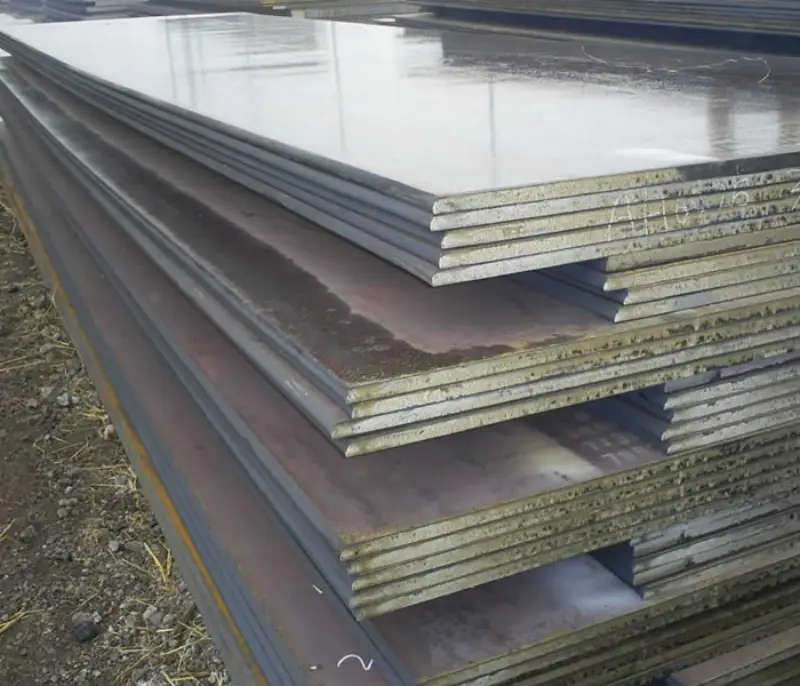
LR Grade EH55
LR Grade EH55: Arctic-Grade High-Strength Quenched & Tempered Shipbuilding Steel
Comprehensive data sheet for Lloyd's Register EH55 shipbuilding steel: chemical composition, mechanical and physical properties, international equivalents, and application guidelines.
Welding (SMAW, SAW, GMAW), thermal cutting, cold forming with suitable bend radii, machining
- Phone : +8618037372205
- Email : [email protected]
- WhatsApp: Contact via Whtsapp
- WeChat: +8618037372205
LR Grade EH55 Introduction
LR Grade EH55 is a high-strength, quenched and tempered structural steel plate certified by Lloyd's Register for shipbuilding and offshore applications. It offers a minimum yield strength of 550 MPa and outstanding low-temperature impact toughness down to -40°C, making it ideal for vessels operating in Arctic and harsh environments. Key characteristics:
- Minimum yield strength 550 MPa with good elongation
- Excellent notch toughness at -40°C (longitudinal min. 46 J)
- Good weldability with controlled carbon equivalent
- Supplied in quenched and tempered (QT) condition
- Compliant with LR Rules for Materials
LR Grade EH55 Chemical Composition
The chemical composition of LR Grade EH55 is controlled to ensure high strength, toughness, and weldability. Maximum limits are imposed on impurities such as phosphorus and sulfur to enhance ductility and resistance to brittle fracture. Microalloying elements like niobium, vanadium, and titanium refine the grain structure. Carbon Equivalent (CEV) is typically limited to ≤0.43% (depending on thickness) to guarantee satisfactory welding performance without preheating under normal conditions.
| Element | Typical Value (max unless range) | Remarks |
|---|---|---|
| Carbon (C) | 0.18% | Contributes to strength; kept low for weldability |
| Silicon (Si) | 0.50% | Deoxidizer, improves strength |
| Manganese (Mn) | 0.90 - 1.60% | Enhances hardenability and strength |
| Phosphorus (P) | 0.020% | Low level to prevent embrittlement |
| Sulfur (S) | 0.015% | Improves ductility and through-thickness properties |
| Chromium (Cr) | 0.30% | Optional; increases hardenability |
| Nickel (Ni) | 0.50% | Improves low-temperature toughness |
| Molybdenum (Mo) | 0.10% | Minor addition for strength |
| Copper (Cu) | 0.35% | Minor element; provides some corrosion resistance |
| Aluminium (Al) total | ≥0.020% | Grain refinement and deoxidation |
| Niobium (Nb) | 0.05% | Microalloying for grain refinement |
| Vanadium (V) | 0.10% | Precipitation hardening |
| Titanium (Ti) | 0.02% | Grain refinement and nitrogen fixation |
| Nitrogen (N) | 0.012% | Controlled to prevent strain aging |
| Carbon Equivalent (CEV) | ≤0.43% (typical) | CEV = C + Mn/6 + (Cr+Mo+V)/5 + (Ni+Cu)/15 |
LR Grade EH55 Thermal and Electrical Physical Properties
The physical properties are representative of quenched and tempered low-alloy steels and are provided as typical values at room temperature unless otherwise noted. These data assist in engineering calculations for thermal expansion, heat transfer, and structural analysis. Density, elastic moduli, and thermal expansion are essential for weight estimation, stiffness and thermal stress evaluation. Actual values may show minor variations depending on exact composition and heat treatment history.
| Property | Typical Value | Unit | Test Condition / Remarks |
|---|---|---|---|
| Density (ρ) | 7.85 | g/cm³ | Room temperature |
| Elastic Modulus (E) | 210 | GPa | Room temperature |
| Shear Modulus (G) | 80 | GPa | Calculated from E and ν |
| Poisson's Ratio (ν) | 0.3 | - | Room temperature |
| Thermal Expansion Coefficient (α) | 12 (20–100°C); 13 (20–200°C); 14 (20–400°C) | ×10⁻⁶ /°C | Mean linear expansion for indicated temperature range |
| Thermal Conductivity (λ) | 50 (at 20°C); 45 (at 200°C); 38 (at 400°C) | W/(m·K) | Approximate values for low-alloy QT steel |
| Specific Heat Capacity (cp) | 460 | J/(kg·K) | At 20–100°C range |
| Electrical Resistivity (ρe) | 0.20 | Ω·mm²/m (or ×10⁻⁶ Ω·m) | Room temperature |
LR Grade EH55 Mechanical Properties
Mechanical properties are determined on transverse test pieces unless otherwise specified. The steel demonstrates a high yield strength combined with excellent elongation and impact resistance. Charpy V-notch impact tests are performed at -40°C to guarantee safe service in Arctic climates. Bend test specimens withstand 180° bending without cracking (mandrel diameter dependent on thickness). Values may vary slightly with plate thickness; the table represents typical requirements for thicknesses up to 50 mm.
| Property | Specification Requirement | Unit | Test Condition / Remarks |
|---|---|---|---|
| Yield Strength (ReH) | ≥550 | MPa | Upper yield or 0.2% proof stress; transverse specimen, room temperature |
| Tensile Strength (Rm) | 670 - 830 | MPa | Transverse specimen, room temperature |
| Elongation (A5) | ≥16 | % | Gauge length 5.65√S0, transverse |
| Bend Test (180°) | d = 3t (t ≤ 20 mm); d = 4t (20 < t ≤ 50 mm) | - | No cracks; mandrel diameter 'd', specimen thickness 't' |
| Charpy Impact (KV) at -40°C, Longitudinal | ≥46 (average), ≥32 (single) | J | 10×10 mm specimen; for thicknesses where sub-size specimens are required, minimum values are adjusted per LR Rules |
| Charpy Impact (KV) at -40°C, Transverse | ≥31 (average), ≥22 (single) | J | Transverse specimen (if specified) |
LR Grade EH55 Completely Equivalent Material Standards and Replaceable Grades
| Country/Region | Standard | Grade | Remarks |
|---|---|---|---|
| International (IACS) | Lloyd's Register Rules | EH55 | Original LR grade, quenched & tempered |
| USA | ABS Rules | ABS EH55 | Equivalent high-strength QT steel for ships |
| Norway/Germany | DNV Rules | DNV E550 | DNV designation for 550 MPa yield QT shipbuilding steel |
| France | BV Rules | BV EH55 | Bureau Veritas equivalent |
| China | CCS Rules | CCS EH55 | China Classification Society equivalent |
| Japan | NK Rules | NK KE55 | ClassNK designation; same strength and toughness class |
| South Korea | KR Rules | KR EH55 | Korean Register equivalent |
| Italy | RINA Rules | RINA EH55 | Equivalent grade |
| Russia | RS Rules | RS E550 | Russian Maritime Register equivalent |
LR Grade EH55 Application Introduction
LR Grade EH55 is specifically designed for extreme service conditions where high strength and excellent low-temperature toughness are critical. Typical applications include:
- Hull envelopes and internal stiffeners of icebreakers and polar supply vessels
- Structural components in Arctic offshore platforms, such as legs, bracings, and deck plates
- Heavy-lift crane pedestals and booms on ships
- Bridges and support structures in cold regions
The steel is delivered in the quenched and tempered condition and can be fabricated using standard shipyard processes. Preheating before welding may be necessary depending on plate thickness and hydrogen control requirements, but the low carbon content and low CEV minimize the risk of cold cracking.
Product Applications: Polar icebreakers, Arctic supply vessels, Offshore platform topsides and jackets, Heavy-lift crane structures, Cold-climate bridges and civil structures
Processed into products: Hull plates and shell plating (ice belt regions), Longitudinal and transverse stiffeners, Bulkheads and deck panels, Bracket plates and web frames, Pedestal and slewing rings for cranes, Support legs and spudcans for jack-up units, Welded tubular joints and nodes
Application industries: Shipbuilding (ice-class vessels, LNG carriers in Arctic routes), Offshore Oil & Gas (jack-up rigs, semi-submersibles, FPSOs), Port and Heavy Lifting Equipment, Renewable Energy (offshore wind turbine foundations in cold seas), Defence and Coast Guard (ice-strengthened patrol boats)
LR Grade EH55 Similar / Alternative Materials Recommendation
| Country/Region | Standard | Grade | Remarks |
|---|---|---|---|
| European Union | EN 10025-6 | S550QL (1.8926) / S550QL1 | Quenched and tempered structural steel with min. 550 MPa yield; similar chemistry and mechanicals; not specifically certified for shipbuilding, but often accepted under class society approval |
| USA | ASTM A514/A514M | Grade A, B, E, F, H, P, Q, S | High-yield-strength quenched and tempered alloy steel plates; grades with ~690 MPa yield; higher strength than EH55 but can be used in heavy structural applications with design adjustments |
| European Union | EN 10025-6 | S690QL (1.8928) | Higher strength QT steel (690 MPa yield); suitable for weight-critical structures; requires careful welding procedure |
| International | API 2Y | Grade 50 (345 MPa) / 60 (415 MPa) | Offshore structural steel plates; lower strength than EH55 but can substitute in less demanding applications |
Notes:
All data are based on typical values from Lloyd's Register Rules and common industry practice. Actual certified values may vary slightly depending on plate thickness and specific mill production. Welding: Preheating and interpass temperature control should follow approved welding procedure specifications (WPS) considering the steel's CEV and hydrogen input. Post-weld heat treatment (PWHT) is normally not required for thicknesses below 50 mm, but stress relieving may be applied if mandated by design codes. Supplementary requirements: Through-thickness tensile testing (Z-grade) and ultrasonic testing can be specified according to LR Rules and client needs. The steel also meets the requirements of IACS UR W11 for hull structural steel.
- Share



