
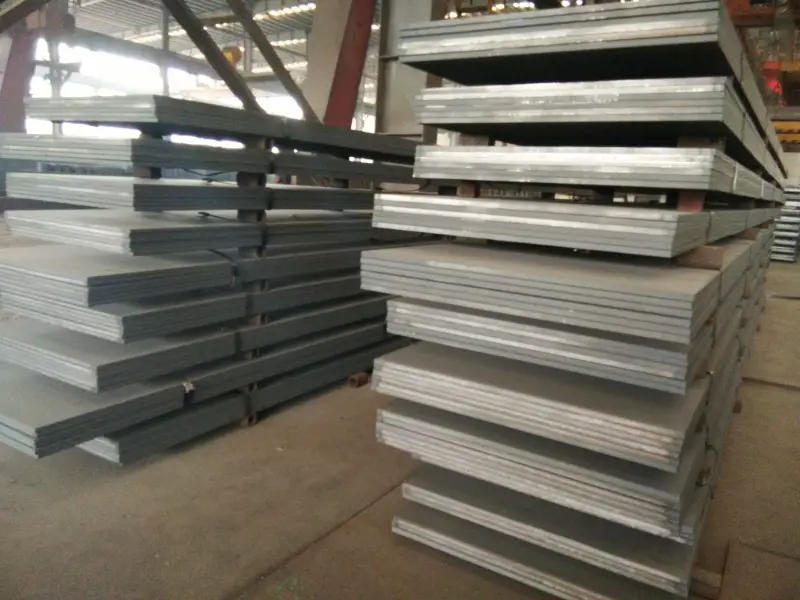
LR Grade FH40 Shipbuilding Steel Plate
LR Grade FH40 Shipbuilding Steel Plate - High Strength, Extra Low Temperature Toughness
Full technical datasheet for LR Grade FH40 shipbuilding steel plate: chemical composition, mechanical properties, thermal and electrical physical data, international equivalents, and application guidance.
Hot rolling, thermomechanical controlled rolling (TMCR/TMCP), normalising, quenching and tempering (optional); machining, cutting, forming and welding
- Phone : +8618037372205
- Email : [email protected]
- WhatsApp: Contact via Whtsapp
- WeChat: +8618037372205
LR Grade FH40 Shipbuilding Steel Plate Introduction
LR Grade FH40 is a high-strength shipbuilding steel plate with specified minimum yield strength of 390 MPa and guaranteed impact toughness down to -60 °C. It is certified in accordance with Lloyd's Register (LR) Rules for the Manufacture, Testing and Certification of Materials. The steel is typically produced via thermomechanical controlled rolling (TMCP) or normalising, delivering a fine-grained microstructure that combines high tensile properties with excellent resistance to brittle fracture. This grade is intended for critical structural members in large container ships, offshore platforms and naval vessels operating in arctic or low-temperature environments.
- Good weldability with low carbon equivalent (CEV)
- Outstanding notch toughness at -60 °C
- Available in a wide range of thicknesses (up to 100 mm)
LR Grade FH40 Shipbuilding Steel Plate Chemical Composition
Ladle analysis requirements according to LR Rules. Fine-grain elements (Nb, V, Ti) may be added singly or in combination. The steel shall be fully killed and contain a sufficient amount of grain-refining elements.
- Carbon equivalent CEV = C + Mn/6 + (Cr+Mo+V)/5 + (Ni+Cu)/15 typically ≤ 0.38 % for thicknesses ≤ 50 mm.
- Aluminium to nitrogen ratio controlled to ensure fine grain size.
| Element | Content (%) | Remarks |
|---|---|---|
| C | ≤ 0.18 | Carbon |
| Si | ≤ 0.50 | Silicon |
| Mn | 0.90 – 1.60 | Manganese |
| P | ≤ 0.035 | Phosphorus |
| S | ≤ 0.035 | Sulphur |
| Cr | ≤ 0.20 | Chromium |
| Ni | ≤ 0.40 | Nickel |
| Mo | ≤ 0.08 | Molybdenum |
| Cu | ≤ 0.35 | Copper |
| Nb | ≤ 0.05 | Niobium (Columbium) |
| V | ≤ 0.10 | Vanadium |
| Ti | ≤ 0.02 | Titanium |
| Al (acid soluble) | ≥ 0.015 | Aluminium |
| N | ≤ 0.012 | Nitrogen |
LR Grade FH40 Shipbuilding Steel Plate Thermal and Electrical Physical Properties
These values are not part of the product standard but represent typical data for structural steel grades at ambient temperature. They are provided for design and processing guidance. Variations may occur depending on chemical composition and heat treatment condition.
- Thermal properties are average values for the range 20–300 °C unless stated otherwise.
- Electrical resistivity is influenced by alloy content and temperature.
| Property | Typical Value | Unit | Test Condition / Remarks |
|---|---|---|---|
| Density (ρ) | 7850 | kg/m³ | At 20 °C |
| Modulus of elasticity (E) | 205 | GPa | At 20 °C |
| Shear modulus (G) | 80 | GPa | At 20 °C |
| Poisson's ratio (ν) | 0.3 | – | At 20 °C, elastic range |
| Thermal expansion coefficient (α) | 11.5 × 10⁻⁶ | 1/K | 20–100 °C |
| Thermal conductivity (λ) | 50 | W/(m·K) | At 20 °C |
| Specific heat capacity (cp) | 460 | J/(kg·K) | At 20 °C |
| Electrical resistivity (ρ_e) | 0.20 × 10⁻⁶ | Ω·m | At 20 °C |
LR Grade FH40 Shipbuilding Steel Plate Mechanical Properties
Mechanical properties specified by LR Rules for material thicknesses t ≤ 100 mm. Tensile testing is carried out in the transverse direction unless otherwise agreed. Charpy V-notch tests are performed in the longitudinal direction standard; transverse values are applicable when specified.
- For thicknesses > 100 mm, minimum yield strength may be reduced.
- Bend test requirement: 180° bend to a diameter of 3 × thickness for t ≤ 25 mm.
| Property | Required Value | Unit | Test Condition |
|---|---|---|---|
| Yield Strength (ReH) | ≥ 390 | MPa | t ≤ 100 mm |
| Tensile Strength (Rm) | 510 – 650 | MPa | t ≤ 100 mm |
| Elongation (A5) | ≥ 20 | % | t ≤ 50 mm, gauge length 5.65√S₀ |
| Elongation (A5) | ≥ 19 | % | 50 < t ≤ 70 mm |
| Elongation (A5) | ≥ 18 | % | 70 < t ≤ 100 mm |
| Charpy V-notch impact energy (KV, longitudinal) | ≥ 41 (average) | J | -60 °C, min. single value ≥ 28 J |
| Charpy V-notch impact energy (KV, transverse) | ≥ 27 (average) | J | -60 °C, min. single value ≥ 19 J |
| Bend test (diameter) | d = 3t | mm | t ≤ 25 mm, 180° |
LR Grade FH40 Shipbuilding Steel Plate Completely Equivalent Material Standards and Substitutable Grade Designations
| Country/Region | Standard | Grade | Remarks |
|---|---|---|---|
| Worldwide | ABS Rules | ABS FH40 | Identical strength and -60 °C impact requirement |
| Worldwide | BV Rules | BV FH40 | Identical high-strength hull steel |
| China | CCS Rules | CCS FH40 | Same yield/tensile strength and low-temperature toughness |
| Worldwide | DNV Rules | DNV FH40 | Formerly DNVGL; tmcp or normalised |
| Worldwide | LR Rules | LR FH40 | Base specification |
| Korea | KR Rules | KR FH40 | Same technical conditions |
| Japan | NK Rules | NK FH40 | Equivalent classed steel |
| Italy | RINA Rules | RINA FH40 | Fully equivalent |
| Russia | RS Rules | RS FH40 | Fully equivalent |
LR Grade FH40 Shipbuilding Steel Plate Application Introduction
LR Grade FH40 is designed for the most demanding low-temperature marine and offshore applications. Its guaranteed Charpy V-notch toughness down to -60 °C makes it suitable for ice-going vessels and arctic structures. It is widely used in critical strength components of ship hulls and offshore structures where fatigue life, safety and weight savings are important. The steel is fully weldable with standard methods, provided low-hydrogen practices and appropriate pre-heating/interpass temperatures are observed.
- Ideal for replacement or upgrade of similar classed FH40 grades.
- Suitable for both monolithic construction and hybrid structural assemblies.
Product Applications: Large oil tankers and bulk carriers, Container ships, Icebreakers and Arctic research vessels, Offshore platform topsides and jackets, Jack-up rig legs and spudcans
Processed into products: Main deck plates and stringers, Shell plating (side and bottom), Longitudinal and transverse stiffeners, Web frames and floors, Bulkhead plates, Bracket assemblies, Hatch coamings, Offshore module support beams
Application industries: Shipbuilding, Offshore Oil & Gas, Marine Engineering, Naval Defence, Arctic and Ice-class Vessels
LR Grade FH40 Shipbuilding Steel Plate Similar or Closely Equivalent Alternative Materials
| Country/Region | Standard | Grade | Remarks |
|---|---|---|---|
| European Union | EN 10025-4 | S420ML | TMCP steel, min. 420 MPa yield, impact -50 °C (27 J min.); requires verification of -60 °C performance and LR certification |
| European Union | EN 10025-4 | S460ML | Higher strength alternative; impact only to -50 °C; additional testing required for LR FH40 equivalency |
| USA | ASTM A131 / A131M | FH40 | Same grade under ASTM shipbuilding standard; properties aligned with LR but must meet LR's specific acceptance criteria |
Notes:
Delivery condition: Usually thermomechanically rolled (M) or as agreed. If normalising (N) is selected, the steel may achieve lower alloy content but still meets the same property targets. Welding: Low-hydrogen processes recommended; pre-heat typically 50–150 °C depending on thickness and CEV. Post-weld heat treatment: Not normally required for thicknesses up to 50 mm unless service conditions dictate. Certification: Material must be supplied with LR inspection certificate 3.1 or 3.2 in accordance with EN 10204.
- Share



