
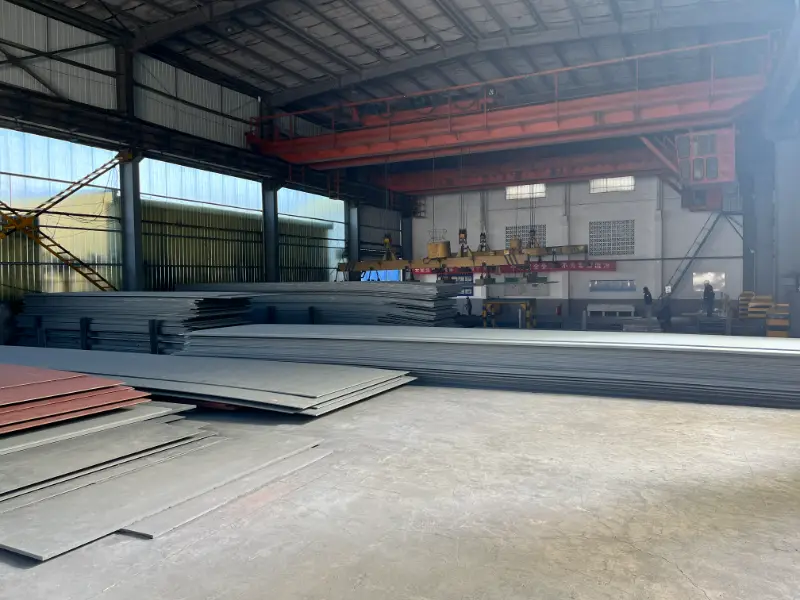
LR Grade EH40 Shipbuilding Steel Plate
LR Grade EH40 Shipbuilding Steel Plate: High-Strength & Low-Temperature Performance for Marine Environments
LR Grade EH40 is a high-strength hull structural steel certified by Lloyd's Register, with a minimum yield strength of 390 MPa and guaranteed impact toughness at -40°C. Ideal for critical ship and offshore components requiring excellent weldability and low-temperature durability.
Hot rolling, Normalizing, Thermo-mechanical controlled processing (TMCP), Quenching and tempering
- Phone : +8618037372205
- Email : [email protected]
- WhatsApp: Contact via Whtsapp
- WeChat: +8618037372205
LR Grade EH40 Shipbuilding Steel Plate Introduction
LR Grade EH40 is a normalised or thermo-mechanically controlled processed (TMCP) high-strength steel primarily used in shipbuilding and offshore engineering. Classified by Lloyd's Register, it guarantees a minimum yield strength of 390 MPa and excellent notch toughness down to -40°C, ensuring reliable performance in cold climate and Arctic operations. Key features include:
- High strength-to-weight ratio allowing thinner sections and reduced structural weight
- Superior weldability with low carbon equivalent (CEV) for efficient fabrication
- Excellent low-temperature impact properties (min. 46 J longitudinal at -40°C)
- Good formability and through-thickness properties suitable for highly stressed members
Delivered in normalised, TMCP or quenched and tempered condition, it meets stringent requirements for critical applications such as hull plates, decks, and offshore platform components. The steel complies with Lloyd's Register Rules and comparable international standards, making it a trusted material for global marine projects.
LR Grade EH40 Shipbuilding Steel Plate Chemical Composition
The following chemical composition complies with IACS UR W11 for EH40 grades. Elements are controlled to ensure a low carbon equivalent (CEV typically ≤0.43%) for excellent weldability and to achieve the required strength and low-temperature toughness. Note: Values are maximum unless ranges are indicated. Fine grain practice with aluminium content is mandatory.
| Element | Standard Value (max, %) | Remarks |
|---|---|---|
| Carbon (C) | 0.18 | |
| Manganese (Mn) | 0.90–1.60 | Range varies by thickness and manufacturing process |
| Silicon (Si) | 0.50 | |
| Phosphorus (P) | 0.025 | |
| Sulfur (S) | 0.025 | |
| Aluminium (Al, total) | ≥0.015 | Minimum acid-soluble or total aluminium as per fine grain practice |
| Niobium (Nb) | 0.05 | |
| Vanadium (V) | 0.10 | |
| Titanium (Ti) | 0.02 | |
| Copper (Cu) | 0.35 | |
| Chromium (Cr) | 0.20 | |
| Nickel (Ni) | 0.40 | |
| Molybdenum (Mo) | 0.08 | |
| Nitrogen (N) | 0.009 | If sufficient amounts of nitrogen-binding elements are present, higher N may be agreed |
| Carbon Equivalent (CEV) | Typ. 0.38–0.43 | Calculated as CEV = C + Mn/6 + (Cr+Mo+V)/5 + (Ni+Cu)/15; exact limit agreed between manufacturer and purchaser |
LR Grade EH40 Shipbuilding Steel Plate Thermal and Electrical Physical Properties
The following physical properties are typical for carbon-manganese high-strength steels and can be used for engineering calculations. They are not mandatory specification values. Note: Actual values may vary slightly depending on exact chemical composition and heat treatment condition. All data are at room temperature unless otherwise indicated.
| Property | Typical Value | Unit | Conditions / Remarks |
|---|---|---|---|
| Density (ρ) | 7850 | kg/m³ | At 20°C |
| Modulus of Elasticity (E) | 210 | GPa | At 20°C |
| Shear Modulus (G) | 80 | GPa | At 20°C |
| Poisson's Ratio (ν) | 0.3 | — | Elastic range |
| Coefficient of Thermal Expansion (α) | 11.7 × 10⁻⁶ | /K | 20–100°C range; up to 100°C |
| Coefficient of Thermal Expansion (α) | 12.5 × 10⁻⁶ | /K | 20–200°C range |
| Coefficient of Thermal Expansion (α) | 13.6 × 10⁻⁶ | /K | 20–400°C range |
| Thermal Conductivity (λ) | ~50 | W/(m·K) | At 20°C; decreases with increasing temperature |
| Specific Heat Capacity (c) | ~460 | J/(kg·K) | At 20°C; increases slightly with temperature |
| Electrical Resistivity (ρ_e) | ~0.22 | μΩ·m | At 20°C |
LR Grade EH40 Shipbuilding Steel Plate Mechanical Properties
Mechanical properties are determined on representative test samples according to LR testing procedures. All values are minimum unless otherwise noted. Impact testing uses Charpy V-notch specimens. Thickness ranges: Properties are generally valid for plates up to 50 mm; for higher thicknesses, slight reductions may apply. Testing conditions: Specimens are taken transverse to the rolling direction unless longitudinal is specified.
| Property | Standard Requirement | Unit | Test Conditions / Remarks |
|---|---|---|---|
| Yield Strength (ReH) | ≥390 | MPa | Transverse, for t ≤ 50 mm |
| Tensile Strength (Rm) | 510–650 | MPa | Transverse, for t ≤ 50 mm |
| Elongation after Fracture (A5) | ≥20 | % | Gauge length 5.65√So, transverse |
| Elongation after Fracture (A50) | ≥18 | % | Gauge length 50 mm, transverse (alternate) |
| Impact Energy (KV, -40°C) | ≥46 (longitudinal) / ≥31 (transverse) | J | Average of 3 specimens, min. single value 70% of average |
| Bend Test (Bend Angle 180°) | No cracks or defects | — | Mandrel diameter: 3t for t ≤ 25 mm, 4t for t > 25 mm; t = specimen thickness |
LR Grade EH40 Shipbuilding Steel Plate Fully Equivalent Material Standards and Replaceable Grades
| Country / Region | Standard / Rules | Grade | Remarks |
|---|---|---|---|
| International (IACS) | IACS UR W11 | EH40 | All IACS classification societies recognize this standard |
| United Kingdom | Lloyd's Register (LR) Rules | EH40 | Original grade per LR |
| United States | ASTM A131 / ABS Rules | EH40 | ASTM A131 Grade EH40 / ABS Grade EH40 |
| Norway | DNV Rules | NV E40 | DNV Grade E40, equivalent toughness requirement |
| Germany | DNV GL Rules (former GL) | GL-E40 | Merged DNV GL rules |
| France | Bureau Veritas (BV) Rules | EH40 | BV Grade EH40 |
| Italy | RINA Rules | E40 | RINA Grade E40 |
| China | China Classification Society (CCS) Rules | EH40 | CCS Grade EH40 |
| Japan | Nippon Kaiji Kyokai (NK) Rules | KE40 | NK Grade KE40 |
| Korea | Korean Register (KR) Rules | RE40 | KR Grade RE40 |
| Russia | Russian Maritime Register (RS) Rules | E40 | RS Grade E40, similar notch toughness requirements |
LR Grade EH40 Shipbuilding Steel Plate Application Introduction
LR Grade EH40 is specifically designed for critical marine and offshore applications where high strength, excellent weldability, and low-temperature toughness are mandatory. It is predominantly used in primary structures subjected to high static and dynamic loads. Typical uses:
Product Applications: Ship hull envelopes (bottom, side, sheer strake and deck plates), Strength decks and hatch coamings, Watertight bulkheads and deep frames, Offshore platform legs, braces, and nodes, Jack-up rig legs and cantilever structures, Transition pieces and monopile foundations for offshore wind
Processed into products: Ship outer shell plates and bottom plating, Longitudinal and transverse stiffeners (bulb flats, angles, T-beams), Rudder horns and pintles, Hatch cover panels and supporting girders, Column and pontoon structures of semi-submersibles, Spud cans and footing structures for jack-ups, Crane pedestals and king posts
Application industries: Shipbuilding (commercial and naval vessels, including ice-class ships), Offshore oil & gas (fixed platforms, jack-up rigs, semi-submersibles), Renewable energy (offshore wind turbine substructures, transition pieces), Marine engineering (floating docks, heavy-lift crane barges), Port and harbour construction (sheet piling, mooring structures)
LR Grade EH40 Shipbuilding Steel Plate Similar / Comparable Alternative Material Recommendations
| Country / Region | Standard / Specification | Grade | Remarks |
|---|---|---|---|
| Europe | EN 10225 | S420G2+Q | Offshore structural steel with 420 MPa yield; slightly higher strength, excellent toughness; requires re-certification for marine use |
| Europe | EN 10025-4 | S420ML | Thermo-mechanically rolled structural steel; similar strength, may be considered for non-ship applications after evaluation |
| International | API 2W | Grade 60 | Steel for offshore platforms; yield 415 MPa, TMCP; closer to EH40 but requires verification for specific design codes |
| United States | ASTM A572/A572M | Grade 65 | High-strength low-alloy structural steel; yield 450 MPa; not recommended for primary ship structures without additional notch toughness testing |
| Japan | JIS G 3106 | SM490YB | Welded structural steel with yield 365 MPa; lower strength; suitable only for non-critical or lightly loaded members |
Notes:
Certification: Material must be produced by an LR-approved manufacturer and supplied with LR inspection certificates (3.1 or 3.2 per EN 10204). Weldability: Consumables should match the strength and toughness requirements; preheat and interpass control may be necessary based on thickness and CEV. NDT: Ultrasonic testing per LR rules may be specified for critical zones. Z-grade: For components subjected to through-thickness tensile loading, grades with improved property (Z25 or Z35) can be ordered per LR requirements. Corrosion: Surface protection (coatings, cathodic protection) is required in marine service; the steel itself has no enhanced atmospheric corrosion resistance.
- Share



