
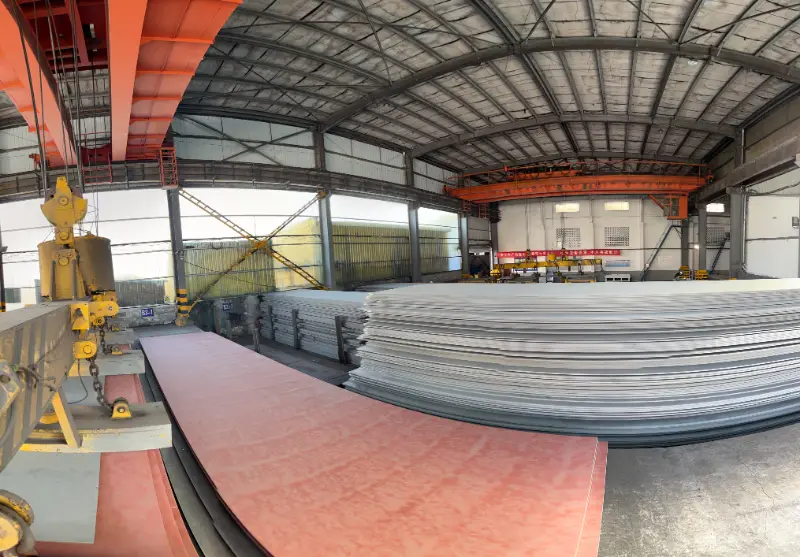
LR Grade DH50 Shipbuilding Steel Plate
LR Grade DH50 Shipbuilding Steel Plate: High-Strength Hull Structural Material for Demanding Marine Applications
Explore the properties, chemical composition, mechanical performance, and global equivalents of LR Grade DH50 shipbuilding steel plate, a premium high-strength material for hulls and offshore structures.
Cutting, bending, welding (SAW, SMAW, GMAW/FCAW), forming, drilling, machining
- Phone : +8618037372205
- Email : [email protected]
- WhatsApp: Contact via Whtsapp
- WeChat: +8618037372205
LR Grade DH50 Shipbuilding Steel Plate Introduction
LR Grade DH50 is a high-strength, low-temperature tough shipbuilding steel plate certified by Lloyd's Register. It belongs to the DH series, where 'D' denotes the toughness class with impact testing at -20°C, and '50' indicates a minimum yield strength of 500 MPa. This grade is ideal for critical structural components in ships and offshore platforms that require superior strength, weldability, and resistance to brittle fracture. Manufactured through thermomechanical controlled processing (TMCP) or quenching and tempering, DH50 offers an excellent balance of tensile strength (610–770 MPa) and ductility, meeting the stringent requirements of IACS UR W11. Its low carbon equivalent facilitates good weldability, reducing preheating needs. The steel is supplied in various thicknesses and normalized or TMCP delivery conditions, ensuring consistent properties for heavy fabrication.
LR Grade DH50 Shipbuilding Steel Plate Chemical Composition - LR DH50
The chemical composition of LR DH50 is controlled to ensure high strength, excellent weldability, and good low-temperature toughness. Maximum limits are specified for residuals and microalloying elements to achieve fine grain structure. Typical ladle analysis values are shown; the final product analysis may have slight variations within allowed tolerances.
- Carbon equivalent (CEV) is kept low to minimize hardenability risks during welding.
- Microalloying elements (Nb, V, Ti) are added for grain refinement and precipitation strengthening.
- Aluminum is used as a deoxidizer and grain refiner.
| Chemical Element | Standard Value (max. unless range given) | Notes / Remarks |
|---|---|---|
| Carbon (C) | ≤ 0.18 | Typical aim below 0.16 for improved weldability |
| Manganese (Mn) | 0.90 – 1.60 | |
| Silicon (Si) | ≤ 0.50 | |
| Phosphorus (P) | ≤ 0.035 | |
| Sulfur (S) | ≤ 0.035 | |
| Aluminum (Al, acid soluble) | ≥ 0.015 | Minimum required for fine grain practice |
| Niobium (Nb) | ≤ 0.05 | May be added alone or in combination |
| Vanadium (V) | ≤ 0.10 | May be added alone or in combination |
| Titanium (Ti) | ≤ 0.02 | For grain refinement and nitrogen control |
| Copper (Cu) | ≤ 0.35 | Residual element; may be specified lower for certain applications |
| Chromium (Cr) | ≤ 0.20 | Residual element; maximum typically 0.25 |
| Nickel (Ni) | ≤ 0.40 | Residual element; maximum typically 0.40 |
| Molybdenum (Mo) | ≤ 0.08 | Residual element; maximum typically 0.08 |
| Nitrogen (N) | ≤ 0.009 | If sufficient amount of Al or other nitrogen-binding elements present |
LR Grade DH50 Shipbuilding Steel Plate Thermophysical and Electrical Properties - LR DH50
The following physical properties are typical for low-alloy structural steel with similar composition and processing. They are not mandatory specification values but are useful for design calculations. Thermal expansion and thermal conductivity vary with temperature; values given are at room temperature unless otherwise stated.
| Property | Standard/Typical Value | Unit | Test Conditions / Remarks |
|---|---|---|---|
| Density (ρ) | 7850 | kg/m³ | At 20°C |
| Modulus of Elasticity (E) | 210 | GPa | Longitudinal, room temperature |
| Shear Modulus (G) | 80 | GPa | Room temperature |
| Poisson's Ratio (ν) | 0.3 | – | Within elastic range |
| Thermal Expansion Coefficient (α) | 11.7 × 10&supminus;&sup6; | 1/K | 20–100°C |
| Thermal Conductivity (λ) | 50 | W/(m·K) | At 20°C |
| Specific Heat Capacity (c&sbp;) | 460 | J/(kg·K) | At 20°C |
| Electrical Resistivity (ρ&sbe;) | 0.2 | µΩ·m | At 20°C |
LR Grade DH50 Shipbuilding Steel Plate Mechanical Properties - LR DH50
Mechanical properties are determined on test specimens taken from the finished plate in accordance with LR's testing procedures. Tensile testing is performed at ambient temperature, and Charpy V-notch impact testing is conducted at -20°C (for D-grades). Values below apply to plates up to 50 mm thickness. For thicker plates (< 100 mm) slight reductions in strength may be agreed. Note: Longitudinal (L) test orientation is standard; transverse values may be lower.
| Property | Standard Requirement Value | Unit | Test Conditions |
|---|---|---|---|
| Yield Strength (ReH) | ≥ 500 | MPa | Room temperature, as per ISO 6892-1 |
| Tensile Strength (Rm) | 610 – 770 | MPa | Room temperature, as per ISO 6892-1 |
| Elongation (A5) | ≥ 14 | % | Gauge length 5.65√S‚ on proportional test piece |
| Impact Energy (KV, -20°C, longitudinal) | ≥ 27 | J | Charpy V-notch, average of three specimens, single min. 70% of average |
LR Grade DH50 Shipbuilding Steel Plate Fully Equivalent Material Standards and Replaceable Grades
| Country / Region | Standard / Classification Society | Grade Designation | Remarks |
|---|---|---|---|
| International (IACS) | IACS UR W11 | DH50 | Adopted by all IACS members; identical requirements |
| USA | ABS | DH50 | American Bureau of Shipping |
| Norway / Germany | DNV | DH50 | Det Norske Veritas (now DNV GL) |
| France | BV | DH50 | Bureau Veritas |
| China | CCS | DH50 | China Classification Society |
| South Korea | KR | DH50 | Korean Register |
| Japan | NK (ClassNK) | DH50 | Nippon Kaiji Kyokai |
| Italy | RINA | DH50 | Registro Italiano Navale |
| Russia | RS | DH50 | Russian Maritime Register of Shipping |
| Germany | GL | DH50 | Germanischer Lloyd (now merged into DNV) |
LR Grade DH50 Shipbuilding Steel Plate Application Introduction
LR DH50 steel plate is designed for demanding marine and offshore environments where weight savings and high structural integrity are critical. Its excellent strength-to-weight ratio allows thinner sections, reducing weight without compromising safety. Common applications include:
- Main hull structural members (deck, bottom, side shells) of large container ships, naval vessels, and ice-class ships.
- Offshore platform topside modules, jacket legs, and helidecks.
- Heavy-lift crane booms and mobile offshore units.
- Pressure hulls of submarines and underwater vehicles (subject to additional requirements).
The material is readily formable and weldable with proper procedures, making it suitable for complex fabrications.
Product Applications: Ship hull plates and stiffening profiles, Offshore platform jackets and deck plates, Crane pedestals and booms, Ice breaker hulls and reinforcement belts, Ballast-free structural components, Bulkhead and deck girders
Processed into products: Main deck plates and longitudinal stiffeners, Bottom shell plating in high-stress areas, Bilge keels and rudder horns, Web frames and stringers, Helicopter landing decks (helideck panels), Fatigue-sensitive nodal joints in offshore structures
Application industries: Shipbuilding (commercial and naval), Offshore oil & gas structures, Marine engineering, Heavy lifting equipment, Defense / naval architecture
LR Grade DH50 Shipbuilding Steel Plate Similar / Comparable Substitute Materials
| Country / Region | Standard / Source | Grade Designation | Remarks |
|---|---|---|---|
| Europe | EN 10225 | S500G1+M or S500G1+Q | Higher-strength structural steel for offshore structures; yield 500 MPa, good toughness |
| Europe | EN 10025-6 | S500QL / S500QL1 | Quenched and tempered structural steel, min. yield 500 MPa, high toughness |
| USA | API 2W | Grade 50 | High-strength steel for offshore platforms, yield 50 ksi (345 MPa) – note lower yield; not direct substitute |
| International | ISO 630-4 | S 500 M / S 500 Q | High-strength structural steel plates for welded structures (not specifically ship class approved) |
Notes:
For plates exceeding 50 mm thickness, mechanical properties may be subject to modification; consult the manufacturer's mill certificate. LR DH50 plates are usually supplied with through-thickness testing (Z-quality) upon request (e.g., Z25, Z35) to avoid lamellar tearing. Preheating before welding is generally not required for thicknesses below 50 mm, but low-hydrogen practices are recommended. Post-weld heat treatment is typically not needed for TMCP grades. Full traceability and LR stamping are mandatory. The steel complies with IACS UR W11 latest revision.
- Share



