
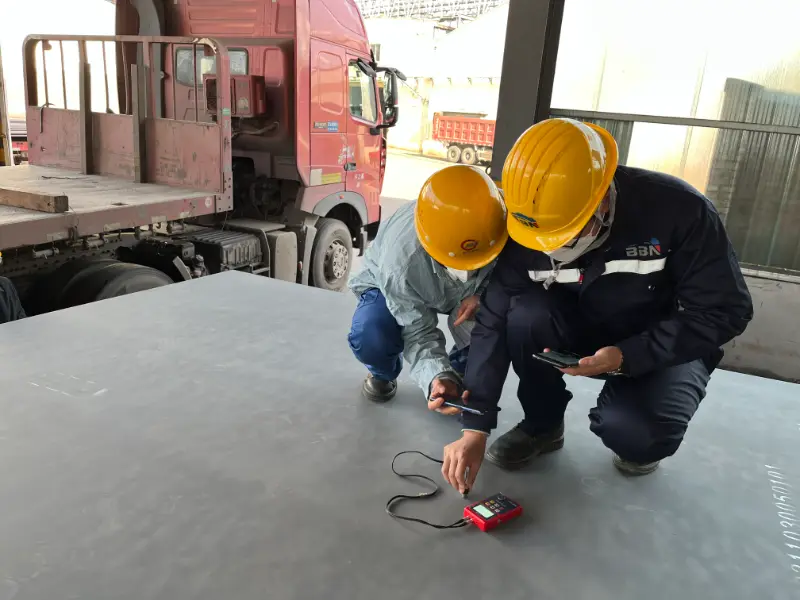
LR Grade EH50 Shipbuilding Steel Plate
LR Grade EH50 Shipbuilding Steel Plate - High Strength Quenched & Tempered Steel for Offshore Structures
Full datasheet for LR Grade EH50 shipbuilding steel plate: chemical composition, mechanical and physical properties, international equivalent standards, similar materials and application guide according to Lloyd's Register rules.
Quenching and tempering (Q&T) or thermomechanical controlled rolling (TMCP) with accelerated cooling; suitable for hot forming, welding, cutting, and machining
- Phone : +8618037372205
- Email : [email protected]
- WhatsApp: Contact via Whtsapp
- WeChat: +8618037372205
LR Grade EH50 Shipbuilding Steel Plate Introduction
LR Grade EH50 is a high-strength quenched and tempered (Q&T) shipbuilding steel plate with a minimum yield strength of 500 MPa. It is designed for use in the construction of hull structures and offshore units under Lloyd's Register classification. The steel offers excellent low-temperature toughness with impact energy guaranteed at -40°C, making it suitable for critical structural applications in harsh marine environments. It features high strength-to-weight ratio, good weldability when proper procedures are followed, and uniform mechanical properties through thickness. Typical applications include deck plating, bottom shells, hatch coamings, and heavy offshore structures. The delivery condition is normally quenched and tempered, but thermomechanical controlled processing (TMCP) may be an alternative by agreement.
LR Grade EH50 Shipbuilding Steel Plate Chemical Composition
The chemical composition of LR Grade EH50 steel is closely controlled to achieve high strength and excellent toughness. The values below represent typical ladle analysis limits per LR rules and common industry practice. All elements are in weight percent. Microalloying elements (Nb, V, Ti) may be added singly or in combination to ensure fine grain structure and precipitation hardening. Total aluminium content is normally required for grain refinement. Maximum limits for Cu, Ni, Cr, Mo may be specified as residuals; they can be present at higher levels by agreement, provided the required mechanical properties are met.
| Element | Specified Value (max unless range) | Remarks |
|---|---|---|
| Carbon (C) | ≤ 0.20% | Depending on carbon equivalent (CEV) requirements |
| Silicon (Si) | ≤ 0.50% | Silicon deoxidation |
| Manganese (Mn) | 0.90 – 1.60% | For strength and hardenability |
| Phosphorus (P) | ≤ 0.025% | Strict control for toughness |
| Sulfur (S) | ≤ 0.025% | Low sulfur for formability and HIC resistance |
| Aluminium (total Al) | ≥ 0.015% | Fine grain practice; usually 0.020–0.050% |
| Niobium (Nb) | ≤ 0.05% | Microalloy, grain refinement |
| Vanadium (V) | ≤ 0.10% | Precipitation strengthening |
| Titanium (Ti) | ≤ 0.02% | Grain control; may be specified as ≤0.05% |
| Nitrogen (N) | ≤ 0.012% | Prevent strain ageing |
| Copper (Cu) | ≤ 0.35% | Residual; higher by agreement |
| Nickel (Ni) | ≤ 0.80% | Residual; may be increased for thicker plates |
| Chromium (Cr) | ≤ 0.25% | Residual; allows up to 0.50% by agreement |
| Molybdenum (Mo) | ≤ 0.08% | Residual; up to 0.25% by agreement |
| Combined Nb+V+Ti | ≤ 0.12% | Sum of microalloying elements |
LR Grade EH50 Shipbuilding Steel Plate Thermal and Electrical Physical Properties
Physical properties are typical for quenched and tempered high-strength low-alloy steel of this strength class. Actual values may vary slightly depending on composition and heat treatment. These values are not mandatory requirements of the LR specification but are provided for engineering calculations. Data reported at room temperature unless otherwise stated.
| Property | Typical Value | Unit | Test Condition |
|---|---|---|---|
| Density (ρ) | 7.85 | g/cm³ | At 20°C |
| Elastic modulus (E) | 210 | GPa | Tensile modulus at 20°C |
| Shear modulus (G) | 81 | GPa | Calculated from E and Poisson's ratio |
| Poisson's ratio (ν) | 0.30 | - | At 20°C, elastic range |
| Thermal expansion coefficient (α) | 12.0 – 13.0 | 10⁻⁶/K | Range 20–100°C |
| Thermal expansion coefficient (α) | 13.0 – 14.0 | 10⁻⁶/K | Range 20–200°C |
| Thermal conductivity (λ) | 36 | W/(m·K) | At 20°C |
| Thermal conductivity (λ) | 35 | W/(m·K) | At 200°C |
| Specific heat capacity (c) | 460 | J/(kg·K) | At 20°C |
| Specific heat capacity (c) | 500 | J/(kg·K) | At 200°C |
| Electrical resistivity (ρ_e) | 0.22 | μΩ·m | At 20°C |
LR Grade EH50 Shipbuilding Steel Plate Mechanical Properties
The mechanical properties listed below are based on transverse test specimens taken from plates in the as-delivered condition (quenched and tempered). Requirements may vary slightly with product thickness; multiple rows are shown for different thickness categories. Bending test mandrel diameter is related to nominal thickness t. Impact testing is performed on Charpy V-notch specimens at -40°C, with a minimum absorbed energy of 27 J for transverse samples. These values represent typical specification minima; actual product may exceed them.
| Property | Required Value | Unit | Test Condition / Remarks |
|---|---|---|---|
| Yield Strength (ReH) | ≥ 500 | MPa | Thickness ≤ 50 mm, transverse |
| Yield Strength (ReH) | ≥ 490 | MPa | Thickness > 50 mm to 100 mm, transverse |
| Tensile Strength (Rm) | 610 – 770 | MPa | All thicknesses, transverse |
| Elongation after fracture (A5) | ≥ 16 | % | Gauge length 5.65√S₀; transverse; thickness ≤ 50 mm |
| Elongation after fracture (A5) | ≥ 15 | % | Thickness > 50 mm to 100 mm |
| Bend Test | d = 2a | - | d = mandrel diameter, a = specimen thickness; 180° bend |
| Charpy Impact Energy (KV) | ≥ 27 | J | At -40°C, transverse, V-notch, average of 3 specimens |
| Charpy Impact Energy (single min.) | ≥ 19 | J | At -40°C, transverse, single value permitted |
LR Grade EH50 Shipbuilding Steel Plate Full Equivalent Material Standards and Substitute Grades
| Country / Region | Standard | Grade | Remarks |
|---|---|---|---|
| European Union | EN 10025-6 | S500Q | Quenched and tempered; Charpy at -20°C for QL/QL1 option; equivalent E quality requires -40°C |
| UK | BS 7191 | - | Withdrawn; previously covered similar 500E grade |
| France | BV Rules | EH50 | Bureau Veritas; same mechanicals, -40°C impact |
| China | CCS Rules | EH50 | China Classification Society; identical requirements |
| Norway / Germany | DNV GL | E500 | Now DNV; yield 500 MPa, impact at -40°C |
| USA | ABS Rules | EH50 | American Bureau of Shipping; equivalent high-strength marine steel |
| Korea | KR Rules | EH50 | Korean Register; essentially the same as LR EH50 |
| Japan | NK Rules | KE500 | Nippon Kaiji Kyokai; KE500 is the equivalent of EH50 |
| Italy | RINA Rules | E500 | Registro Italiano Navale; E500 grade |
| Russia | RS Rules | E500 | Russian Maritime Register; E500 grade |
LR Grade EH50 Shipbuilding Steel Plate Application Introduction
LR Grade EH50 is optimised for welded ship and offshore structures where high strength, low temperature toughness and good weldability are essential. It is typically employed in plate thicknesses from 6 mm up to 100 mm. The steel can be hot-formed and welded using appropriate preheating, interpass temperature control and post-weld heat treatment when necessary. It is not intended for use in sour service (H₂S) without special qualification, although low sulfur levels make it suitable for many offshore topside applications.
Product Applications: Hull plating (bottom, side, deck, inner bottom), Offshore module support structures, Heavy longitudinal and transverse stiffeners, Hatch coamings and corner castings, Offshore mooring system components, Transition pieces and monopile doors for wind turbines
Processed into products: Welded box girders and beams, Cut and formed stiffeners, brackets and web frames, Flame-cut parts (water-jet or plasma cut) for complex geometry, Rolled cylindrical or conical sections (after hot forming), Machined bearing housings and padeyes (when approved), Built-up sections using submerged arc welding
Application industries: Shipbuilding (cargo ships, tankers, bulk carriers, container vessels, polar class vessels), Offshore oil & gas (jack-up rigs, semi-submersibles, FPSO hulls, platform decks), Marine renewable energy (offshore wind turbine foundations, transition pieces), Heavy engineering (crane booms, heavy bridges, pressure vessels, hydraulic structures)
LR Grade EH50 Shipbuilding Steel Plate Similar or Closely Related Grades
| Country / Region | Standard | Grade | Remarks |
|---|---|---|---|
| Europe / UK | EN 10025-6 | S500QL1 | EN equivalent with guaranteed impact at -40°C; same strength class, technically identical to LR EH50 after agreement. Order as S500QL1 with LR approval. |
| Europe | EN 10025-6 | S550Q | Higher strength variant (yield ≥550 MPa); could be used with re-rating, similar weldability and toughness. |
| Europe | EN 10025-6 | S460Q | Lower strength variant (yield ≥460 MPa); good alternative where slightly lower strength is acceptable. |
| International | IACS URS | EH50 | All IACS member classification societies issue equivalent grades EH50 or E500. Direct substitution usually possible after approval. |
| USA | ASTM A514 | Grade B, H, etc. | Yield strength 690 MPa, higher strength; requires careful design adjustment. Similar characteristics but overmatching strength. |
| USA | ASTM A537 | Class 2 | Yield 345–415 MPa (normalized); lower strength, not a direct substitute but sometimes considered for less demanding structural parts. |
| Japan | JIS G 3106 | SM520 C | Rolled steel for welded structures; yield ≥355 MPa, much lower strength, not a direct substitute. |
| International | API 2Y | Grade 50 | Yield ~345–414 MPa, offshore structural steel; lower strength level, but similar Charpy requirements. |
Notes:
Important considerations:
- Weldability: EH50 has a carbon equivalent (CEV) typically 0.45–0.55%; preheat and heat input control are required to avoid cold cracking. Use low-hydrogen welding processes.
- Certification: Plates must be delivered with LR inspection certificate 3.1 or 3.2 as agreed.
- Through-thickness properties: Z-quality (Z25, Z35) can be specified for critical joints subject to lamellar tearing risk.
- Strain ageing: The steel should not be cold formed above 5% without subsequent stress relief to avoid brittle fracture.
- Ultrasonic testing: Often required per EN 10160 class S2 or equivalent for thick plates.
- Availability: Plates are typically produced in widths up to 4 m and lengths to 12 m, with longer plates available on request.
- Preservation: Surfaces are usually shot blasted and shop primed for temporary corrosion protection during construction.
- Share



