
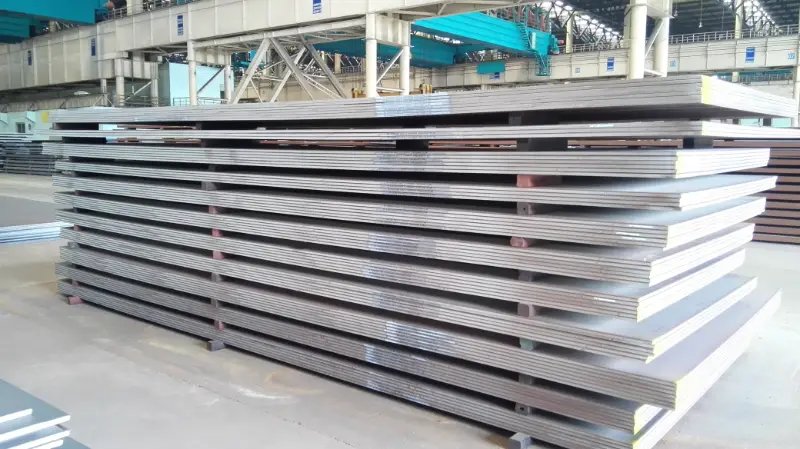
LR Grade FH50 Shipbuilding Steel Plate
LR Grade FH50 Shipbuilding Steel Plate - High Strength Quenched and Tempered Steel for Marine Structures
Comprehensive material data sheet for LR Grade FH50 shipbuilding steel plate under Lloyd's Register rules. Includes chemical composition, mechanical properties at various thickness, physical and thermal properties, international equivalent grades, and application guidance for marine and offshore engineering.
Hot rolling, controlled rolling, quenching and tempering (Q&T), normalizing possible for thin gauges
- Phone : +8618037372205
- Email : [email protected]
- WhatsApp: Contact via Whtsapp
- WeChat: +8618037372205
LR Grade FH50 Shipbuilding Steel Plate Introduction
LR Grade FH50 is a high-strength quenched and tempered shipbuilding steel plate certified by Lloyd's Register (LR). With a minimum yield strength of 460 MPa, it provides superior toughness even at low temperatures (F-grade indicates impact testing at -60°C). The steel exhibits excellent weldability and formability, making it suitable for critical structural components in ships, offshore platforms, and heavy marine equipment where weight reduction and high load-carrying capacity are required. It is produced through controlled rolling and quenching/tempering, ensuring a fine-grained microstructure and consistent mechanical properties across plate thickness up to 150 mm.
LR Grade FH50 Shipbuilding Steel Plate Chemical Composition
Chemical composition limits as per Lloyd's Register Rules for FH50 grade. Values are maximum unless otherwise stated. Fine grain practice and appropriate micro-alloying (Nb, V, Ti, etc.) are applied to achieve strength and toughness. Carbon Equivalent (CEV) is controlled to ensure weldability, commonly ≤0.50% for thickness ≤50 mm, adjusting for thicker plates.
| Element | Standard Value (max %) | Remarks |
|---|---|---|
| Carbon (C) | 0.18 | Lower carbon improves weldability |
| Silicon (Si) | 0.10 – 0.55 | Deoxidation and strength |
| Manganese (Mn) | 0.90 – 1.70 | Higher Mn for strength and toughness |
| Phosphorus (P) | 0.020 | Strictly controlled |
| Sulfur (S) | 0.010 | Low sulphur for cleanliness |
| Chromium (Cr) | 0.25 | Optional alloying |
| Nickel (Ni) | 0.80 | May be added for low-temperature toughness |
| Molybdenum (Mo) | 0.25 | Optional |
| Copper (Cu) | 0.50 | Optional |
| Niobium (Nb) | 0.05 | Micro-alloying for grain refinement |
| Vanadium (V) | 0.10 | Precipitation strengthening |
| Titanium (Ti) | 0.05 | Grain refinement and nitrogen fixation |
| Aluminium (Al) total | 0.015 min | Grain refining, acid soluble Al |
| Nitrogen (N) | 0.012 | Typically 0.009 max |
LR Grade FH50 Shipbuilding Steel Plate Physical and Thermal Properties
Physical properties are representative for quenched and tempered high-strength low-alloy steel with yield strength 460 MPa class. Actual values may vary slightly with heat treatment and thickness. Data at room temperature unless specified otherwise.
| Property | Typical Value | Unit | Test Condition / Remarks |
|---|---|---|---|
| Density (ρ) | 7.85 | g/cm³ | 20°C |
| Elastic Modulus (E) | 205 – 210 | GPa | 20°C |
| Shear Modulus (G) | 80 | GPa | Calculated from E and Poisson's ratio |
| Poisson's Ratio (ν) | 0.3 | – | Elastic region |
| Thermal Expansion Coefficient (α) | 11.5 – 12.5 | 10⁻⁶/K | 20°C to 100°C |
| Thermal Expansion Coefficient (α) | 13.0 – 13.5 | 10⁻⁶/K | 20°C to 200°C |
| Thermal Expansion Coefficient (α) | 13.8 – 14.2 | 10⁻⁶/K | 20°C to 400°C |
| Thermal Conductivity (λ) | 38 – 42 | W/(m·K) | 20°C |
| Thermal Conductivity (λ) | 36 – 40 | W/(m·K) | 200°C |
| Specific Heat Capacity | 450 – 480 | J/(kg·K) | 20°C |
| Specific Heat Capacity | 520 – 550 | J/(kg·K) | 200°C |
| Electrical Resistivity (ρ_e) | 0.25 – 0.30 | µΩ·m | 20°C |
LR Grade FH50 Shipbuilding Steel Plate Mechanical Properties
Mechanical properties according to LR Rules. Tensile testing at ambient temperature; impact testing at -60°C for FH50. Values vary with plate thickness. The yield strength is the upper yield point (ReH) or 0.2% proof stress (Rp0.2) if no yield phenomenon. Elongation measured on gauge length 5.65√S0.
| Property | Required Value | Unit | Test Condition / Thickness Range |
|---|---|---|---|
| Yield Strength (ReH/Rp0.2) | ≥ 460 | MPa | Thickness ≤ 50 mm |
| Yield Strength (ReH/Rp0.2) | ≥ 440 | MPa | Thickness > 50 mm ≤ 70 mm |
| Yield Strength (ReH/Rp0.2) | ≥ 420 | MPa | Thickness > 70 mm ≤ 100 mm |
| Yield Strength (ReH/Rp0.2) | ≥ 400 | MPa | Thickness > 100 mm ≤ 150 mm |
| Tensile Strength (Rm) | 570 – 720 | MPa | Thickness ≤ 100 mm |
| Tensile Strength (Rm) | 570 – 720 | MPa | Thickness > 100 mm ≤ 150 mm (may be 560-720) |
| Elongation (A5) | ≥ 17 | % | Longitudinal, thickness ≤ 150 mm |
| Elongation (A5) | ≥ 15 | % | Transverse, thickness ≤ 150 mm |
| Impact Energy (KV) | ≥ 46 (average of 3) | J | -60°C, transverse, thickness ≤ 50 mm |
| Impact Energy (KV) | ≥ 46 (average of 3) | J | -60°C, transverse, thickness > 50 mm ≤ 70 mm |
| Impact Energy (KV) | ≥ 46 (average of 3) | J | -60°C, transverse, thickness > 70 mm ≤ 100 mm |
| Impact Energy (KV) | ≥ 46 (average of 3) | J | -60°C, transverse, thickness > 100 mm ≤ 150 mm |
| Bend Test | No cracks | – | Bend diameter 3t, 180° (t = specimen thickness) |
LR Grade FH50 Shipbuilding Steel Plate Fully Equivalent Material Standards and Substitutable Grades
| Country/Region | Standard | Grade | Remarks |
|---|---|---|---|
| International | Lloyd's Register (LR) | FH50 | Original specification |
| USA | ABS Rules | FH50 | American Bureau of Shipping equivalent for 460 MPa yield |
| Norway/Germany | DNV Rules | NV F460 | Det Norske Veritas equivalent, impact at -60°C |
| France | BV Rules | FH50 | Bureau Veritas equivalent |
| China | CCS Rules | FH50 | China Classification Society equivalent |
| Korea | KR Rules | FH50 | Korean Register |
| Japan | NK Rules | FH50 | Nippon Kaiji Kyokai |
| Italy | RINA Rules | FH50 | Registro Italiano Navale |
| Russia | RS Rules | FH50 | Russian Maritime Register of Shipping |
| Europe | EN 10025-6 | S460Q/QL/QL1 | Quenched and tempered structural steel with similar strength and low-temperature toughness |
LR Grade FH50 Shipbuilding Steel Plate Application Introduction
LR FH50 steel plate is engineered for demanding marine and offshore environments where high strength, excellent low-temperature toughness, and good weldability are critical. It is widely used in shipbuilding and offshore construction to reduce weight and improve structural integrity. Typical processing includes cutting, cold forming, welding (with preheat and post-weld treatment as needed due to Q&T condition), and machining. Always follow approved welding consumables and procedures specified by classification societies.
Product Applications: Ships' hull plating (bottom, side, deck, and longitudinal strength members), Jack-up rig legs, spud cans, and cantilever beams, Offshore platform decks, module support structures, flare booms, Heavy-lift crane pedestals and slew rings, Subsea templates and manifolds, Highly stressed transition pieces in wind turbine monopiles, Hydraulic cylinder bodies and thick-walled structural pipes
Processed into products: Stiffeners and brackets for ship frames, Girder webs and flanges, Reinforcement pads and insert plates, Lifting lugs and trunnions, Connection nodes for tubular space frames, Pin connections and shackle bodies, Structural parts of mechanical presses and forging machines
Application industries: Shipbuilding (naval vessels, container ships, bulk carriers, tankers), Offshore oil and gas (jack-up rigs, semi-submersibles, fixed platforms), Renewable energy (offshore wind turbine foundations, substructures), Heavy lifting and transport (crane booms, heavy-duty trailers), Pressure vessel and boiler manufacturing (when approved by LR), Mining and earthmoving equipment (structural components), Bridge construction (especially movable or floating bridges)
LR Grade FH50 Shipbuilding Steel Plate Closely Related or Alternative Material Recommendations
| Country/Region | Standard | Grade | Remarks |
|---|---|---|---|
| Europe | EN 10025-6 | S460Q | Quenched and tempered, impact at -20°C, comparable strength, lower toughness |
| Europe | EN 10025-6 | S460QL | Quenched and tempered, impact at -40°C, still below -60°C of FH50 |
| Europe | EN 10025-6 | S460QL1 | Q&T, impact at -60°C, closer to FH50; check thickness range |
| USA | ASTM A514/A514M | Grade Q | Quenched and tempered, min yield 690 MPa, higher strength, not exact match |
| USA | ASTM A517/A517M | Grade Q | Pressure vessel plates, 690 MPa class, similar processing, different application |
| Worldwide | API 2Y | Grade 60 | Offshore structural steel, yield 414 MPa, lower strength but similar toughness class |
| Worldwide | API 2W | Grade 60 | Through-thickness tested, higher toughness, strength 414-550 MPa |
Notes:
- All mechanical properties must be verified on a per-heat and per-plate basis according to LR surveyor requirements. Impact testing at -60°C is mandatory for F-grade designation.
- For thicknesses above 50 mm, through-thickness properties (Z-quality) according to LR rules or EN 10164 may be specified, typically Z25 or Z35, if required by the design.
- Welding consumables should be selected to match the base material strength and low-temperature toughness; preheat and interpass temperature control are critical to avoid cold cracking.
- Heat treatment after welding (post-weld heat treatment, PWHT) may reduce strength and toughness; often avoided or carefully controlled for Q&T steels.
- Share



